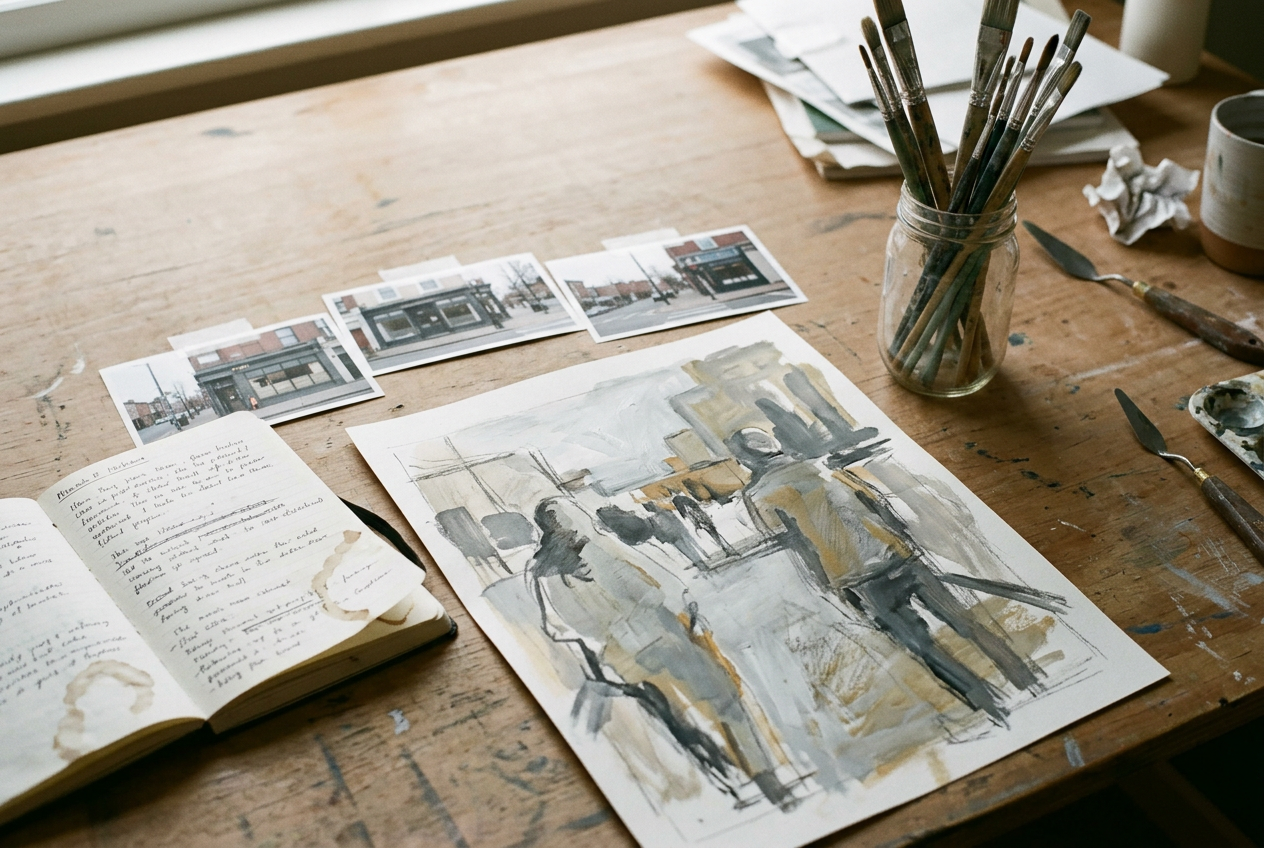
AI Mixed Sacred and Commercial Designs in Her Beadwork Handout
A beadwork instructor let AI draft a six-page beginner handout. Page four made her stop class and reconsider what a pattern needs to carry with it.
August 9, 2026 · 7 min read
The six-page handout was supposed to save an evening.
At her desk, the instructor had a bead tray pushed beside her laptop and a beginner bracelet half-finished near the trackpad. Her adult education class would meet later that week. Several students had never threaded a needle, while others had learned basic stitches from relatives or videos and wanted help reading patterns.
She needed something clearer than the collection of notes she had accumulated over twelve years of teaching: diagrams copied by hand, reminders about tension, and paragraphs that made sense only if she stood nearby pointing at the page.
She opened a generative tool that could produce text and images together. Her prompt described the students, the materials and the skills she wanted to cover. She asked for a printable beginner guide with bead-grid diagrams, plain-language captions and a few patterns that increased in difficulty. Within minutes, the system produced the bones of the six-page handout.
Some of it was useful. The explanation of thread tension was cleaner than her old version. One diagram showed how a row can pull inward when the thread is too tight, an error beginners often assume they can fix by tugging harder. She changed several sentences, corrected the bead counts and removed a pattern that would have required supplies her students did not have.
Then she printed the handout and went home.
The page that changed the class
The students were already sorting beads when she looked closely at page four.
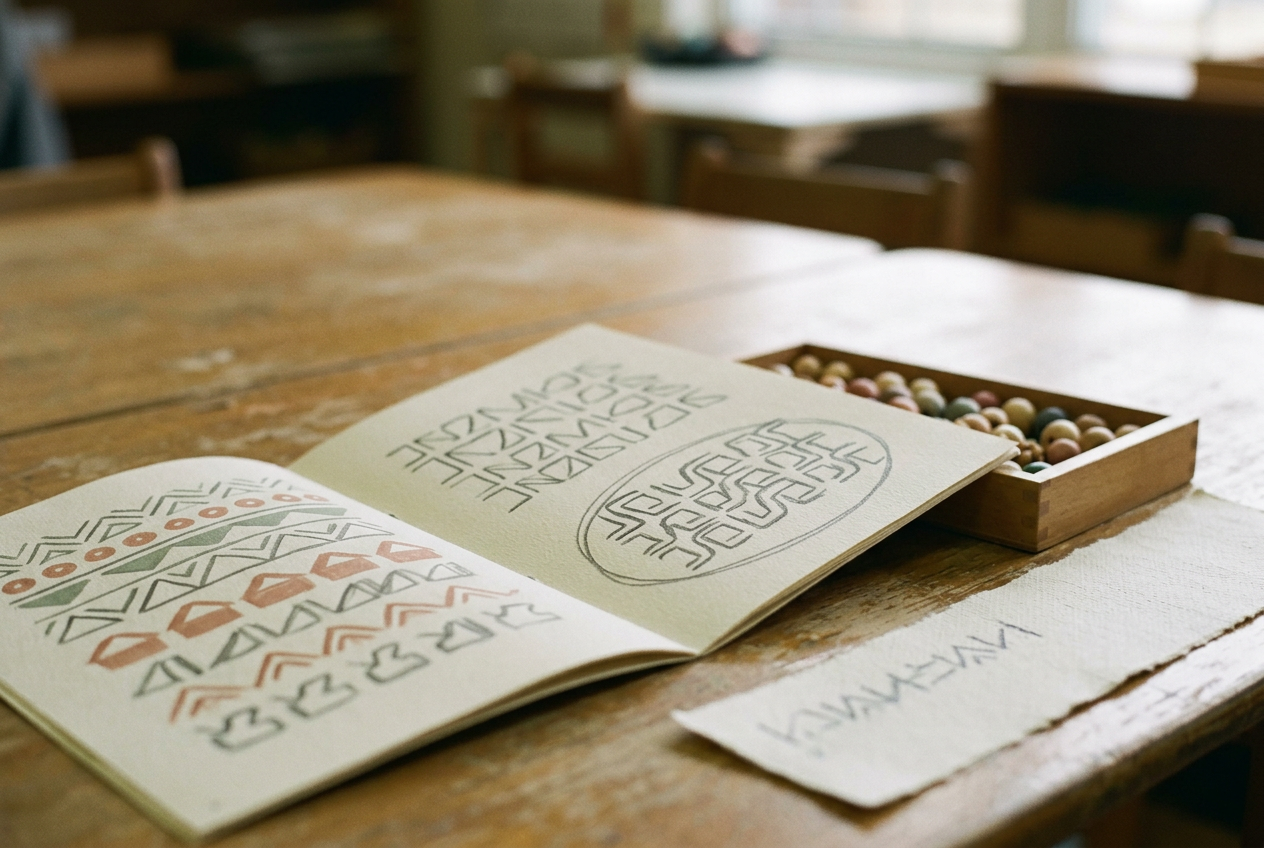
The page held two generated designs. One was a commercial border of repeated flowers, similar to patterns sold in craft kits. The other used a figural arrangement she recognized from ceremonial regalia made within a particular Indigenous community. She had encountered it years earlier during a workshop led by an artist from that community, who had explained that the arrangement was connected to ceremonial use and was not being shared as an open pattern for reproduction.
The generated caption described it as an advanced geometric border.
That sentence did much of the damage. The system had not merely displayed an image without a source. It had reassigned the image to a neutral craft category, placing it beside a store-bought floral repeat and inviting beginners to understand both as decorative options on the same skill ladder.
She circled the design in pencil. On the margin of page four, she wrote the community association she remembered, then stopped. Memory was not provenance. She did not know whether the generated image came from one photograph, several related photographs or a statistical blend that happened to preserve enough of the arrangement for her to recognize it.
The students had started the warm-up exercise. Needles tapped against bead trays. A few people were still reading the supply list, which included a mistake she had missed: the system had recommended a thread weight that did not match the needles shown in its own illustration.
That error was ordinary. Page four was different.
She paused the class and collected the handout. She explained that the generated patterns had not come with reliable sources, and that one appeared to reproduce a design she did not have permission to teach as a decorative exercise. The students kept the first pages for the stitch diagrams. Page four went back into her folder, carrying a pencil circle that grew darker each time she handled it.
What the generator flattened
A generative image system does not usually assemble a handout by searching a catalog of approved patterns and attaching each one to a verified record. It learns statistical relationships from large collections of images and text, then produces a new image by predicting visual elements that fit the request.
That ability can be startlingly practical. The tool understood that a beginner beadwork handout should contain grids, repeated shapes and progressive exercises. It arranged them neatly enough that the instructor could imagine using the result after an hour of editing rather than spending an entire evening drawing diagrams.
The same process gave her no dependable account of where the patterns came from. Training images may have appeared online with weak captions, incorrect labels or no cultural information at all. Photographs of ceremonial objects can circulate through sales listings and reposted image collections, where the picture remains visible after the maker’s name and the conditions around its use have disappeared.
The generator learned visual likelihood, not permission.
Its confident label on page four reflected another feature of these systems: when asked to caption their own output, they produce words that plausibly fit the image and the prompt. A grid with repeating forms can be labeled a border because that is a likely description, even when the arrangement carries a specific history that the model cannot establish. The polished layout made the caption look researched. It was generated alongside the picture.
Later, the instructor ran a version of her original prompt again. The system returned different patterns. That variation clarified part of what had happened. She had not uncovered a stable lesson plan stored inside the tool; she had received one probable response from a system built to generate alternatives, each of which could carry a different mix of recognizable motifs and invented transitions.
She also tried asking for sources. The tool offered broad references to museum collections and beadwork traditions, but it did not connect the design on page four to a verifiable object or maker. A source-shaped answer was not the same thing as a source trail.
The instructor had known that generated text could be wrong. She had watched systems invent book titles and smooth over uncertainty in workshop descriptions. The image felt different in her hands. Bead patterns are instructions as well as pictures; once printed on a grid, a design can move directly from paper to thread, with each square telling the student what to place next.
Rebuilding the beginner lesson
She did not throw away the tool.
For the next class, she used it to reorganize her own writing about tension and to produce two versions of a vocabulary explanation at different reading levels. She checked both against her notes. She did not ask it to generate cultural patterns.
The redesigned handout was four pages. Every practice grid was drawn by the instructor and used plain changes in color or spacing to teach one physical problem, such as keeping an edge straight. The source line beneath each example stated whether she had made it for the exercise or adapted it with permission from a teaching resource.
Page four from the first handout stayed in the folder.
She brought it back to class as an object to examine rather than an instruction sheet. The students compared the two generated designs and considered why the commercial flower border appeared interchangeable with the ceremonial arrangement once both had been reduced to unlabeled grids. Their discussion moved away from identifying forbidden shapes, which would have created another tidy but misleading chart, and toward the conditions under which a design had been shared.
That distinction mattered. No symbol is sacred in every setting, and communities do not share one rule about who may make a form or how it may be taught. The instructor could not repair the first handout by adding a general warning about Indigenous designs. She had to know where an example came from and whether its maker or community had offered it for teaching.
The change slowed her preparation. It also changed what counted as preparation.
Previously, she spent most of that work checking bead counts and making sure a beginner could follow the thread path. Now she also tracked the path of the pattern itself, which meant keeping the artist’s context attached when she adapted an example and declining to use images whose origins had been lost.
There was a creative gain she did not want to dismiss. The generated handout had shown her a better order for introducing two technical ideas, and its rough layout gave her enough distance from her old notes to see where they assumed too much. She continued using the system for structure, though each saved hour came with a smaller task waiting inside it: deciding which outputs could remain generic and which needed a human history the tool could not supply.
Months later, the pencil circle on page four was still visible through the folder. She had written two words beneath it: no source.
Questions people ask
Can generative
AI tell whether a beadwork design is sacred?
Not reliably. A generator can reproduce visual features associated with ceremonial or community-specific work, but it does not establish who made the source material, what the design means or whether it was shared for copying. In this class, it confidently relabeled a recognizable ceremonial arrangement as a generic border.
Why did the
AI handout look researched when it was not?
The system generated the diagrams, captions and page structure in one polished response. That visual consistency made the labels feel like documented findings, although they were predictions based on patterns in training data and the instructor’s prompt. When she asked for sources later, the broad references still did not trace page four to a maker.
Did the instructor stop using generative AI for teaching?
No. She kept using it to reorganize material she had written and to vary reading levels, then checked the output against her own notes. She stopped asking it to invent beadwork designs whose provenance mattered, because the time saved on drawing a grid did not supply the missing permission.
What changed in the rebuilt beadwork class?
The instructor taught technique with grids she drew herself and attached a source line to every adapted example. Students also examined the withdrawn handout as evidence of how context can disappear during generation. The original page four remained in her folder, beside a practice strip and a small bead tray.
One story a day
The story of the day, in your inbox
One real story about AI each morning — no hype, no alarm, just company for the road.