A Prison Student Logged 43 Errors From an Offline AI
The approved writing assistant could polish a paragraph, but it could not check current sources. One notebook forced a prison education program to reconsider what digital literacy meant.
August 9, 2026 · 8 min read
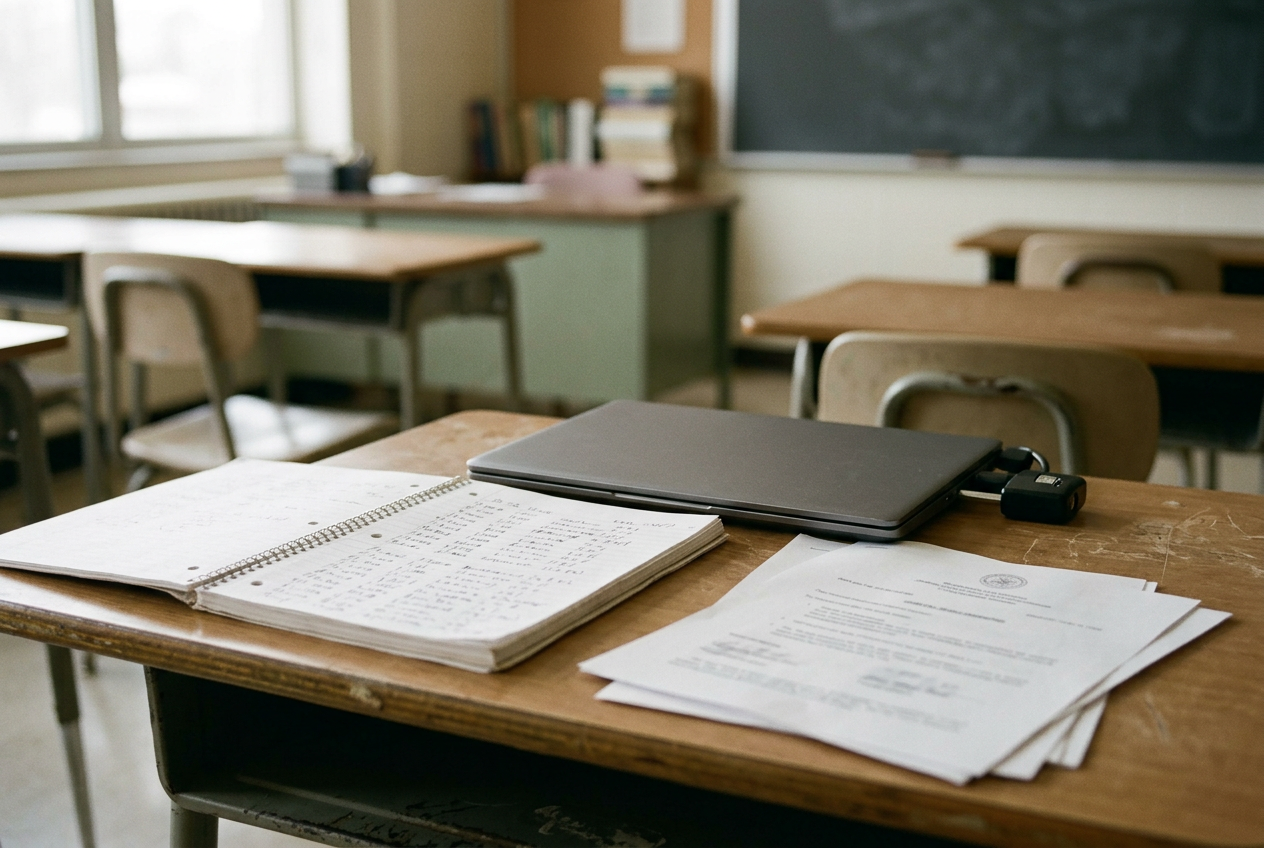
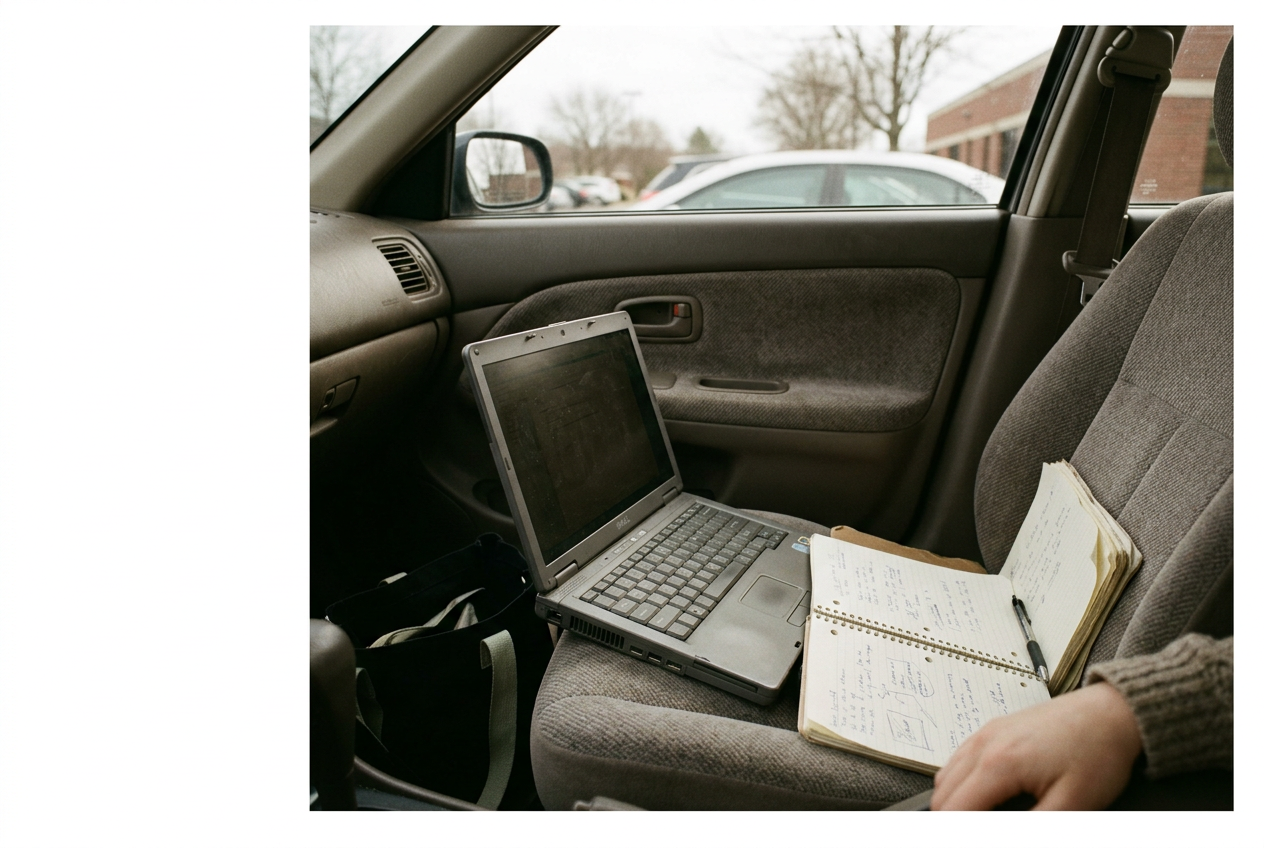
Andre kept the notebook open beside the laptop, close enough that his wrist rested on its lower edge while he typed. The classroom was inside a state prison, with cinderblock walls, bolted tables, printed readings and computers that could reach approved educational material but not the open internet.
Andre is a composite of students in prison education programs. He was working toward an associate degree after fourteen months of classes, and he had become the person classmates asked about thesis statements or citations. He liked revision. The small decisions mattered to him: whether a sentence made the claim it appeared to make, whether a paragraph had earned its final line.
The writing assistant arrived during the semester on locked-down laptops. It could suggest an outline, explain a term and revise prose. It could not search current sources. Administrators had approved that limitation as part of the tool’s safety design, which made sense within an institution where access to information, communication and personal data is reviewed before a student touches a keyboard.
On his first week using it, Andre asked for help organizing an essay about access to higher education during incarceration. The assistant produced a clean structure and supplied a claim that people in prison remained categorically barred from receiving federal education grants.
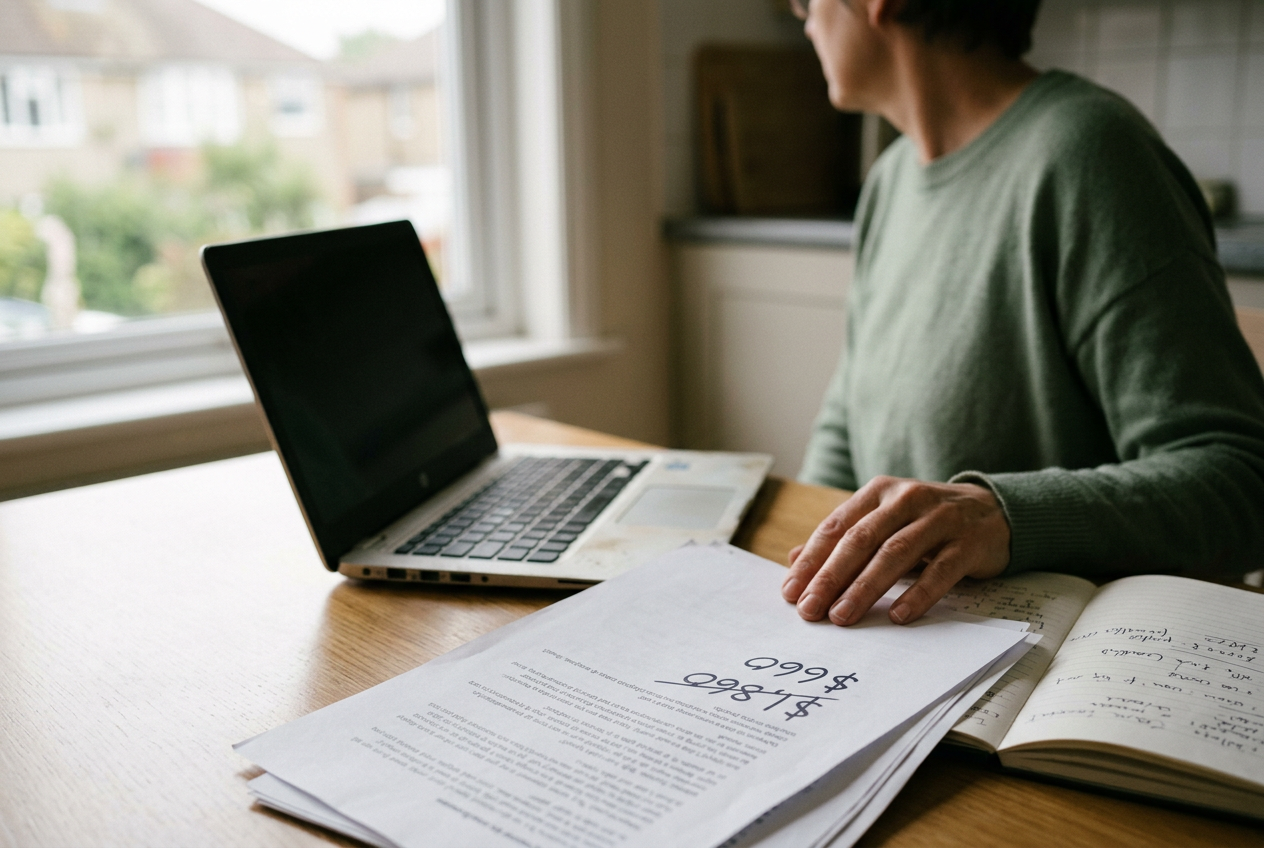
The claim was stale. Federal policy had changed in July 2023, and the printed guidance in the instructor’s folder described eligibility through approved prison education programs. Andre crossed out the sentence in his draft, then opened the notebook and copied down the claim. On the facing page, he wrote where he had checked it and marked it false.
That became entry one.
The error that changed the assignment
The notebook was not assigned. Andre started it because he wanted to know whether the federal aid mistake was unusual, and because the assistant had delivered the sentence without visible hesitation. There was no warning that its information stopped at a past date. Nothing in the paragraph distinguished a verified fact from a fluent completion.
Over four months, Andre logged 43 errors. Some were old facts stated in the present tense. Others were citations that looked usable until an instructor searched the program’s library materials and found no matching publication. One entry recorded a statistic attributed to a real public agency, though the agency’s printed report contained a different figure and covered another population.
He wrote each questionable claim on the left page. On the right, he recorded the source he had been able to consult, which might be a course reader or an instructor’s printed update; where no check was possible, he left a blank space and wrote “open” in the margin.
The blanks bothered him more than the crossed-out claims. A student outside prison could search the title, inspect the publication and look for independent coverage, although many students do none of those things. Andre could recognize that a claim needed checking and still have no permitted route to check it.
His instructor had initially framed the tool as a writing aid rather than a research system. That distinction held for sentence revision, where Andre could compare an edited paragraph with his own intentions, but it weakened once the assistant began supplying background facts in the same composed voice it used to move a topic sentence.
A smoother paragraph could contain a worse claim.
The instructor changed the assignment after reading the notebook. Students still used the assistant to test outlines and revise drafts, but factual claims generated by the tool had to be matched against the materials available in class. If the packet could not support a claim, students could label it unverified rather than dressing it up with a citation they could not inspect.
That adjustment sounds modest. In the room, it changed what counted as a strong paper, because a student who acknowledged a gap could receive more credit than one who submitted polished prose with unsupported certainty, even when the polished version looked closer to conventional academic writing.
Literacy inside a closed network
Many familiar descriptions of digital literacy assume movement. A reader opens another tab, checks the author and follows a link to an earlier source. Andre’s classroom had no other tab. Some approved databases contained older journal articles, while current government guidance usually arrived through instructors as printed pages after staff had reviewed it.
The program began building verification into each unit. Instructors selected a smaller body of sources that students could inspect in full, then asked them to compare the assistant’s output against those texts. The work became less about spotting prose that sounded artificial and more about locating the boundary between what the available evidence established and what the machine had added.
Andre was good at that boundary work. He circled dates. He noticed when a paragraph shifted from discussing students in approved programs to making a claim about everyone held in a prison or jail, a broader group that the source did not cover. His notebook filled with arrows between the assistant’s wording and the narrower language in the readings.
Still, the arrangement had a hard limit. An instructor could bring in a current source only after knowing that students needed it, and the assistant’s errors were not predictable enough to assemble every relevant page in advance. The closed network reduced exposure to unsafe websites and outside communication, yet it also removed a basic response to misinformation: looking elsewhere.
The tool itself became part of the curriculum almost by accident. Students examined why a citation could have the shape of scholarship without corresponding to a document, and why a statement based on an old policy might remain grammatically correct after it had become factually wrong. They learned that confidence was a feature of the sentence, not evidence for the claim.
Andre’s notebook gave those discussions a physical record. By the end of the term, some pages held quick corrections in pencil, while others still had “open” in the margin because neither the classroom packet nor the approved databases could settle them. The uncertainty did not disappear when the assignment ended.
Privacy without a private screen
The program also had to decide what students should tell the assistant. Writing classes often draw on personal history, and Andre’s proposed essays included details about his conviction, his family and the education records he was trying to rebuild. The tool ran within an approved environment, but students did not control its technical settings or know how long prompts might be retained for review.
Instructors asked students to keep identifying case details and family names out of prompts. That reduced one privacy risk, though it made some writing tasks stranger. Andre would draft a personal passage in his notebook, remove the facts that gave it context, then ask the assistant about sentence structure. The returned paragraph could be tidy and emotionally wrong because the system had been denied the information that made the passage specific.
He stopped using it for autobiographical work.
That choice complicated the program’s early assumption that an offline tool was the safer version of an online one. Disconnection prevented web browsing and outside messaging. It did not answer who could review a prompt, what might be stored on institutional systems or whether a student could meaningfully decline a tool presented during class.
Safety had another edge. A fabricated claim in a practice essay could be corrected before grading. The same confident error would carry different weight if a student used it while writing about a disciplinary record, an appeal or access to a benefit. Instructors kept the assistant within coursework, but Andre’s notebook showed how easily the voice of a writing helper could be mistaken for the authority of a current reference.
Near the end of the semester, the instructor set the notebook beside a stack of final papers and read several entries aloud without Andre’s personal details. One concerned the outdated aid policy. Another ended with no correction, only the name of a source the class could not access and the word “open.”
Andre took the notebook back after class. He did not close that entry.
Questions people ask
Can an offline
AI writing assistant provide current information?
It can provide information contained in its training data or approved local materials, but it cannot independently check later changes. In Andre’s class, the assistant described an outdated federal education policy as current, and its tone gave no useful signal that the answer needed verification.
How can students verify AI claims without open internet access?
Andre’s program relied on course readers, approved databases and printed updates supplied by instructors. Those sources resolved some errors, while other claims remained open because the necessary material was unavailable. The class began treating a documented inability to verify something as meaningful academic work rather than a failure to finish.
Are prompts to an offline school AI private?
Offline access does not by itself establish privacy. Students in this composite program lacked clear control over retention and review, so instructors limited the personal information used in prompts. Andre kept autobiographical details on paper and used the assistant only for decontextualized sentence work before abandoning it for personal essays.
Did the writing assistant still help Andre?
It helped him reorganize paragraphs and compare revisions, especially when the task stayed within text he had already written. Its factual output demanded more labor than expected, and some claims could not be checked from inside the prison. The forty-third entry in his notebook remained marked “open.”
One story a day
The story of the day, in your inbox
One real story about AI each morning — no hype, no alarm, just company for the road.