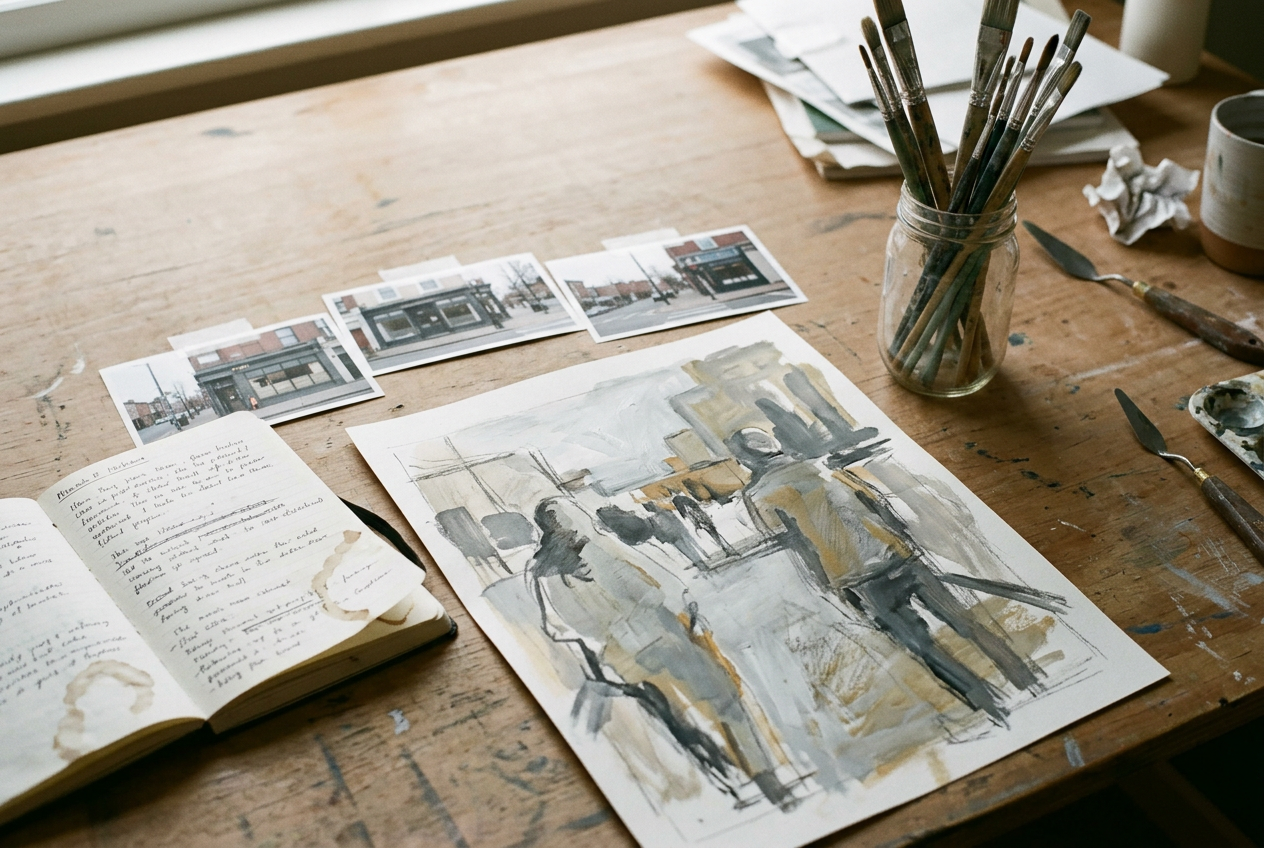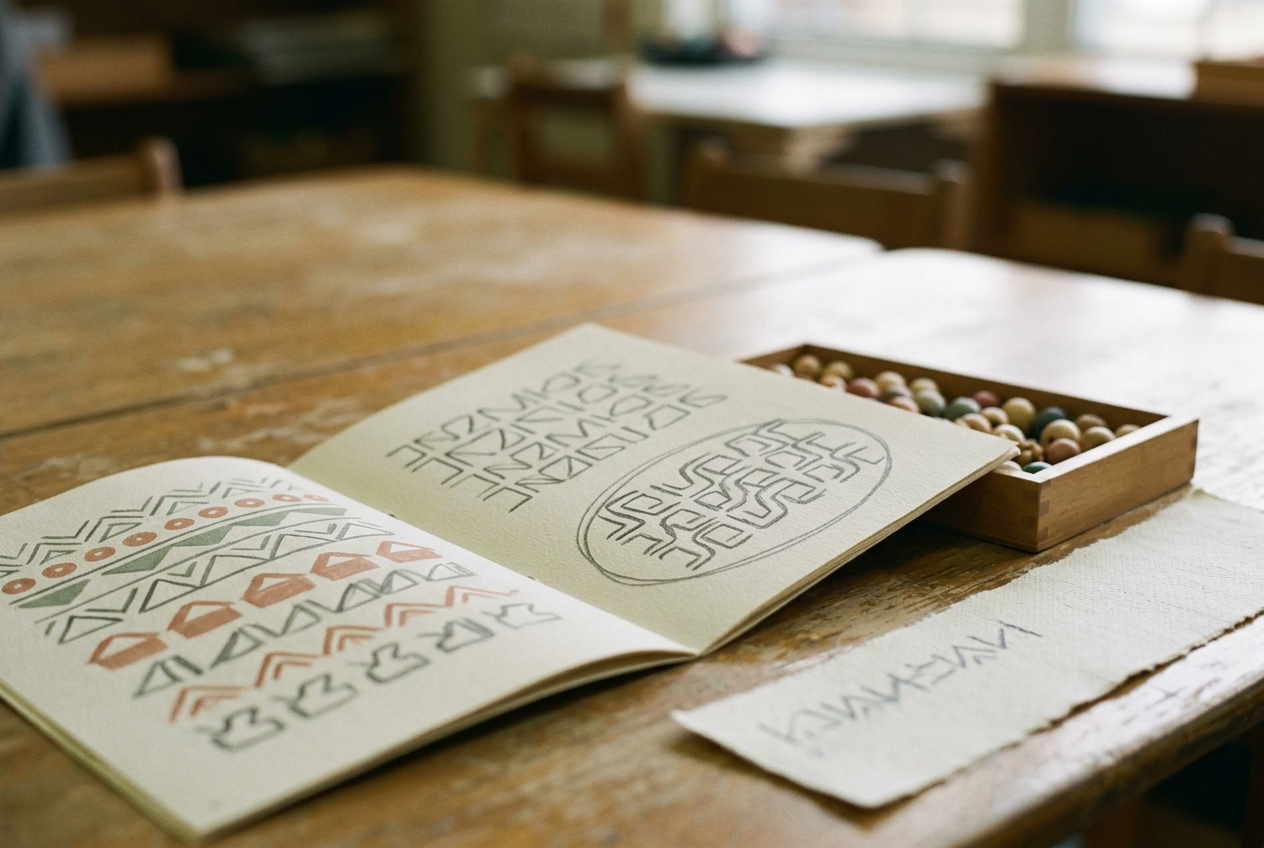
AI Gave a Beadwork Student Sacred Patterns. She Stopped.
A non-Indigenous hobbyist wanted color ideas for a beadwork project. The generated pattern sheet crossed cultural boundaries she had not known to look for.
August 9, 2026 · 8 min read
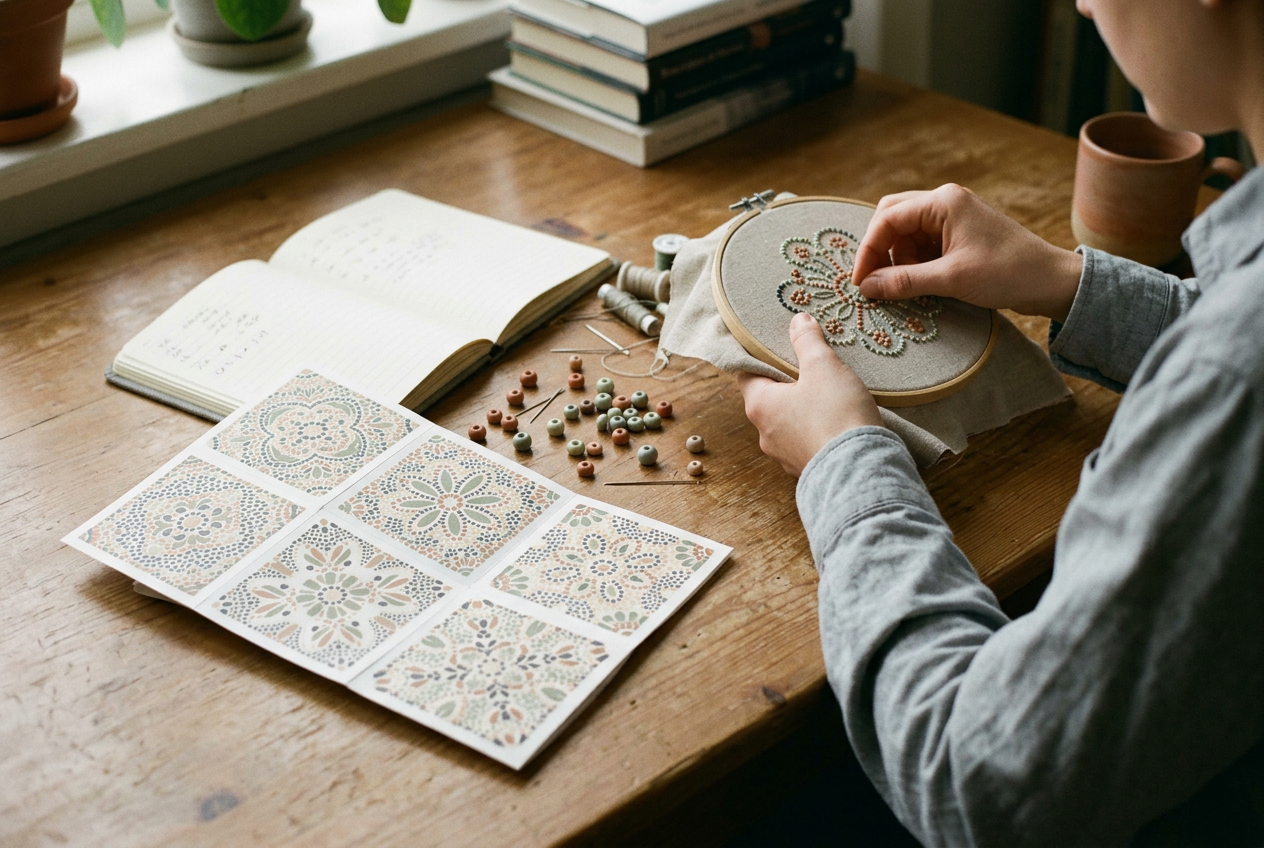
The printed sheet held six beadwork patterns. She had made it at home after class, when her needle was back in its case and the small piles of beads on her desk had begun to look less like a palette and more like a decision she was avoiding.
Her assignment was a floral medallion for a cloth bag. The instructor had demonstrated a public, beginner-friendly pattern and encouraged students to plan their own colors before sewing. The student, a non-Indigenous hobbyist who had attended the weekly class for seven months, could place beads with growing confidence. Choosing colors still stopped her.
She uploaded a rough sketch to a generative image tool and asked for several color arrangements. The results went well beyond that request. Each square on the printed sheet offered a finished pattern, complete with borders, central figures and geometric forms she had not drawn.
Design four caught her first. Its colors worked together, at least on paper. A divided circle sat behind a bird figure, while the border repeated a shape she recognized from beadwork photographs online. She circled the design in pencil, wrote down four bead colors in her notebook and set the sheet beside her tray.
Two classes later, she showed it to the instructor.
The instructor did not treat the page as a neutral set of color samples. She pointed out that the tool had combined visual elements associated with different Indigenous communities, then arranged them as though they belonged to one interchangeable tradition. One figure had ceremonial associations. The border resembled a form that, in its own context, could communicate family or community ties rather than serve as decoration.
The student folded the sheet in half.
What the pattern sheet left out
Beadwork is sometimes discussed online as a single Indigenous art form, a broad label that flattens distinct materials, histories and rules into a searchable style. In practice, beadwork traditions differ among nations and communities, and meaning can also sit with a family, a maker or the person entitled to wear an object.
Some forms are taught publicly and shared widely. Others may be connected to ceremony or status, even if photographs of them appear in museum collections, sale listings or social posts. Sacred does not always mean hidden. An image can be displayed so that people may learn from it, document it or recognize its significance without receiving permission to reproduce it.
That distinction was the part the student had missed. She knew that copying another artist’s finished pattern could be disrespectful, so she had avoided downloading a pattern from a maker’s page. The generated sheet seemed different because no artist’s hand or name appeared on it. Its clean little squares looked newly made.
Yet the tool had learned visual relationships from existing material. The printout offered no source trail, no community name and no way to tell whether a shape came from an openly taught design, a ceremonial object in an archive or a commercial imitation already detached from its origin. The absence of attribution made the patterns harder to assess. It did not make them culturally blank.
The instructor also resisted translating every element into a fixed definition. Meanings change with context, and a symbol lifted from a photograph may be misidentified before it ever reaches a generated image. A confident explanation from the tool would have added another layer of guesswork.
For the student, that was uncomfortable in a useful way. She had expected a technical answer about color balance. Instead, the six-pattern sheet exposed a larger problem: the tool could recombine visual material faster than she could understand where any part belonged, and its polished output made that gap easy to overlook.
Availability is not permission
The student had seen versions of the bird figure and divided circle before. They appeared in search results, on craft boards and among photographs posted without much context. Repetition had made them feel general. Once an image shows up often enough, the internet has a way of presenting familiarity as ownership.
Cultural permission works through relationships that a search result cannot show. A design may have been given to a person, inherited within a family or made for a particular use. Another may be available for anyone in a community to make while remaining inappropriate for outsiders to reproduce. There is no universal chart that settles those distinctions across Indigenous peoples.
Legal availability is also a different question from cultural permission. A historic image may be easy to download, or old enough that a platform allows it to circulate without restriction, while the community connected to it still understands its use through living protocols. The class discussion stayed with the cultural issue. It was not a copyright ruling, and the student did not need one to decide that the project should wait.
She returned to the printed sheet that evening. Design four still looked appealing. That bothered her more than if it had looked obviously clumsy, because the attraction came partly from forms carrying meaning she had not earned and could not name.
The pencil circle remained around it. She did not erase the mark or throw away the page.
What changed in her creative process
Pausing the project did not end her interest in beadwork. It narrowed the task back to what she had first intended: learning technique through material the instructor had chosen to teach publicly.
She returned to the class sample and worked with its floral structure, testing colors by placing loose beads against the cloth rather than asking the tool for complete compositions. The choice took longer. Several arrangements looked dull. One combination was abandoned after she stitched part of a petal and saw that the contrast disappeared from a few inches away.
There was less instant abundance at the desk, though abundance had been part of the trouble. Six finished options had arrived without the slow friction that might have prompted her to wonder why a bird was there, where the border came from or whether changing the colors altered anything important.
She also began keeping source notes in the notebook where she recorded thread length and bead quantities. The notes were modest: which class exercise introduced a form, whether the instructor had described it as open for student use, and which parts were her own variations. They did not certify permission. They helped her remember that a pattern had a path before it reached her hands.
The generated page stayed in the notebook as well. Weeks later, she unfolded it during class and noticed that two designs used nearly the same central figure with unrelated borders. What had first looked like range now looked like shuffling. The tool could produce difference on the surface while treating cultural sources as parts in one bin.
Her floral medallion was finished after five weeks. It was smaller than the generated versions and less symmetrical in places. The instructor helped her correct the tension near the edge. Nothing on it carried the visual drama of design four.
That absence was part of what she had made.
Questions people ask
Can
I use an AI-generated Indigenous beadwork pattern if I cannot find the original source?
The student’s experience showed that missing provenance creates uncertainty rather than freedom. A generated image may combine material from public lessons, ceremonial objects or unattributed copies, while giving no useful account of those sources. She chose not to stitch the pattern because she could not place its elements in context.
Why can a publicly visible design still require cultural permission?
Public visibility can come from documentation, education or an image reposted without context. None of those circumstances necessarily carries permission to reproduce the design. In the class, the instructor explained that some forms remain connected to community relationships and particular uses even when photographs circulate widely.
What did the student use instead of the generated designs?
She returned to the beginner floral form her instructor had chosen for public teaching, then tested color combinations with loose beads on the cloth. She also recorded where the form came from in her notebook, which changed the project from selecting a finished image to working within a known teaching relationship.
Does changing the colors make a sacred or restricted pattern appropriate to use?
Color changes did not resolve the student’s concern because the composition and its cultural associations remained. She abandoned the generated layout rather than trying to alter it until its source became less recognizable. The six-pattern sheet remained folded inside her notebook, with design four circled and left unstitched.
One story a day
The story of the day, in your inbox
One real story about AI each morning — no hype, no alarm, just company for the road.