A Museum Preparator Made AI’s Invented Loom Handle Look Uncertain
The reference image looked complete. The archive was not, and a museum workshop had to fabricate a missing handle without letting the AI’s plausible details harden into fact.
October 23, 2026 · 7 min read
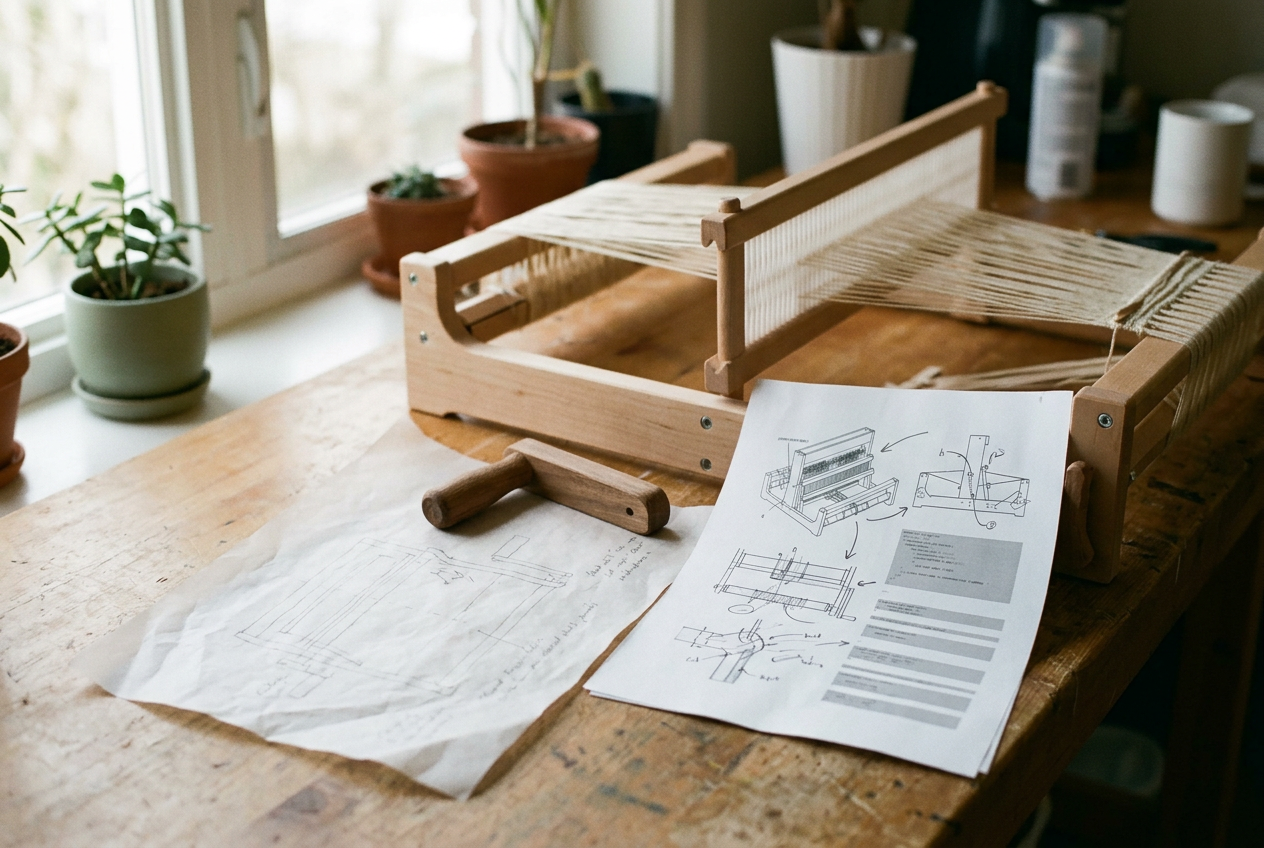
The reference arrived as a letter-size printout laid beside the loom. It showed a wooden crank handle with a tapered grip and a small brass collar, rendered from an angle no surviving photograph had captured. The museum preparator, whom I’ll call Renee, turned the page sideways and held it near the broken iron shaft where the original handle had once been.
The proportions looked reasonable. More than reasonable, really. A faint turning line ran around the grip. The collar met the wood cleanly.
Even the shadow beneath it agreed with the light in the generated scene.
That neatness was the problem.
The tabletop loom belonged to a planned exhibition about making and learning in American classrooms. A regional school had bought it for handwork lessons in the 1920s, when students were expected to learn through wood, yarn, paper, and tools. The museum still had the loom, a catalog card from the 1970s, and one archival photograph showing children gathered around it. The crank appeared at the far edge of that photograph, partly blocked by a sleeve.
Its handle had disappeared before the museum acquired the object. Without one, visitors would struggle to understand how a student advanced the woven cloth. The exhibition team wanted a replacement that could demonstrate the motion without passing as original material, a common enough workshop assignment until the generated image supplied details nobody remembered requesting.
The printout stayed on Renee’s bench for eleven weeks.
The view the archive never had
The reconstruction had been made with a generative image system. Staff supplied the archival photograph, a recent picture of the loom, and a short description drawn from the catalog card. The prompt asked for a clear reference view of the missing crank assembly, appropriate to the loom’s period and construction.
What came back looked less like a proposal than documentation.
That distinction mattered because the system was not recovering a concealed handle from the dark edge of the photograph. A generative image model predicts visual information that fits the supplied pixels and written instructions, drawing on patterns learned from large collections of images. Where the input offers little evidence, the model does not leave a measured blank. It can produce the kinds of grips, collars, fasteners, and joinery that often appear in similar pictures.
Plausibility is one of its strengths. Provenance is not.
The brass collar demonstrated the gap. In the archival photograph, the relevant area was blocked. The catalog card mentioned a hand crank but no metal collar. The surviving shaft carried no clear mark showing that brass had rested against it.
Yet the generated reference gave the collar a precise width and a convincing reflection, details that felt observed because they were specific.
Renee asked for the other outputs from the same session. Four had been saved. One gave the handle a straight cylindrical grip. Another added a washer where the brass collar had been.
The handle changed length, too, even though each image retained the same general period look and the same air of confidence.
This was the specific technical failure hiding inside the useful result: each generated image was a new completion, not another camera angle on a stable digital object. Unless a system is built to preserve geometry across views, asking for a side view after a front view can produce a second plausible handle rather than the same handle turned around. True three-dimensional reconstruction usually depends on overlapping evidence or measured geometry. Here there was one partial photograph and a great deal of learned visual probability.
Renee wrote two words in the printout’s margin: “source?” and “guess.” The question mark sat beside the collar. “Guess” pointed to the tapered grip.
A convincing object can overstate the record
Museum preparators are often asked to make things that must succeed physically while remaining honest about what they are. They build mounts, supports, replicas, and replacement parts. The work can disappear when it is done well; a bracket holds without drawing attention, and a recreated component helps the visitor read an incomplete object.
The generated reference altered that work from the inside. Renee was no longer interpreting a thin archive with the limits in view. She was auditing a finished-looking answer, separating features supported by evidence from details supplied by a system that had no obligation to distinguish the two.
She could have copied the printout. The result would have turned smoothly, matched the loom, and photographed well. A visitor might never have noticed the brass was new. A future staff member, finding images of the completed display years later, might assume the replacement preserved the form of the missing original.
That was the danger in the workshop, small enough to fit in one hand. The AI had converted uncertainty into surface detail. Fabrication could convert that detail into wood and metal, after which the museum’s own authority would make the guess harder to see.
Renee brought the printout to a work session with the curator and an intern studying exhibit fabrication at a community college. They placed tracing paper over the image and marked the parts differently. The shaft diameter came from measurement. The crank’s reach could be estimated from the loom’s clearance and the partial photograph.
A rotating grip was functionally necessary. The taper, turning line, collar, and hidden fastener remained unsupported.
The intern had initially treated the generated image as the assignment’s best source because it showed the most. Once the four outputs were placed side by side, the lesson changed. More visible detail did not mean more evidence. Sometimes it meant the model had encountered more room to improvise.
Renee kept the original printout rather than replacing it with a cleaner drawing. Its margin filled with arrows and brief notes until the polished handle at the center looked less settled. The page became a record of where confidence had entered the room.
Building the gap into the handle
The final replacement used a plain wooden grip sized from the loom’s working clearance. Renee left it cylindrical because the taper in the generated image had no support, and she omitted the brass collar. A removable pin joined the grip to a new crank arm, allowing the museum to service the mechanism without disturbing the original shaft.
She also cut a shallow groove around the replacement near its base. The groove had no decorative purpose. It marked the boundary between the historic loom and the interpretive addition, a visible interruption that could be understood at arm’s length without making the object unusable.
The exhibition label described the handle as a modern reconstruction based on the surviving mechanism and an incomplete archival photograph. It did not reproduce the AI image. The longer workshop record retained the generated versions and Renee’s annotated printout, preserving the fact that the system had helped staff imagine workable forms while also proposing details the archive could not confirm.
This was not a rejection of the tool. The generated image helped the team see practical questions that the partial photograph did not answer, including how much clearance a hand needed and where a grip might bind against the frame. It gave the workshop something concrete to challenge. Without the system, there would have been no brass collar to interrogate, no false second angle, and no finished-looking proposal pressing the museum toward a particular shape.
The useful part and the misleading part arrived together.
Late in the fabrication period, wood dust gathered along the edge of the printout. Renee brushed the page off, then circled the generated fastener, which had changed between versions. The real replacement used a pin whose presence could be seen. Nothing was plugged or stained to resemble age.
The intern tested the loom with a narrow strip of yarn. The grip turned. The cloth advanced. At the base, the shallow groove passed beneath her fingers on every rotation.
Questions people ask
Can
AI reconstruct a missing museum object from one photograph?
It can generate a plausible view conditioned on the photograph and a written description, but that is different from recovering the missing object. In this case, blocked and unseen areas were completed from learned visual patterns, and repeated generations produced different handles while making each one look fully observed.
Why did the generated brass collar look historically accurate?
The image model had learned associations among old looms, hand cranks, wooden grips, and metal fittings from many images. Those patterns helped it create a period-appropriate collar with coherent lighting, but neither the archival photograph nor the catalog card confirmed that the original loom had one.
How did the preparator show that the handle was a reconstruction?
She omitted unsupported decorative details, used a visible modern pin, and cut a shallow groove near the replacement’s base. The exhibition label also identified the handle as a modern reconstruction based on incomplete evidence rather than presenting the AI-generated form as a recovered design.
Was the AI reference still useful to the museum?
Yes. It exposed practical issues around clearance and grip placement, and comparing several outputs showed where the system was improvising. The annotated printout remained in the workshop record, with “source?” beside the collar and wood dust caught in the shallow fold.
One story a day
The story of the day, in your inbox
One real story about AI each morning — no hype, no alarm, just company for the road.