
An Indie Film Used 600 AI Extras, Then the Deal Stalled
Synthetic crowds saved an indie production about $17,500. Near delivery, its distributor wanted consent and training-data records the filmmakers did not have.
October 25, 2026 · 7 min read
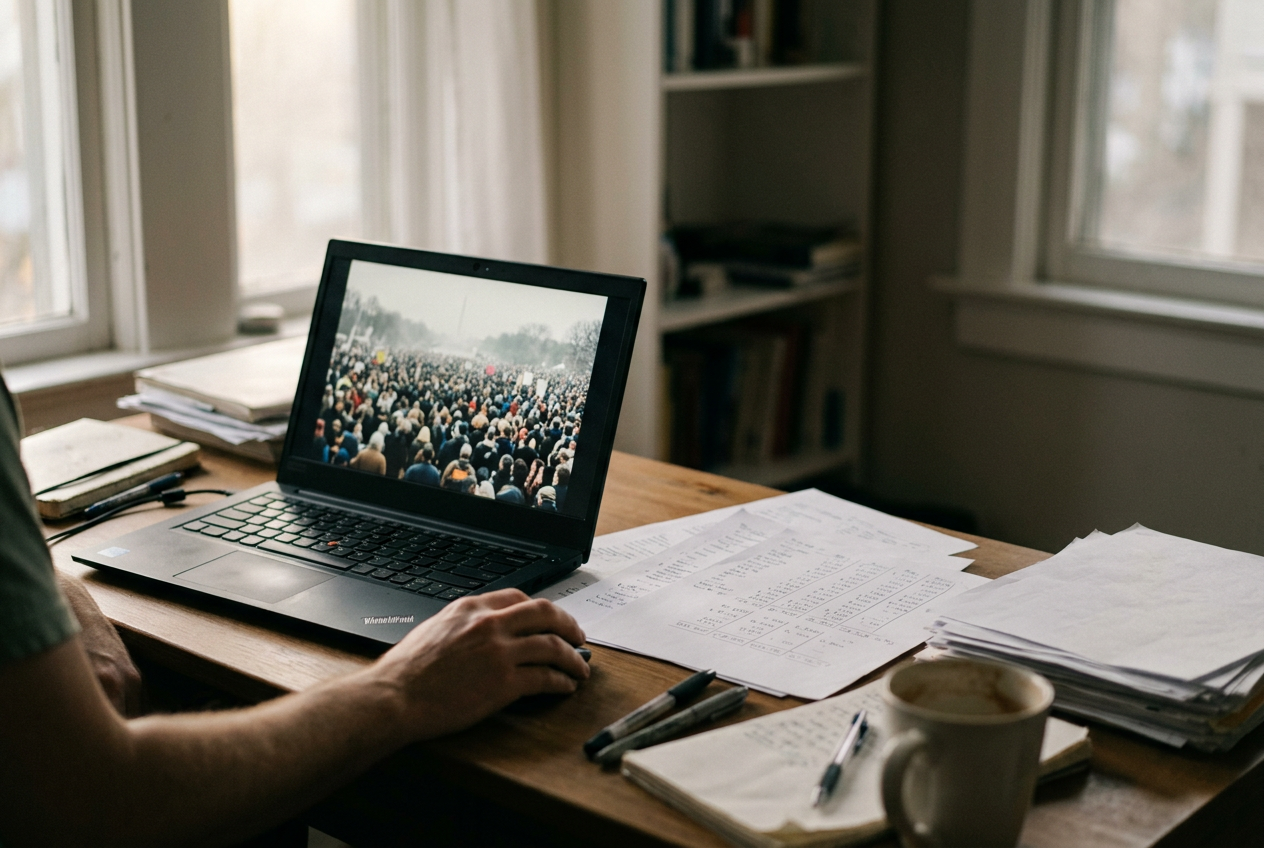
The film was nearly locked when the director opened the budget spreadsheet again.
For months, one line had felt like a small production victory: “synthetic crowd replacement,” $1,184. The figure covered a tool subscription, extra rendering credits, and a freelance compositor’s additional work. The original estimate for hiring, feeding, transporting, and insuring enough background performers across two shooting days had been $18,700.
Now the spreadsheet sat beside a delivery checklist from the distributor, and that cheap line had acquired two new columns. One was labeled source. The other was labeled consent. Both cells were blank.
The distributor had asked for documentation covering the digitally created people visible in the film, including where their faces came from and what material had trained the system that made them. The director understood performer releases. She understood location agreements and music licenses. She could not parse what release might exist for a face generated from statistical patterns, or how an indie production was supposed to identify millions of training images held by a software provider.
The crowd had solved a real filmmaking problem. It had also created a question that could not exist without the machine: when a model makes a person who was never cast, whose permission belongs in the production file?
The crowd that was never on set
The scene took place at a public rally. The speaking roles were filmed against a partial practical crowd, with eighteen people changing jackets and positions between setups. Crew members shifted signs out of frame. A production assistant watched the background for repeated clothing while the camera stayed close enough to keep the gathering plausible.
The wider shots were the problem. The script needed a public event large enough to alter the mood of the story, yet the production could not afford the roughly seventy background performers in its first budget. Rewriting the scene would have reduced its scale. Repeating the same eighteen people across the frame looked like what it was.
After principal photography, the visual-effects artist fed clean background plates and rough masks into a generative video system. Text prompts described ordinary actions: people listening, turning toward a speaker, lifting signs, moving through gaps. Reference frames established the camera angle and daylight. The system produced short crowd clips, which the artist layered behind the real performers and adjusted to match the camera movement.
This was more than copying and pasting figures. A video diffusion model begins with visual noise represented inside a compressed mathematical space, then repeatedly predicts what should be removed from that noise to produce frames matching the prompt and reference image. During training, it learned associations among words, shapes, faces, clothing, depth, and motion from a large collection of image or video examples. During generation, it used those learned associations to construct new pixels.
It did not consult a casting file. It did not attach a source photograph to each face.
The first results were poor in useful ways. A man near the edge acquired a second forehead when he turned. Two women appeared to share part of an arm. Signs changed lettering between frames because the model treated each moment as a fresh prediction while trying to preserve enough continuity for motion.
A crowd member disappeared behind another person and returned in different clothes.
Those failures come from a limitation that still matters in generated video: the model can produce the appearance of temporal continuity without maintaining a durable, fully modeled identity for every person in the shot. It is predicting plausible frames, not managing six hundred digital performers who each retain a body, wardrobe, and personal history.
The artist shortened the generated clips, kept faces small, and placed the least stable movement behind real shoulders and signs. The finished shots held for only as long as they needed to. In the edit suite, the crowd finally behaved.
The director updated the spreadsheet. Against the $18,700 estimate, the $1,184 line looked decisive. The savings paid for sound mixing and another week with the editor, both of which improved the film more than a wide shot full of hired bodies would have done.
What the distributor was asking for
Eight months later, the film had interest from a small distributor. Delivery review reached the rally sequence, and the production disclosed that generative video had been used for background performers. The response was not an immediate rejection. It was a request for records.
The distributor wanted to understand two different kinds of provenance, which the director had treated as one.
The first concerned the production inputs. Had the team uploaded photographs of real people, footage from another project, or reference material carrying restrictions? The answer was partly reassuring. The plates belonged to this production, and the eighteen performers had signed agreements covering their filmed appearances.
Yet the visual-effects artist had also assembled temporary reference images while testing body positions and crowd density, and nobody had kept a clean log of which tests influenced the delivered shots.
The second concerned the model itself. What had been used to train it, and did the provider have permission to use that material? Here the production had little more than the platform’s public terms and a receipt.
Generative systems may be trained on licensed collections, publicly available images, material supplied by contractors, synthetic data, or mixtures of those sources. A customer-facing interface rarely reveals which training examples contributed to a particular cheekbone or expression, partly because generation does not usually work by retrieving one neat source image. The model’s behavior is distributed across learned numerical weights.
That technical fact does not make provenance disappear. It makes person-level tracing difficult, while leaving the commercial question intact. A distributor assessing a film may care about documented rights even when nobody can point to a single copied frame, especially if a generated face resembles a recognizable performer or the provider’s training claims are broader than its available records.
The director returned to the tool’s account page. It listed a model version and described the service as suitable for commercial work, but it did not provide a dataset inventory or releases from people depicted in training material. The support inbox supplied general assurances rather than a chain of records the distributor could place in the film’s file.
The spreadsheet changed again. Beside $1,184, the director added the model version and the month the shots were generated. The source column now noted production plates and generated output. Consent remained blank, because “no identifiable source person” was an explanation, not a signed document.
The price of replacing the shot
The distributor paused delivery review while the filmmakers considered what could be supported. Rebuilding the sequence with conventionally licensed crowd elements would cost thousands of dollars. Removing the wide shots would cost less, though it weakened the scene and required changes to sound, pacing, and color work that had already been approved.
There was another possibility: keep some generated material where faces were indistinct, replace the closer synthetic figures, and provide the records the team did possess. That approach did not turn an undocumented training set into a documented one. It narrowed what a viewer could identify and reduced the part of the frame resting on uncertain material.
The director was irritated by the timing. She was also reluctant to call the experiment a mistake. The generated crowd had allowed the film to retain a scene it could not otherwise afford, and the money saved had gone into work audiences would hear in every minute. On a late desk crowded with export drives and paper notes, that original budget figure still made sense.
What had changed was the meaning of completion. The team had treated provenance as something attached to an input file, while the tool produced output through a training process they could neither inspect nor document. They had saved prompts, exports, and invoices. They had not saved evidence about the system’s education because the system had never offered it.
The revised cut used fewer generated faces. The distributor resumed its review but left final acceptance unresolved while other delivery materials moved forward. In the spreadsheet, the director changed the $1,184 entry from final to pending and widened the consent column so the explanation would fit.
Questions people ask
Can a synthetic background performer sign a release?
No person exists to sign for a wholly generated face. Productions may still be asked for records showing what footage and reference images went into the shot, what rights covered those inputs, and what the tool provider disclosed about commercial use. In this case, the absence of a real performer removed one familiar document without removing the distributor’s concern.
Does a generated face come from one person in the training data?
Usually there is no single source image that maps cleanly to one output face. Diffusion models learn visual patterns across large datasets and encode them in numerical weights, although they can sometimes reproduce recognizable features or unusually similar images. That is why the filmmakers could explain how generation worked but could not name the people whose images shaped the model.
Why was the tool’s commercial-use statement not enough?
The statement described what the customer was permitted to do under the platform’s terms. The distributor wanted evidence supporting how the output had been made, including the production’s inputs and the provider’s account of training material. Those were different records, and the spreadsheet still had an empty consent cell.
One story a day
The story of the day, in your inbox
One real story about AI each morning — no hype, no alarm, just company for the road.