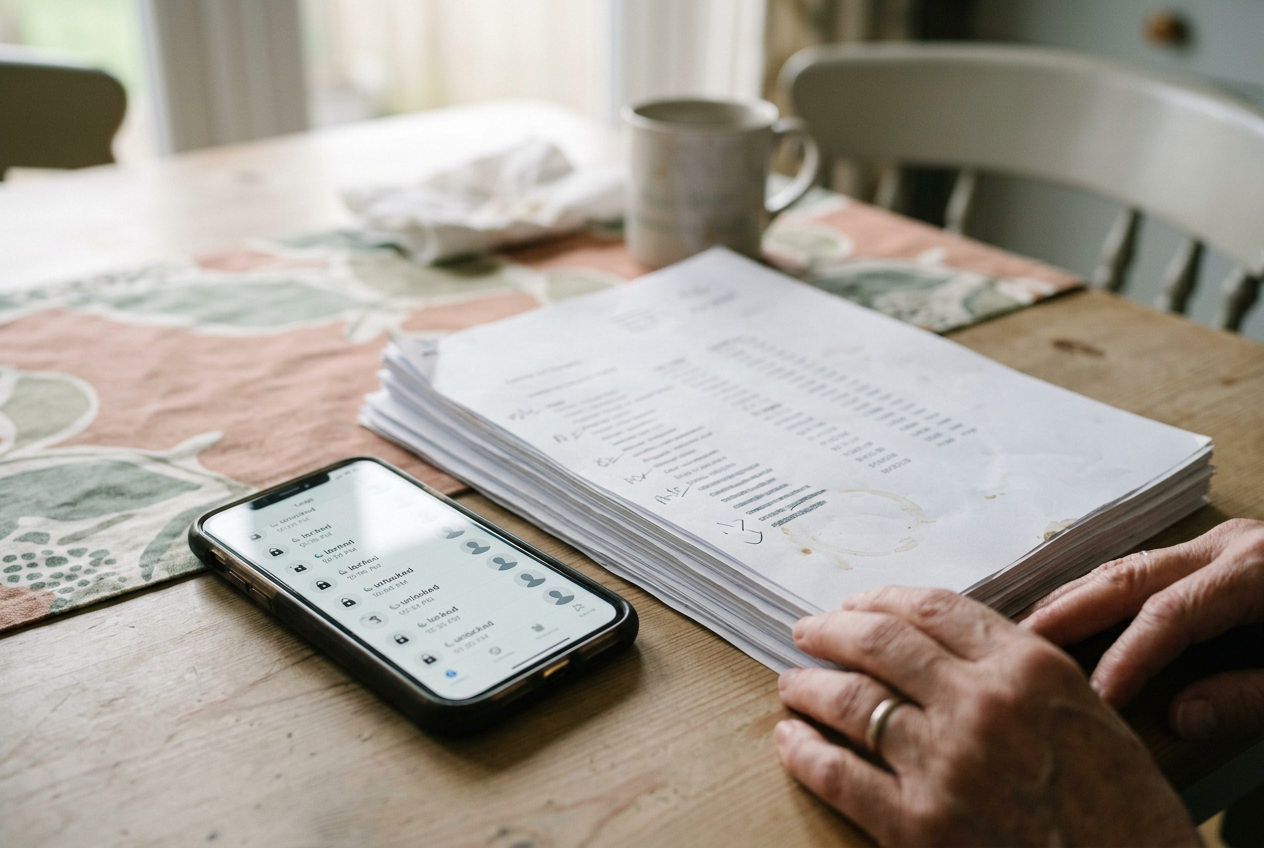
AI Changed “Heard” to “Hurt” in Her Client’s Jail Call
A public defender traced a damaging phrase to one uncertain word in an automated jail-call transcript. The recording did not settle what her client said, but the transcript had already changed how his family saw him.
August 9, 2026 · 8 min read
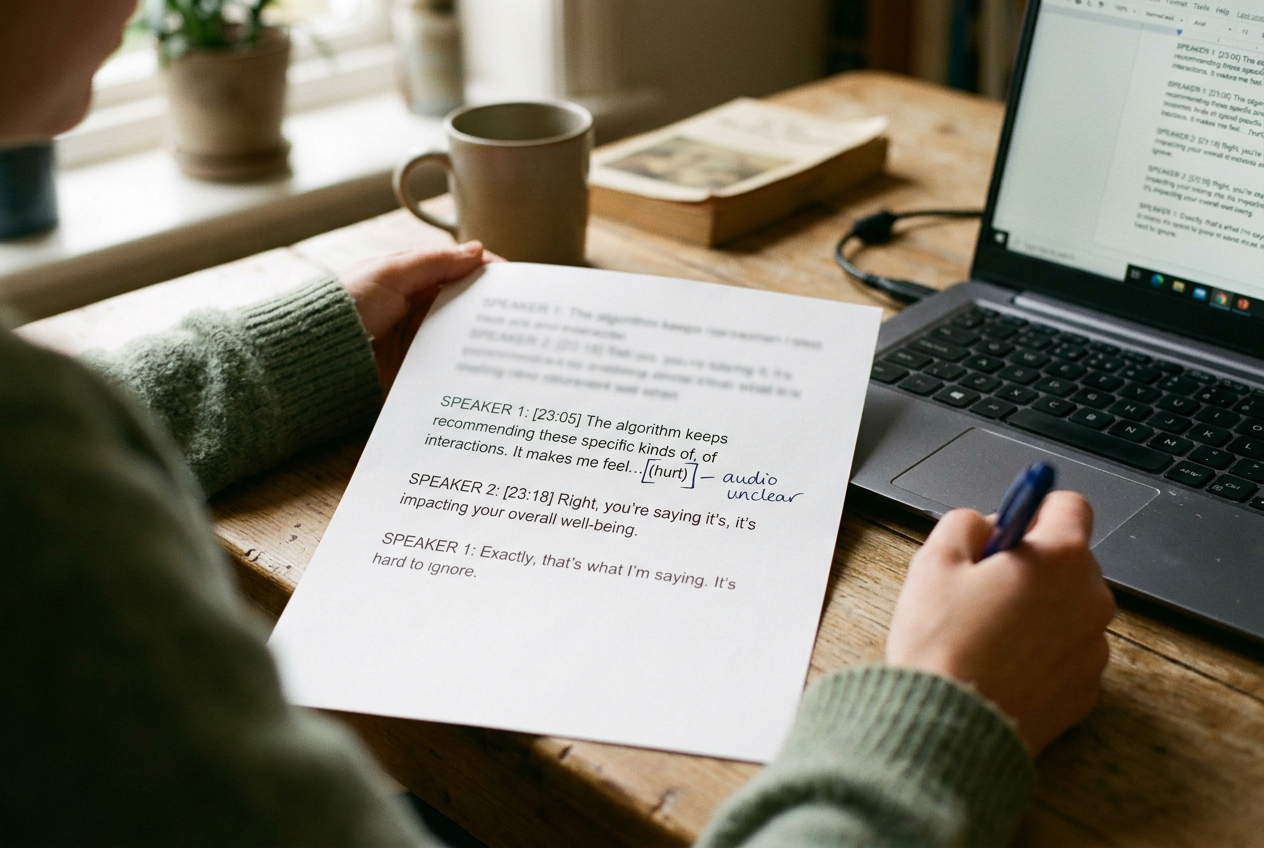
The public defender placed a printed transcript page beside her laptop. Halfway down was the line that had unsettled her client’s family:
I hurt her in the kitchen.
Her client said he had told his sister, “I heard her in the kitchen.” The difference was one consonant. On the recording, that consonant sat under a burst of background noise, while the compressed audio flattened the end of the word and another voice started nearby.
The defender played the passage again. “Heard” was possible. “Hurt” was possible. Anyone expecting one version could begin to hear it.
That uncertainty was the point she needed the family to understand. The transcript did not capture a clean statement that the recording later confirmed. It supplied a word where the recording remained unclear, and that word turned an ordinary recollection into something that resembled an admission.
The printed transcript page became the hard artifact around which everything else moved. Her client’s sister had stopped taking his calls after reading it. His mother wondered whether he had lied to them. The defense team now had to examine an automated output built for speed, while the family was already reacting to its most damaging sentence as if somebody had typed it after listening closely.
This is a composite account drawn from recurring features of jail communications and criminal defense work. It describes experience and process, not legal advice.
How a guess becomes a searchable sentence
Jails and their communications contractors can record calls made by incarcerated people, subject to local rules and notices. Automated speech-recognition software can then turn those recordings into text. The transcript makes a large collection of calls searchable, allowing an investigator to look for a name or phrase without listening from the beginning of every recording.
That speed changes the work. A person can search thousands of calls, open the results that contain a selected term, and focus on a few passages. The software may also divide speakers or attach timestamps, although those features can be wrong when voices overlap or a caller uses speakerphone.
Speech recognition does not recover words from sound with human certainty. It calculates which sequence of words best fits the available audio and the patterns learned during training. Clear speech can produce accurate text. Accuracy can fall when a call contains background noise, an unfamiliar accent, a weak connection, emotional speech or corrections made mid-sentence.
Jail calls can contain several of those conditions at once. Audio may be compressed. People speak over recorded notices. A relative may answer in a noisy home, and the incarcerated caller may lower his voice when discussing something personal.
The system still produces text, even when the sound does not support a confident choice.
In this case, the defense team could not see a word-level confidence score on the printed transcript page. Nor could the page show the family how readily a listener’s expectation influenced the disputed consonant. It looked settled because text always looks more settled than noise.
The public defender explained that the transcript was useful as an index. It could help locate a passage worth hearing. Its presence did not make every word independently verified, and the team still needed to compare important language with the recording.
The distinction sounded modest. It was not.
The family encountered the sentence first
Her client had been jailed for seven months while the case remained unresolved. His calls had become part family contact and part practical coordination, with conversations about child care, money for basic expenses and who might attend the next court appearance. Everyone knew the calls were recorded. That knowledge did not mean they understood that their speech could become searchable text, or that an automated word choice might later circulate apart from the sound.
The sister saw the printed sentence during a conversation about the evidence. By then, the disputed line had lost its surroundings. The call contained pauses, interruptions and a longer discussion of where people had been. The transcript extracted a grammatical statement from that disorder.
She did not treat it as a software hypothesis. She treated it as something her brother had said.
For almost three weeks, she declined his calls. Their mother continued answering but asked guarded questions, trying to reconcile his denials with the sentence on the page. Another relative worried that discussing the phrase on a recorded line could create more material for investigators, so the family communicated less when they most wanted an explanation.
The damage did not depend on a court accepting the transcript. The printed transcript page had already entered a relationship with the authority of a document, and the family’s fear gave the disputed word more weight before anyone slowed the audio or examined its limits.
That is one way automated transcription shifts power. The tool does not need to make a final decision. It can decide what gets noticed, which call receives attention and what a person must explain.
The defense team slowed the search process down
The public defender began with context rather than a competing declaration. She listened to the full stretch of audio around the line, then compared it with the transcript while a colleague listened without first seeing the disputed word. Their notes differed. Neither listener considered the consonant clear enough to resolve the sentence.
The team also compared nearby passages. The software had dropped small words elsewhere and merged speech from the caller’s sister into his lines. Those errors did not prove that “hurt” was wrong, but they showed that the transcript was not a verbatim human record.
That boundary mattered. The recording did not establish “heard.” It also did not cleanly establish “hurt.” A defense team can challenge certainty without claiming that uncertain audio proves the preferred version, and in this composite case the defender’s explanation remained narrower than the family wanted: the transcript had selected a word that the sound could not settle.
The process moved in the opposite direction from the tool. Automated transcription converted many hours of audio into text so that people could find relevant fragments quickly. The defense team took one fragment and expanded it back into sound, surrounding conversation and competing interpretations, which required more attention than the searchable system was designed to give each result.
On her copy of the printed transcript page, the defender crossed no words out. She drew brackets around “hurt” and wrote “unclear from audio” in the margin.
She then played the passage for the family without asking them to decide which word they heard. The sister noticed the interference for the first time. Their mother still heard “hurt” on one playback and “heard” on another. Her client’s account did not become proven, but the family no longer treated the transcript as a neutral witness.
The sister began accepting some calls again. The disputed line remained between them.
Searchability expands the privacy impact
Callers may know a jail call is monitored while still missing the practical reach of transcription. A recording ordinarily demands time from anyone who wants to review it. Searchable text lowers that barrier, allowing names and sensitive phrases to be found across a large archive.
That affects people outside the jail. Family members may discuss medical concerns, a child’s behavior or conflict inside the home. Their words can be mistranscribed, attached to the wrong speaker or surfaced because they resemble a search term. Even an accurate transcript can expose details that a relative understood as part of a private family conversation, despite the monitoring notice.
What happened to the disputed word also shows why privacy and safety cannot be separated cleanly. The sister’s fear changed contact with her brother. Other relatives restricted what they said because they worried about creating searchable material, and the resulting silence left the family with less context for judging the sentence already on the page.
The defender could explain the limits of the artifact in front of her. She could not determine how many other transcripts contained similarly uncertain words, how searches had been run across the call archive or who might later encounter a text excerpt without opening the audio. Those facts were not visible on the printed transcript page.
Questions people ask
Can an automated jail-call transcript be wrong?
Yes. Speech-recognition systems select likely words from audio, and errors can occur when sound is compressed, voices overlap or speech is unclear. In this story, the recording supported more than one plausible word, while the printed transcript displayed only “hurt” and gave the family no visible measure of uncertainty.
Does an unclear recording prove the transcript is false?
No. Unclear audio may leave competing interpretations unresolved. The defense team did not claim the recording proved that the client said “heard”; it documented that the sound did not clearly support the transcript’s more damaging choice. That narrower finding changed how the family understood the page.
Why are automated transcripts used if they can make mistakes?
They make large collections of recorded calls searchable, which can save people from listening to every call in full. The risk appears when a search aid is treated as a verified quotation, especially after the text has been separated from the recording and its surrounding conversation.
Can a transcript show which words the system was unsure about?
Some systems may retain confidence information, but what users receive and what reaches a case record varies. The family in this story saw no word-level warning. On the defender’s printed copy, the only visible uncertainty was handwritten beside the bracketed word: “unclear from audio.”
One story a day
The story of the day, in your inbox
One real story about AI each morning — no hype, no alarm, just company for the road.