A Detector Said 90% AI. Her Draft History Cleared Her
The essay took 12 days to write and three weeks to defend. A version history with 47 saved entries did what the detector could not: show the work unfolding.
August 9, 2026 · 8 min read

The message arrived while Elise was at the small table in her apartment, eating noodles beside an open statistics workbook. I’m calling her Elise because this is a composite account, built from patterns students and educators have described rather than one identifiable case.
Her instructor had run an essay through a detection tool. The result said there was a 90 percent likelihood that the text had been generated by a machine, and until the school reviewed it, the assignment would carry no grade.
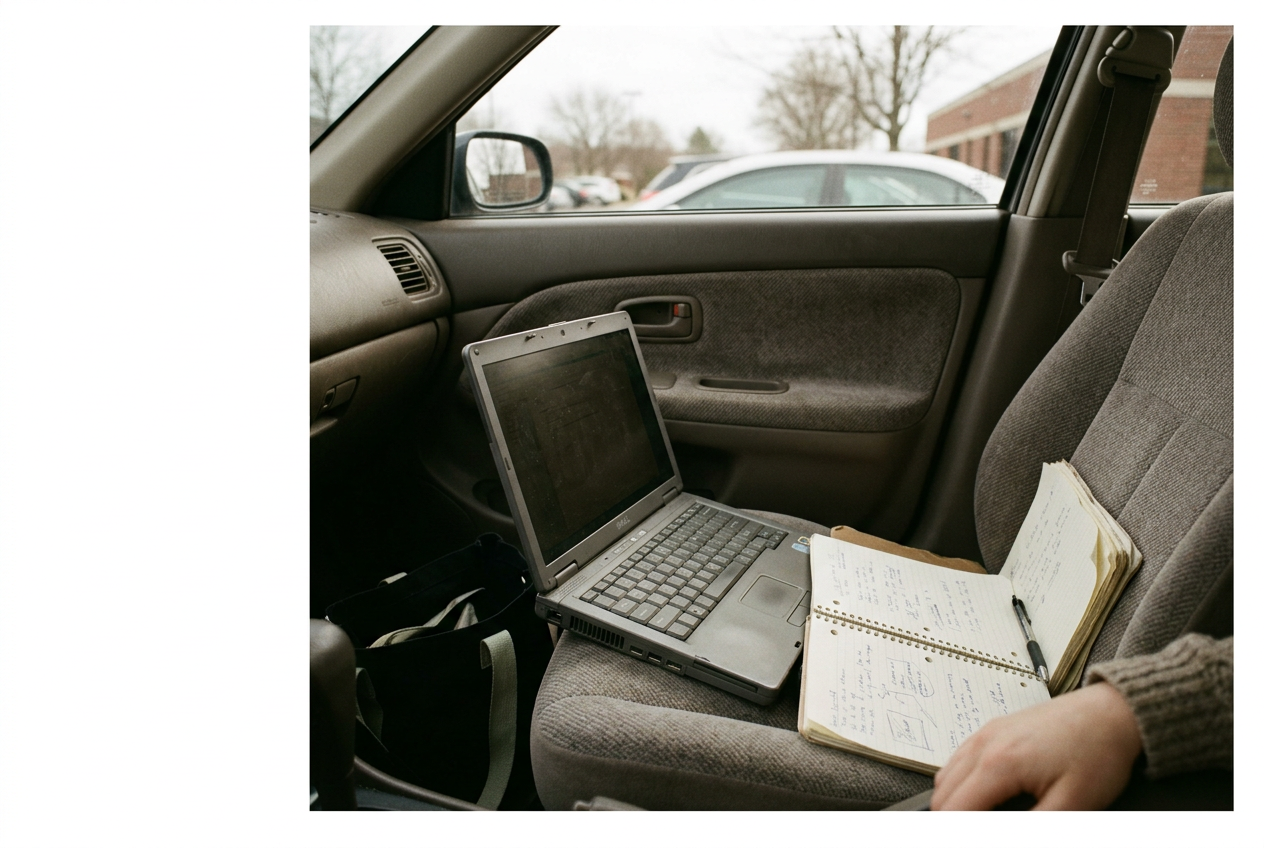
Elise opened the essay in her word processor. Its version history showed 47 saved entries spread across 12 days.
That was the thing she kept returning to: 47 entries. Some contained a sentence or two. Others showed paragraphs being cut, restored and cut again. The earliest saved draft was 312 words long and began with a definition she later deleted because it sounded stiff.
A middle version had the argument she eventually used, though the examples were in the wrong order and one section ended halfway through a sentence.
The submitted essay was 1,846 words.
She had written it at the library, at the apartment table and during gaps between classes, adding pieces whenever she could. She worked 12 hours a week at a campus dining counter and carried four classes, which left little open space in the week even before proving authorship became another assignment with no credit attached.
The detector had taken a finished paper and produced one large number. The version history held the opposite kind of evidence: repeated small decisions, including weak ones, preserved because the word processor had saved them.
The record behind the score
Elise’s essay examined who gets to feel welcome in shared public spaces. One sentence in the final version read, “Public space is never evenly public.” The first draft said, “Places that are supposed to be for everyone do not feel that way to everyone,” which was plainer and longer. Across several saved entries, she shortened it, moved it to another paragraph and then built the surrounding argument around it.
That revision mattered during the review. A detection score could label the finished sentence. It could not explain why an earlier version existed, or why Elise had spent two days trying the sentence near the conclusion before returning it to the opening section.
Her handwritten notebook helped too. It contained page references from two assigned readings and a rough diagram connecting those passages to her main claim. Still, the version history was the hard artifact. The notebook showed preparation; the 47 entries showed the paper becoming itself.
At the first meeting, Elise was asked to describe how she had written the essay and whether she had used any automated writing tools. She said she had used the word processor’s ordinary spelling and grammar features but had not generated the paper. Then she opened the revision panel and moved through the entries while her instructor watched.
There were awkward moments. A paragraph appeared almost fully formed between two saves because Elise had drafted it in the notebook first. Another passage had changed little after its first appearance. The record did not offer a perfect keystroke-by-keystroke account, and she worried that every clean sentence now looked suspicious precisely because it was clean.
She began explaining her own prose in a way she never had while writing it. Why this verb? Why had she removed that example? She could answer, though memory after submission was not as neat as the questions implied, and sometimes the honest answer was that one phrase had sounded better than another after she read the paragraph aloud.
The instructor forwarded the material for a broader academic review. Elise was told the process could take some time. The temporary missing grade remained visible in the course portal, beside grades for work she had finished before and after the essay.
What three weeks cost
The review lasted three weeks.
That period included a statistics exam and another paper. Elise spent six evenings gathering material or checking for updates, although there was little new to gather after she had shared the version history, her notes and the source files saved on her computer. She kept reopening the 47 entries anyway. The panel became less a record of writing than an object she inspected for danger.
Her semester grant was worth $4,000 and depended on maintaining satisfactory academic standing. No one told her the accusation would end the grant, but the possibility sat close enough to everything else that she checked the policy twice and calculated what she had left in savings. It was $286.
She did not study well that week. The statistics exam came back at 68 percent, lower than her other exam scores in the class. A single result cannot be cleanly assigned to a single cause, and Elise had found probability difficult before the accusation, but she remembered looking at a practice problem while thinking about whether a deleted introduction counted as evidence.
Friends offered the usual reassurance that she had proof. That helped until it didn’t. Proof still had to be opened by someone, interpreted and accepted, and the people doing that work were moving through an institutional schedule that did not change because her next assignment was due.
The accusation also altered how she wrote. On the next paper, she avoided revising in a separate document because she wanted every change captured in one place. She left weak openings in the file instead of deleting them. At one point she typed a note to herself explaining why she had moved a paragraph, then kept the note in the draft history after removing it from the essay.
That did not make the paper better. It made the record thicker.
Other students in her seminar heard that an essay was under review, though they were not told whose. The instructor briefly reminded the class about the course policy on generated text. Elise sat with her laptop open and said nothing. She later wondered whether silence looked guilty, but speaking would have meant announcing the accusation before the school had decided what it meant.
Cleared, with residue
At the end of the third week, Elise received a short notice saying the allegation would not move forward. Her essay was graded on its academic content and received 87 percent. The temporary missing mark disappeared from the portal.
The explanation was restrained. The materials she provided, especially the sequence of drafts, supported her account of authorship. The detector result had prompted the review, but it was not treated as sufficient proof once a human looked at the writing record.
Elise read the notice at the apartment table. The statistics workbook was there again, along with a mug and the notebook from the essay. She felt relieved. She was also behind.
The 90 percent score did not vanish from the report her instructor had received. It remained one output attached to the submitted paper, while the school’s final conclusion lived elsewhere. That split bothered her: the accusation was a bold number, easy to repeat, while the clearing depended on someone understanding 47 saved entries across 12 days.
She finished the semester in good academic standing and kept the grant. Her grade in statistics was lower than she had expected at the beginning of the term. There was no way to rerun those three weeks without the review inside them.
For the final paper, she used the same word processor. She checked the version history after the first page, then after the second, watching the saved entries collect beside work she had not finished yet.
Questions people ask
Can draft history clear an AI cheating accusation?
In Elise’s case, it provided the strongest evidence because it showed the essay changing across 47 saved entries over 12 days. The reviewers could compare early language, moved paragraphs and deleted material with the submitted paper. The history did not decide the case automatically; people still had to interpret it.
What does a 90 percent AI detection score prove?
In this story, the score triggered scrutiny but did not establish who wrote the paper. It described the detector’s assessment of the finished text, while offering no account of the student’s notes or revisions. The school changed course only after reviewing evidence outside the detector report.
Why can an academic-integrity review take weeks?
Elise’s instructor did not make the final decision alone. Her explanation and files moved through a broader school process, and she waited while continuing the same semester that the allegation had interrupted. The three-week delay mattered because exams and paper deadlines did not pause with the missing grade.
Did being cleared undo the academic impact?
The missing grade was replaced, the allegation stopped and Elise kept her $4,000 grant. The statistics exam she took during the review remained 68 percent, however, and there was no separate accounting for six evenings spent assembling evidence and reopening the 47 saved entries.
One story a day
The story of the day, in your inbox
One real story about AI each morning — no hype, no alarm, just company for the road.