A Noise Sensor Flagged Her Home 14 Times. No One Could Check Why.
A public housing parent received a disturbance warning based on sound classifications, but neither she nor management could hear what triggered them.
August 9, 2026 · 8 min read

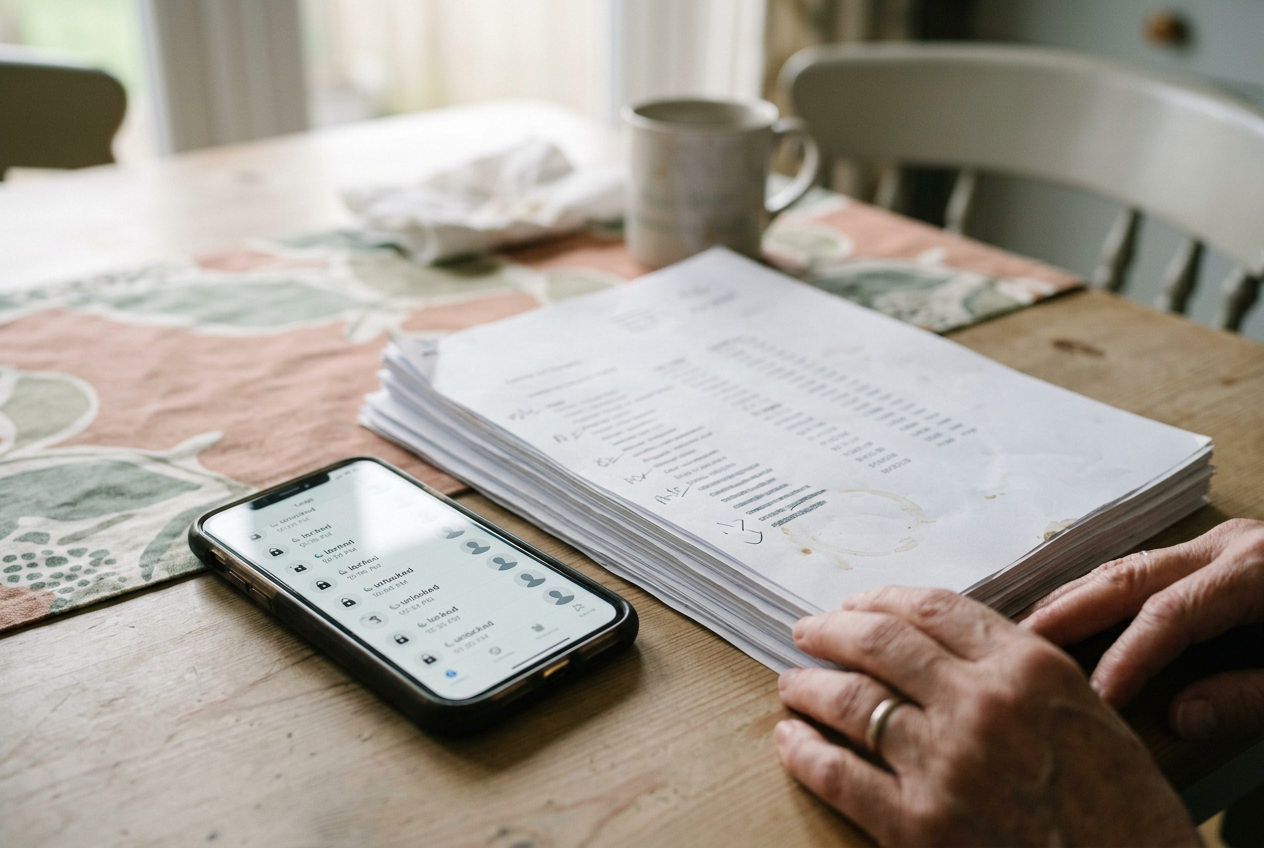
The warning arrived in October 2024, folded around a one-page event log. The parent, whom we will call Lena, had lived in the public housing complex with her son for six years. She knew that neighbors sometimes heard him moving through the apartment, especially after school, but she had received no recent complaint from a person.
The log was different. It contained 14 rows covering 23 days in September and October. Each row showed a broad sound category, such as an impact or a raised voice, along with a date and a confidence score. The accompanying notice said repeated disturbances had been detected and could lead to further action if the pattern continued.
It did not say what had made each sound.
Lena read the page at the kitchen table while her son worked nearby. One entry appeared to fall during a two-night visit with a relative, when both of them had been away from the apartment. Another covered a period when her son was at school and she was at a medical appointment. She had a receipt from the visit, though it could establish only where she had been, not what the sensor had detected at home.
The remaining rows were harder. A dropped backpack could register as an impact. So could furniture moving in the next apartment, work in the hallway, or something falling above them. A raised-voice classification might describe an argument, a television program, a child calling from another room, or a sound the system had categorized incorrectly.
The event log did not distinguish among those possibilities. That was the artifact management had, and it was the artifact Lena had to answer.
A classification without a recording
Management had installed acoustic sensors as part of a building effort to identify recurring noise and respond to safety concerns. Residents were told that the devices did not store understandable speech. That limit mattered. A microphone that preserves conversations would create an obvious privacy risk inside a home.
The sensor still processed sound.
Systems of this kind can convert pressure changes picked up by a microphone into measurements. Depending on the design, software may examine volume, frequency patterns, abrupt changes, and duration, then assign a label or score. Some systems perform part of that analysis on the device and send only event data to a dashboard. Others transmit more information for remote processing.
The exact architecture used in Lena’s building was not available to her.
Management said staff could not listen to conversations or replay intelligible audio. A housing worker could see the classifications shown on the dashboard, but could not open an alert and determine whether it came from a child, a television, a neighboring unit, or an object hitting the floor.
That design reduced one form of intrusion while creating a problem for review. The system made a claim about activity inside Lena’s home, yet it discarded or never retained the material that might have helped a person assess the claim later, and the confidence score did not explain which features had pushed an ordinary sound into a concerning category.
A score can look precise without answering the practical issue. It may describe how strongly an event resembles examples used to build or configure the classifier. It does not establish that the label is correct, that the sound violated a housing rule, or that it came from the household associated with the alert.
There were other unknowns. Lena did not know how the thresholds had been selected, how often the system produced false alerts in apartments like hers, or whether building construction affected the results. Management did not have those answers in the material it gave her. Staff had access to the dashboard, not a full independent evaluation of the sensor.
The dispute changed the household
Lena responded through the building’s ordinary review process. She marked the two entries that conflicted with her records and asked management to explain what evidence supported the rest. The answer returned to the same page: the event log showed repeated classifications, while the system’s privacy settings meant there was no understandable audio to inspect.
She could deny making excessive noise. She could describe household routines. She could point to the absence that undermined one entry. None of that identified the source of the other 13 rows, and management could not demonstrate the source either.
The warning began changing life in the apartment before anyone resolved it. Lena told her son to stop playing movement-heavy games indoors. When he dropped something, he looked toward the sensor and then toward her. She lowered the television further than she thought necessary and avoided running household appliances while he had friends over, though she had no evidence that either activity had triggered an alert.
Her son started asking whether ordinary sounds would get them removed from their home. Lena did not tell him that eviction was imminent; management had not made that claim. Still, a notice tied to repeated disturbances carried more weight in public housing than an informal complaint between neighbors, because the landlord controlled both the monitoring system and the record that might later be used to describe a pattern.
The sensor also altered how Lena viewed people around her. At first she assumed a neighbor had complained and management had added the technology’s data. Later she learned that the warning could be generated from dashboard alerts without a resident identifying the source. She felt some relief, then became less certain about where the sounds had originated.
The uncertainty did not repair the relationships. She became guarded in the hallway and stopped inviting another family’s child over after school.
Safety was part of the building’s justification for the system. Persistent noise can accompany fights, property damage, or a person in distress, and residents may want management to respond without requiring a neighbor to confront someone directly. Yet a classifier that cannot distinguish an ordinary household event from danger can redirect attention toward the wrong apartment, while a low score or an unexpected kind of sound might fail to prompt attention where it is needed.
Lena’s case did not show that every alert was wrong. It showed that the available record could not establish what had happened.
Data can be intimate without containing words
The statement that the sensor did not record understandable audio was reassuring in a narrow sense. Staff could not replay Lena speaking with her son. They could not hear the content of a disagreement or a private call.
The event log still revealed information about the home. A pattern of alerts could suggest when people were present, whether activity increased on certain days, or whether the system believed voices were raised repeatedly. Those inferences might be mistaken, but they could still influence how a household was treated.
For Lena, privacy was not limited to the secrecy of spoken words. It also involved who could assign meaning to sounds from her living room, how long those assignments remained on a dashboard, and whether an unverified pattern could follow her into a later decision about her tenancy. Management did not provide a clear retention period in the material she received.
Seven weeks after she challenged the warning, management told her that it would not move forward as a lease matter at that point. The disputed classifications remained in the system. The event log was neither accepted as proof nor deleted as unreliable.
Lena kept the paper in a folder with her rent receipts. She had written “away” beside one row and “appointment” beside another. The other 12 remained unmarked.
Questions people ask
Can a noise sensor listen without saving understandable audio?
Yes. A device can measure sound and classify patterns while retaining only labels, scores, or other event data. That can limit access to spoken content, but it does not mean the device collects no information about a household. In Lena’s building, the classifications still became part of a management record.
What evidence did management have against the tenant?
Management had a dashboard and the one-page event log showing 14 classified sounds over 23 days. It did not have understandable audio that staff could replay, and the log did not identify the physical source of each sound. Lena could challenge the pattern, but neither side could reconstruct most events.
Could sensor alerts affect a public housing tenancy?
Noise rules and housing procedures vary, and this account is not legal advice. In Lena’s experience, the alerts supported a formal warning and created fear of later lease action, although management eventually said it would not advance the matter at that point. The classifications stayed in the system after the dispute.
Why was the event log so difficult to challenge?
The log stated what the software believed it detected, not what produced the sound. Lena had records contradicting one period, but most household noise leaves no separate evidence. Management also lacked replayable audio, leaving both sides with the same page: 14 rows, two handwritten notes, and 12 classifications without an agreed explanation.
One story a day
The story of the day, in your inbox
One real story about AI each morning — no hype, no alarm, just company for the road.