
A Coach Uploaded 1,842 Player Clips Before Families Saw the Data
The AI gave injured players useful feedback by tracking their movement. It also turned four seasons of ordinary team video into a searchable record of bodies, injuries and places.
October 27, 2026 · 7 min read
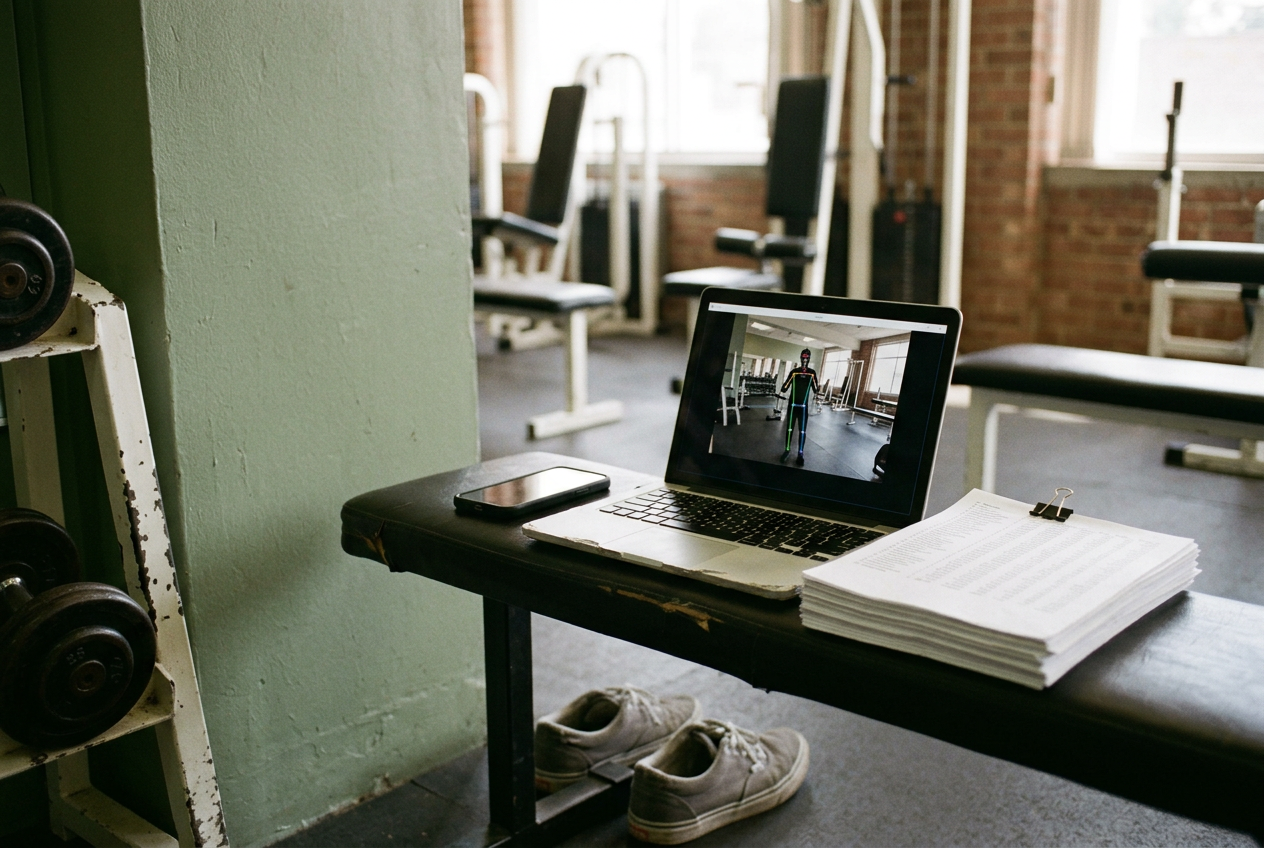
The spreadsheet had 1,842 rows. The coach downloaded it after a parent asked what the team’s video analysis account held, expecting a short list of recent practice clips. Instead, each row represented a video uploaded across four seasons, with columns for an athlete, capture date, drill, body area, model-generated movement labels and, in some cases, a location.
That spreadsheet became the object everyone kept returning to. It was more legible than the platform’s dashboard, where videos appeared as thumbnails organized around players and sessions. On paper, the accumulation was hard to miss.
The coach had started using the tool for a practical reason. When a player returned after a knee or ankle injury, he recorded a short drill on his phone and uploaded it. The software placed a digital skeleton over the player, tracked points around the shoulders, hips, knees and ankles, then estimated joint angles through each step or landing.
Players liked it. A teenager could watch one knee move inward during a squat instead of trying to understand a general instruction about alignment. The tool could compare later clips with an earlier baseline, and its charts gave the coach a way to show change across several weeks without relying on memory.
One player recovering from an ankle injury had felt ready to resume full practice. The system repeatedly marked an uneven landing, drawing the coach’s attention to how quickly the player shifted weight onto the uninjured side. The coach reduced the drill load and recorded another clip the following week. The difference was visible to the player before it appeared in the tool’s score.
That result mattered. It also encouraged more recording.
What the system saw
The software did not understand an injury in the way a physical therapist or physician would. It performed pose estimation: a model predicted where body landmarks appeared in each frame, linked those points across the video and calculated relationships among them. Another layer compared the resulting movement pattern with earlier clips or patterns learned from training data.
A knee angle was therefore not measured by a sensor attached to the knee. It was inferred from pixels showing where the hip, knee and ankle probably were. Camera position, loose clothing, poor lighting and another person entering the frame could all change that estimate.
The coach discovered one failure when the tool marked left-knee instability in a player returning from a right ankle injury. During part of the drill, another athlete had crossed behind the subject. The tracking overlay briefly moved to the other athlete’s leg, then returned. The score remained on the injured player’s profile, presented with the same precision as cleaner measurements.
This failure mode is called a track switch. A computer vision system must decide whether the body detected in one frame is the same body detected in the next. When people overlap, look similar or move out of view, the model can join points from different bodies. A calculated angle may still appear valid even though it belongs to the wrong movement.
The coach learned to inspect overlays rather than trust the summary score. That was new work created by the tool: recording from a usable angle, checking whether the digital joints stayed attached to the correct person and deciding whether a flagged asymmetry reflected the athlete or the camera. The analysis saved time only when the video behaved as expected.
The privacy problem came from the same technical feature that made the system useful. It did not merely store game film. It extracted movement data, connected repeated clips to individual profiles and made old footage searchable by athlete, injury area and model label. Without that automated analysis, the coach would not have built a four-season archive around each player’s body.
The rows families had not expected
A parent raised the first concern after seeing a practice clip open on a laptop. The player’s face was visible. Teammates could be heard discussing soreness in the background, and the notes beside the video identified the body part being monitored.
The parent had known coaches recorded games and occasional practice drills. The family had not understood that short injury videos were being uploaded to an outside analysis platform, associated with a named player and retained after the immediate recovery period.
The coach opened the account settings, then requested the spreadsheet export. Its rows showed how much context had traveled with the videos. File names sometimes included an athlete’s name and an injury shorthand. The platform had generated labels such as reduced hip rotation or landing asymmetry.
Some videos retained capture-location information from the phone’s media metadata, while other rows could be tied to a place through team and session labels.
Location metadata was not required for pose estimation. It arrived because phones can attach coordinates and capture details to media files, depending on device settings, and an upload can preserve some of that information unless the receiving system removes it. The coach had checked whether the videos played. He had not checked what metadata accompanied them.
The distinction between supplied and inferred information became important at a team meeting. A face and a spoken name were captured directly. An injury note was entered by the coach. A label about unstable movement came from the model, based on estimated body points and comparison rules.
All of it appeared together in the same player record, which made an inference look like another settled fact.
Families reacted differently. Several players wanted the analysis to continue. They had used the clips to understand corrections and track progress, and one player had saved screenshots of the joint overlays to discuss during a medical appointment. Another family wanted every video removed, including game footage that had been clipped into individual movement sequences.
A third was less concerned about faces than about health information following a student after graduation.
There was no single moment when everyone decided the tool had been good or bad. The argument concerned who had been allowed to make that trade, especially after years of recordings had already accumulated.
The participation paperwork mentioned team photography and video. It did not describe automated pose tracking, individual movement profiles or model-generated labels. The school treated those as a different use, even though the source material was familiar sports footage. A player can agree to be visible in a game recording without understanding that software will isolate their body, measure it over time and connect a possible injury to their name.
Deleting a video was not the whole answer
The coach paused new uploads and worked through the spreadsheet with the school. That did not immediately establish what deletion meant.
Removing a thumbnail from the team dashboard could make a clip unavailable to the coach, but the school also wanted to know whether extracted measurements remained attached to the account, whether backup copies aged out later and whether uploaded footage had been used to improve the model. The platform’s support material answered some retention questions in general terms. It did not let the school inspect training systems or backups.
What was known was narrower. The account contained source videos, generated overlays, scores and player profiles. The school could request removal and later confirm what remained visible in the dashboard. It could not independently examine every system operated by the platform.
The spreadsheet helped separate those questions. Rows marked for removal included videos where players were no longer enrolled, clips containing injury discussion in the audio and footage uploaded before families received a specific explanation of the analysis. Other players chose to keep selected records because they still wanted longitudinal comparisons.
The coach changed his practice after the meeting. New clips were framed to avoid faces when possible, recorded without background medical conversation and uploaded only for players whose families had received a plain description of the analysis. Those changes reduced incidental information, but they did not make the activity anonymous. A movement profile tied to a named athlete remained personal even when the face was outside the frame.
Months later, the original spreadsheet was still saved with the school’s review materials. Its 1,842 rows documented both the value of the system and the scale created by repeated, low-friction analysis. The coach had thought in sessions: one landing drill, one useful correction, one player returning to practice. The export showed a database.
Questions people ask
Why did the AI need video instead of injury notes?
The system estimated movement from visible body landmarks across successive frames. Written notes could record pain or a diagnosis, but they could not supply the joint positions and timing used to calculate angles, asymmetry or changes from an earlier baseline. Video also captured faces, voices and surroundings that the movement analysis did not need.
Can movement AI diagnose a sports injury?
The tool in this story produced movement estimates and comparative labels, not a medical diagnosis. Its output depended on predicted body points, camera position and the quality of tracking. A precise-looking score could be wrong when clothing hid a joint or the system switched from one athlete’s body to another.
Does removing a clip also remove the data inferred from it?
Not always. A platform may hold the source video, extracted body points, overlays, scores and account records as separate data. In this case, deleting what appeared in the dashboard did not by itself explain the status of backups or model-training systems, so the school recorded what it could verify and what remained unknown.
Did the team stop using the analysis tool?
No. Uploads paused during the review, then resumed for players whose families accepted the described use. The coach limited what entered each frame and retained fewer old clips, while some families declined further analysis. After those choices and deletion requests, the next spreadsheet export contained 396 rows.
One story a day
The story of the day, in your inbox
One real story about AI each morning — no hype, no alarm, just company for the road.