A Photo Organizer Identified a Protest Medic in 214 Images
A volunteer archive grouped one medic’s face across months of demonstrations. The feature helped locate supplies, but it also turned ordinary photos into an attendance record.
August 9, 2026 · 7 min read

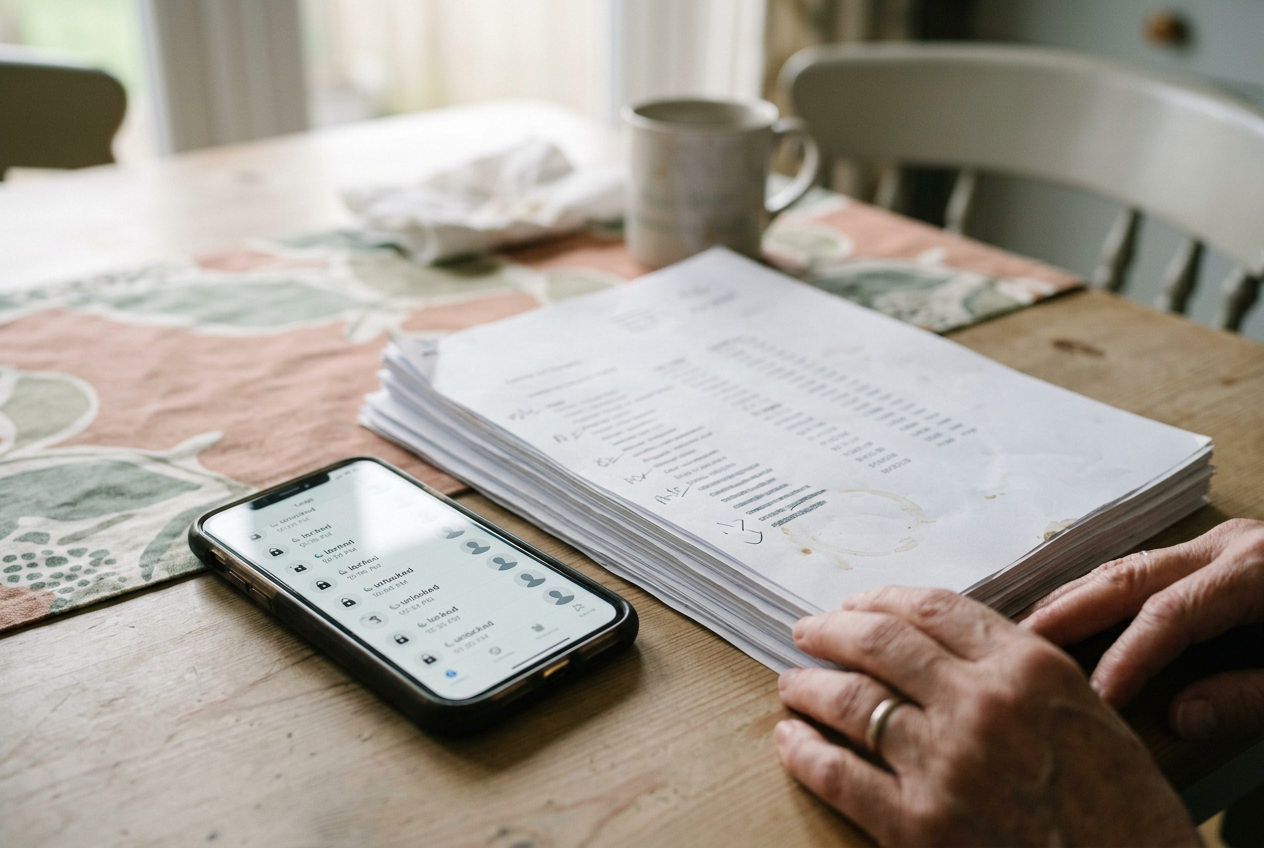
The medic first saw the 12-page contact sheet on a volunteer’s kitchen table in October 2023. It contained 214 thumbnails from seven demonstrations held over five months. Most showed the medic working: opening a supply bag, washing someone’s eyes, standing near other volunteers or moving through a crowd.
Nobody had selected those pictures one by one.
A volunteer had opened the shared photo organizer and clicked a face group marked with a prompt to add a name. The software had found the medic in pictures uploaded by more than a dozen people, including wide crowd shots in which the face occupied a small part of the frame. The volunteer printed the results to understand the scale of the grouping, then circled 17 images that appeared to show someone else.
The medic’s confusion centered on the prompt. No one had added a name, and several photographers did not know the medic personally. Yet the organizer had already built the useful part of an identity record: a persistent cluster that connected the same apparent person across separate days and albums.
The name was optional. The grouping was not.
How the face group was built
Automated photo organizers commonly begin by detecting areas of an image that look like faces. A second model converts each detected face into an embedding, a long sequence of numbers representing visual patterns that help distinguish one face from another. Those numbers do not spell out an identity, and they cannot be read like a name or address. They allow the system to measure similarity.
If two embeddings are close enough under the organizer’s internal rules, the corresponding photographs may be placed in the same group. The system repeats that comparison across an archive, forming clusters without requiring anyone to tag each picture. A person can therefore become searchable before a human supplies a name.
This is part of the same technical family as facial recognition, although the task is narrower than matching an unknown person against a police database or an employee roster. The organizer was performing face clustering: deciding which faces in one collection probably belonged together. That distinction changed the system’s stated purpose, but not what the contact sheet revealed about the medic.
The group could see the output. It could not see the embeddings, the similarity threshold or which features had carried the most weight. Members also could not reconstruct every processing step from the settings available to them. What they knew was more limited and more concrete: photographs from separate contributors had entered one account, and the organizer had connected the medic across them without a manual label.
The 17 circled mistakes showed the other side of that process. The organizer had merged a second volunteer into the medic’s group in images where both wore face coverings and glasses. Only the area around the eyes remained visible, while motion and uneven lighting removed other details that might have separated them. Elsewhere, the system split genuine pictures of the medic into another group after a change in eyewear and hair.
That failure mode comes from the threshold used to decide whether two embeddings are similar enough. A stricter threshold can split one person into several groups. A looser threshold can merge different people, particularly when faces are partly covered, small in the frame or photographed from sharp angles. The volunteers were not shown a meaningful confidence score, so a clean row of thumbnails looked more certain than the underlying comparison was.
Why the feature had seemed useful
The archive had not been created to monitor attendance. Volunteers used it to document injuries, supply handoffs and conditions at demonstrations, while pictures of tables and open bags helped them work out where equipment had gone. The collection grew for eleven months because uploading everything was faster than sorting it after a long day.
Face grouping made that archive easier to use. The medic often carried a shared supply bag, so opening the medic’s cluster brought up photographs of the bag at different points in an event. During one review, volunteers traced a missing pouch of eye-wash supplies from an intake table to a treatment area by following the medic through the grouped images. That search took minutes rather than an evening of opening files.
The organizer had made the documentation better at answering a practical question. It had also created a new answer nobody had requested.
Each photograph carried context beyond the face. Some retained location metadata. Others sat in albums named for a month or event, while backgrounds showed recognizable intersections and nearby participants. Face clustering did not need to infer every one of those facts.
It supplied the link between images, after which ordinary metadata and visible surroundings could be used to reconstruct where the medic had appeared and who was often nearby.
The 12-page contact sheet made that combination hard to dismiss. One thumbnail revealed little. Two hundred fourteen of them formed a record of association and movement, even after the 17 apparent errors were set aside. A volunteer who had access for supply work also had access to that record.
So did anyone who gained control of the shared account.
There was no evidence in the public account behind this composite that police, an employer or a hostile group obtained the archive. The safety concern came from capability rather than a documented breach. The organizer had lowered the work needed to map attendance, turning a task that once required sustained manual review into a ready-made cluster.
Rebuilding the archive
The discovery strained relationships inside the group because members had understood consent differently. Some photographers believed that sharing images within a volunteer account was a limited form of documentation. People pictured in the archive had often agreed to a photograph, or had tolerated cameras in a public crowd, without knowing that software could connect their appearances across months.
The medic did not want every image destroyed. Some documented care under difficult conditions, and a smaller set had already helped volunteers account for donated supplies. Erasing the archive would also erase work the medic considered worth preserving. Keeping it unchanged no longer felt acceptable.
For six weeks, new uploads stopped while the group separated operational photographs from pictures containing identifiable people. The most consequential change happened before a file reached the shared organizer: volunteers began cropping or obscuring faces unless a person had agreed to be included in the searchable archive. They also removed location metadata from the smaller collection used for supply review.
Those choices reduced what the archive could do. A cropped photograph might show that gauze reached a treatment area without showing who carried it there, which made some searches slower and prevented the group from recreating the earlier path through face clusters. Members accepted more gaps in exchange for limiting the connections available to the organizer.
Consent also became narrower. Permission to take a picture was no longer treated as permission to place an identifiable face in a pooled collection that could sort people automatically. The group recorded whether a volunteer had agreed to that use, while people who had not answered were left out of the face-searchable archive.
This did not settle every disagreement. One photographer withdrew from the project after concluding that useful documentary images were being altered too heavily. Another volunteer kept working but stopped uploading crowd scenes. The medic remained involved and allowed a limited set of training photographs to stay, including images used to teach new volunteers how supplies were arranged.
The contact sheet stayed with the medic. Its handwritten circles did not make the system’s correct matches harmless, and the errors were not reassuring. Both showed how much interpretive work had been hidden behind a prompt to add a name.
Questions people ask
Can a photo organizer group someone who has never been named?
Yes. Face clustering compares numerical representations of faces and places similar ones together before anyone supplies a name. Adding a name makes the cluster easier for a person to read or search, but the underlying links between photographs may already exist.
Does removing a person’s name stop face grouping?
Not necessarily. In this archive, the medic’s group existed without a name because the software relied on visual similarity rather than a text label. The available controls and deletion behavior vary by organizer, and the volunteers could not verify every processing step from the account settings they could see.
Why did the organizer mix two volunteers together?
Both volunteers wore glasses and face coverings in several photographs, leaving the model with less distinguishing information. Small faces, motion and changes in angle also affected the embeddings. The organizer’s threshold then favored one larger cluster, presenting 17 likely mismatches beside photographs that did show the medic.
What changed after the group found the face cluster?
Volunteers stopped treating a shared upload as neutral storage. They reduced identifiable images, removed location metadata from the supply collection and sought separate permission for face-searchable photographs. The original 12-page contact sheet remains folded in an envelope with the 17 mismatches circled in marker.
One story a day
The story of the day, in your inbox
One real story about AI each morning — no hype, no alarm, just company for the road.