Doorbell Camera AI Turned Her Service Visit Into a Suspension
A customer uploaded doorbell footage with a low rating. An AI system interpreted the worker’s voice and movements, escalating the complaint and pausing her access to jobs.
October 20, 2026 · 8 min read
I will call the worker Rosa. She had taken jobs through a home-services platform for fourteen months, mostly cleaning kitchens and bathrooms, and her rating had stayed above 4.8 out of five. The platform let customers choose workers, but its rankings decided which profiles appeared first and which workers received offers for better-paying jobs.
In October 2024, Rosa accepted a $96 cleaning appointment at a house she had not visited before. The customer met her at the door, pointed out the rooms included in the booking and left. A doorbell camera was mounted beside the entrance. Rosa noticed it, as most workers would, but saw no notice that its footage might be analyzed by software or submitted to the platform as evidence about her conduct.
The appointment ran thirty minutes longer than booked. Rosa said the kitchen needed more work than the listing suggested, while the customer later said she had moved too slowly and seemed irritated when asked to finish. The customer gave her two stars.
Low ratings hurt, but this one did more. Within a day, Rosa’s account stopped showing new jobs. The dashboard said a conduct concern was under review. She could still see her earnings, including the $72 she received after the platform’s fee, but she could not accept another appointment.
Rosa challenged the complaint through the support inbox. Four days later, a three-page PDF appeared in the appeal area of her account. That file became the one useful record of what had happened.
The file
The first page summarized the customer’s complaint. The second contained still images from a doorbell recording. The third showed an automated behavior analysis, with labels covering Rosa’s voice, body position and movement near the doorway.
The customer had uploaded a 52-second clip recorded as Rosa left the house. The PDF indicated that software had transcribed the audio, tracked visible motion and assigned behavioral categories. It characterized her speech as elevated, her movements as abrupt and her posture as consistent with agitation. A risk marker had then pushed the complaint into a higher review category.
That marker mattered. The two-star rating lowered Rosa’s average, but the automated classification was what paused her access to work while the platform reviewed the complaint. A spreadsheet could have stored the rating. A support worker could have misplaced an appeal.
Neither would have created the additional claim that Rosa’s ordinary movements displayed a risky emotional state.
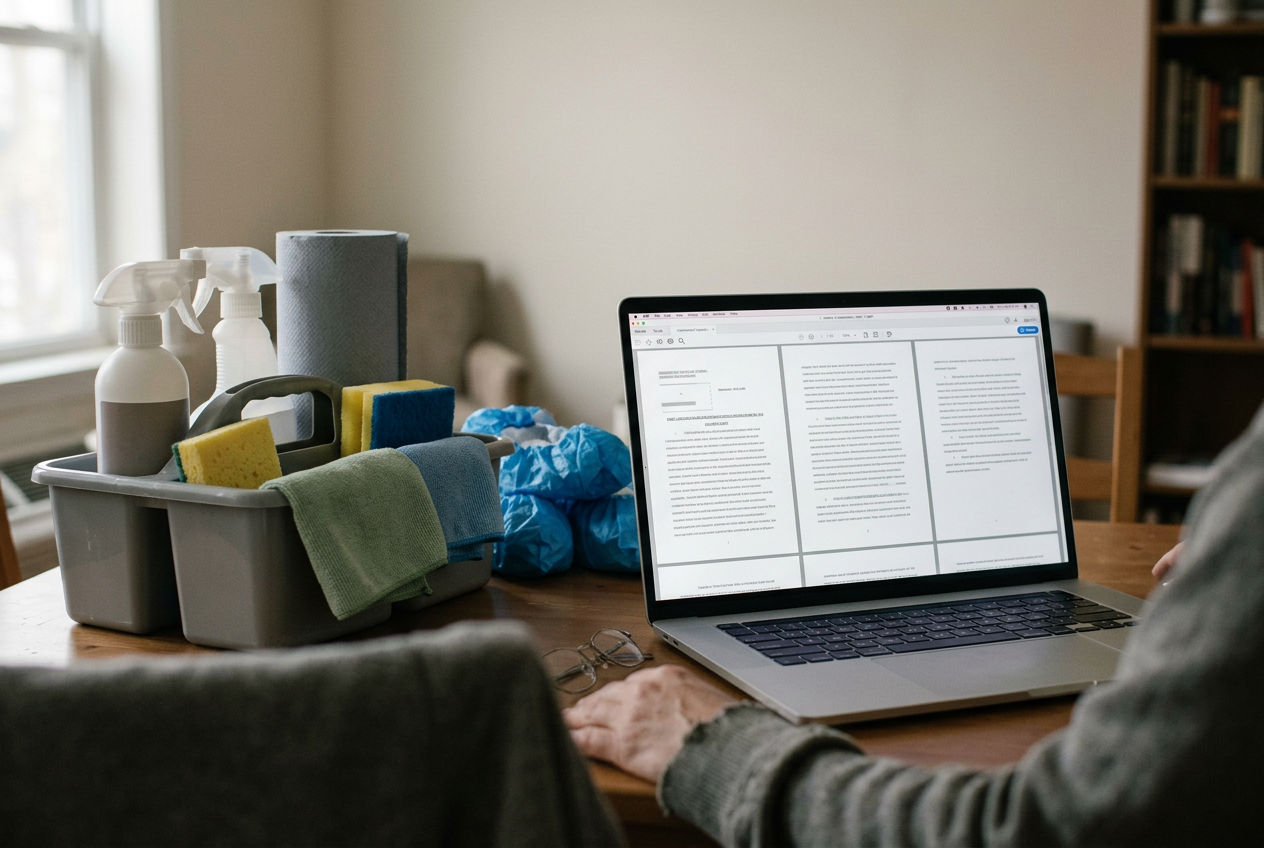
Rosa read the three-page PDF on her phone, then downloaded it to a laptop because the analysis table was hard to follow on the smaller screen. The still images showed her carrying a cleaning caddy, bending to remove a shoe cover and turning back toward the door. One frame caught her arm extended. The system treated that motion as part of the evidence for agitation.
The clip did not show what happened inside the house. It did not show the extra grease on the stove, the messages about which tasks were included or the customer standing several feet inside the doorway. It began after the door opened and ended as Rosa walked toward her car.
What the system measured
The PDF did not identify the model or provide its training data. It revealed enough, however, to show the basic path from recording to judgment.
First, the system converted speech to text. It also appeared to assess features of the audio beyond the words, including volume and changes in pitch. Rosa’s voice rose near the end of a sentence, according to the analysis, while the transcript showed her explaining that the booking time had already ended.
Volume is not temperament. A doorbell microphone records from a fixed position, compresses sound and may amplify a person who is speaking toward the device from outside. Rosa said a vacuum was still running behind the customer. The PDF did not mention that background noise, and the transcript missed part of her sentence.
The visual analysis followed a similar route. Systems that classify movement commonly estimate the position of visible joints across successive frames, measure the speed or direction of a gesture, then compare that pattern with examples assigned labels during development. Other models generate a description directly from sampled frames. The PDF did not disclose which method was used here, so the precise mechanism remains unknown.
What was visible was narrower. Rosa’s extended arm contributed to the abrupt-movement label. She said she was handing back a key. Her bent posture appeared in the sequence used to characterize her body language, though she was pulling off a disposable shoe cover while holding the caddy in her other hand.
The model could detect changes between frames. It could not establish why those changes occurred. Yet the analysis turned measurements into social interpretation, and the risk marker gave that interpretation operational force before Rosa knew the footage had been uploaded.
Confidence indicators in the PDF made the findings look measured, but they did not represent the probability that Rosa was agitated. Such scores usually describe how strongly an input matches a model’s learned category or how stable a prediction is within that system. A high score can accompany a wrong interpretation when the relevant context never entered the model.
The doorway was also a poor vantage point. Rosa moved in and out of the camera’s field, and the caddy blocked part of her torso. The software still produced a behavioral account from the parts it could detect. The PDF did not say whether a human watched the full clip before her account was paused.
The appeal changed the evidence
Rosa’s response did not try to prove that she had looked cheerful. She focused on the three-page PDF and the gap between what its images showed and what its labels claimed.
She acknowledged that her voice was louder at the doorway. She also pointed out that the transcript captured her discussing the end of the booked period, which supported her account of the disagreement. The extended arm aligned with the return of the key. The movement labeled abrupt occurred while she was managing the caddy and shoe cover.
There was one fact in the footage that helped her. The customer had said Rosa left without announcing that she was done. The clip’s transcript, although incomplete, recorded her saying that she was leaving. The same machine analysis that helped escalate the complaint preserved evidence against one part of it.
That left Rosa ambivalent about the recording. She did not object to a customer documenting who approached the house, and the clip gave her something more concrete than competing written accounts. What unsettled her was the extra interpretive layer, applied without her knowledge and presented in the PDF with no visible distinction between observation and inference.
A still image of an arm was an observation. The software’s description of the motion as abrupt was an interpretation. Treating that motion as evidence of agitation added another inference, while using the resulting marker to pause work converted the inference into a decision.
Nine days after the PDF appeared, the platform restored Rosa’s access to jobs. The conduct marker no longer appeared on her dashboard. The two-star rating remained, and support did not tell her whether the automated analysis had been removed from her account or merely overridden for that complaint.
Her job offers returned slowly. During the eleven days without access, she estimated that she missed about $640 in gross bookings based on her previous month. That figure could not account for cancellations, tips or jobs she might have declined, but it described the gap she saw in her calendar.
Rosa kept the three-page PDF. She had no comparable record showing how the platform’s ranking system treated the remaining low rating, or whether the behavioral labels could influence later reviews. The document explained more than the original notice had, while stopping short of the facts she wanted most: which model had judged her, what examples defined agitation and whether a person had accepted that label before her work disappeared.
Notice without a moment of notice
The platform’s general terms said that material submitted by users could be processed to investigate safety and service concerns. Rosa had accepted those terms when she opened her account. The language did not tell her that footage from a privately owned camera could be analyzed for vocal and physical behavior after an appointment.
There are several people with different expectations inside that single recording. The resident sees a safety device attached to a home. The worker enters a temporary workplace where the resident controls the camera, the footage and the decision to upload it. The platform receives a customer’s recording, runs an analysis and uses the result to govern access to paid work.
The PDF showed no method for testing alternative explanations. It did not account for cleaning equipment, the key exchange or the limited view. Rosa supplied those facts only after the model’s categories had shaped the case.
A human reviewer can also misread posture or tone. The technical difference here is scale and sequence: software can extract the same predefined signals from many recordings, attach labels before either person is heard and route a complaint according to those labels. That makes the model more than a storage tool. It becomes an early interpreter of workplace behavior.
Rosa still takes appointments at homes with doorbell cameras. She assumes she may be recorded at the entrance, though she cannot tell which customers will upload footage or which recordings will be analyzed. Before leaving a job, she now keeps her hands visible and states what she is carrying back to the car. That is not a platform rule.
It is a habit she formed after seeing her extended arm in the PDF.
Questions people ask
Can a platform analyze customer doorbell footage about a worker?
In Rosa’s case, the platform accepted customer video and processed it under broad terms covering submitted material and safety reviews. The notice she had seen did not explain that software might infer behavior from her voice and movement. Rules governing recording, workplace notice and automated decisions vary by location and working arrangement.
What can AI infer from a short doorbell video?
A system can transcribe speech, estimate vocal features, track visible movement and assign behavioral labels. Those outputs depend on framing, sound quality and the categories built into the model. Rosa’s clip captured a louder sentence and a fast arm movement, but it could not establish that she was agitated or explain the key in her hand.
Does a confidence score mean the behavior label is true?
No. A confidence indicator usually reflects the model’s match to a learned category, not certainty about a person’s emotional state. Missing context can produce a strong but mistaken result. Rosa’s PDF showed confidence indicators beside interpretations drawn from compressed audio, partial body views and a clip limited to the doorway.
Did the video help Rosa’s appeal?
Yes, in part. The automated labels escalated the complaint, but the transcript also showed that she announced her departure, contradicting one claim. Her access to jobs returned after eleven days, while the low rating remained. She saved the three-page PDF on her laptop beside the calendar showing the $640 gap.
One story a day
The story of the day, in your inbox
One real story about AI each morning — no hype, no alarm, just company for the road.