A Client Sent Her an AI Image in Her Own Style to Copy
The reference looked like her work, down to a habit she had spent years correcting. The client had generated it from six portfolio images and wanted a finished illustration for $2,400.
August 9, 2026 · 7 min read
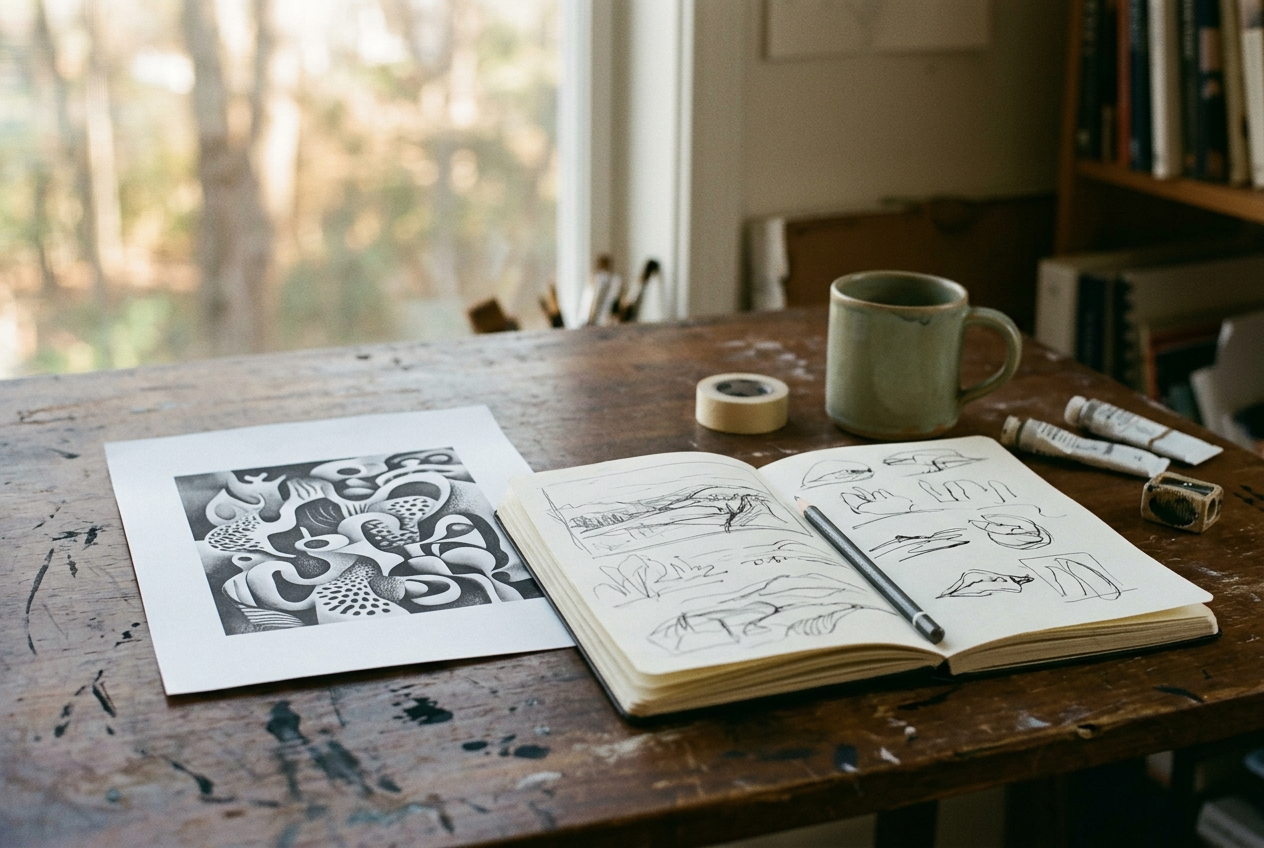
The reference arrived as an attachment late in the workday, while the illustrator was cleaning pencil dust from her desk with the side of her hand. She opened it, enlarged it, then printed it on letter-size paper because she trusted paper more than a bright screen when something felt off.
The image showed a woman leaning over a kitchen counter. The line around the shoulders broke in two places. The hands were oversized. A patch of flat color stopped just short of the ink, leaving a narrow strip of white that made the figure seem to vibrate.
These were not unusual features alone. Together, they were the visual grammar the illustrator had built across twelve years of editorial work.
The printout also contained one of her bad habits.
At the base of the woman’s thumb, the line curled inward before meeting the wrist. The illustrator had drawn hands that way for years, partly to keep them readable at small sizes and partly because she used to avoid drawing the full joint. During the previous eighteen months, she had been teaching herself to stop. The curl still appeared across older portfolio pieces posted online.
The client’s email treated the attachment as a straightforward reference. They liked the composition and wanted her to match the look for a campaign illustration. The fee was $2,400, with revisions included, and the deadline sat nine days away.
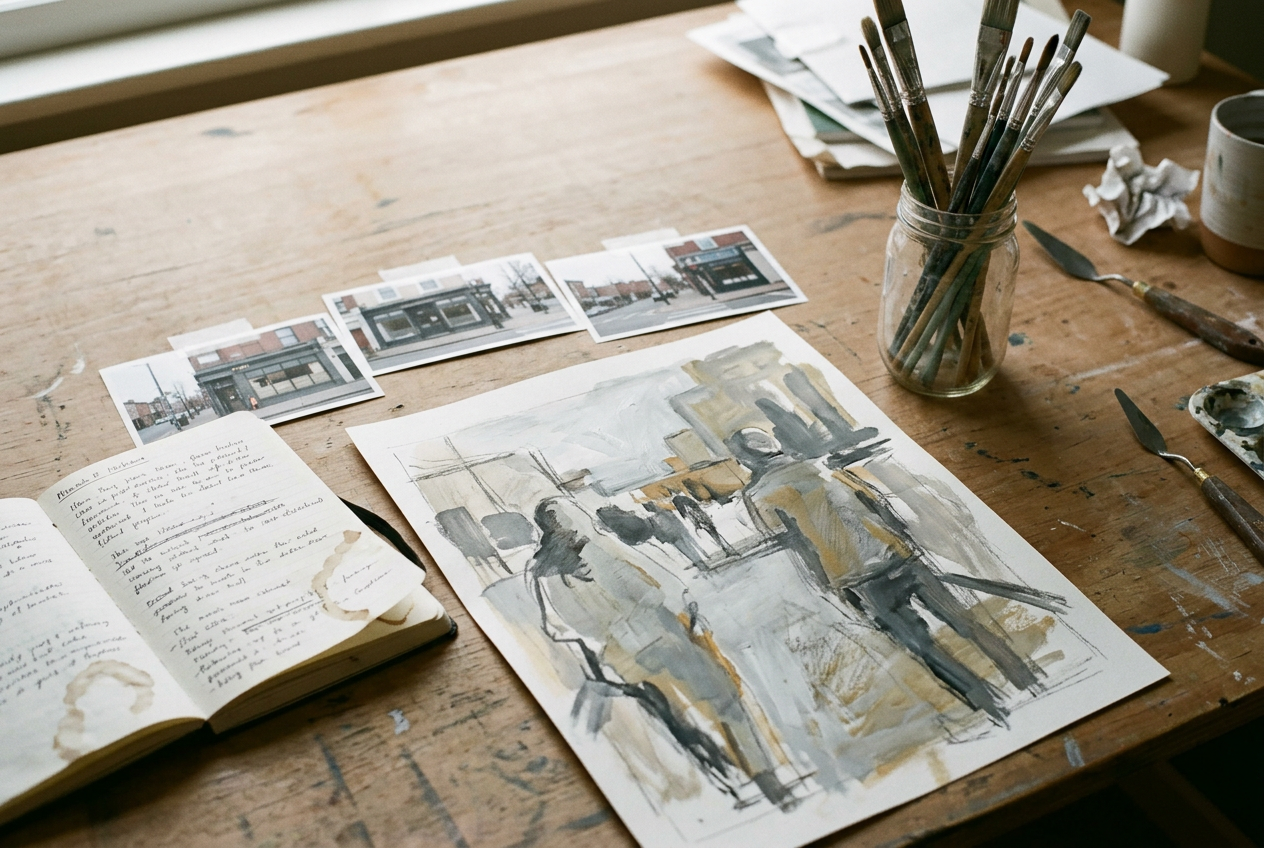
She placed the printout beside her sketchbook. Then she turned it over.
The illustrator had received machine-generated references before. Most carried the familiar errors: text that almost formed words, earrings merging into hair, fingers arranged according to local plausibility rather than a working hand. Clients used them to indicate mood or layout, much as they once sent screenshots, magazine clippings, or a rough drawing made in a slide deck.
This one was different because the image did not merely point toward a broad category. It pointed back at her.
She reopened the email and asked how the reference had been made. The answer arrived the next morning. The client had uploaded six images from her public portfolio to a generative image tool, entered a description of the kitchen scene, and selected one output from a larger batch. They had not intended to replace her.
In their view, they had prepared a clearer brief for the person they already wanted to hire.
That explanation made the situation kinder and stranger.
A reference-based image generator does not need to cut a shoulder line from one illustration and paste it into another. The uploaded images can be processed into numerical representations of visual features, including recurring shapes, color relationships, edges, and spatial patterns. During generation, the system starts with noise and repeatedly predicts what should be removed or changed so that the result moves closer to both the written prompt and the visual reference.
The result can reproduce a recognizable bundle of decisions without knowing they were decisions. It does not know that the illustrator leaves gaps in a contour to keep a drawing open at newspaper scale, or that she enlarged hands after an art director once told her small gestures disappeared on a phone. It can detect that these features recur together and produce another image in which they recur together.
Depending on the tool, an uploaded reference may guide a single generation without permanently retraining the underlying model. That distinction mattered to the illustrator. The printout did not prove that her work had been included in the system’s original training data, and it did not tell her whether other users could summon something similar by typing her name. What it showed was narrower: six ordinary portfolio files were enough to steer the tool toward an imitation that her client recognized as hers.
The failure in the woman’s hand was narrow too. The thumb had the curl, but its joint could not bend as drawn. Image generators are good at matching frequent arrangements of pixels and weaker at preserving structure across complicated forms, especially hands, tools, lettering, and overlapping limbs. The model had reproduced the sign of her shortcut while losing the practical reason she had developed it.
She laughed once when she noticed that. Then she stopped.
For the rest of the morning, the letter-size printout stayed face down beside her keyboard. She worked on another commission, a small drawing of two people carrying a table, but kept reopening the client thread. The deposit for the kitchen project would cover most of that month’s studio rent. Declining the job would make a clean point to a person who, as far as she could tell, had tried to hire her in good faith.
Accepting the reference without comment would mean tracing a machine’s compressed account of her own work.
There was also an awkward professional question beneath the obvious one. Clients had always brought references. Illustrators had always absorbed influences, sometimes with permission and sometimes carelessly. She had learned from printmakers whose books she owned, from classmates, and from years of looking at drawings pinned above shared desks.
Yet those influences had passed through memory and physical practice. This image had been generated by feeding her finished work directly into a system built to extract reusable visual features.
She picked up the printout again and marked it with pencil. The shoulder break got a small circle. So did the white gap beside the color. Around the thumb curl, she drew a box.
The marks were not evidence for a dispute; she was trying to locate the point at which recognition became discomfort.
By the end of the day, she had written a response. She did not accuse the client of theft, and she did not speculate about the generator’s training data. She explained that the output imitated identifiable features from the six uploaded illustrations, including an old drawing habit, and that using it as the target would ask her to reproduce a machine-made version of her portfolio.
She offered a narrower path. She would keep the composition problem in the brief, a person working at a counter with space for copy, but she wanted the generated image removed from the visual direction. Her first sketches would start from the campaign’s subject and dimensions rather than from the printout.
The reply took a day. The client agreed.
They had thought of the tool as a fast way to communicate with an illustrator, not as something that could turn the illustrator’s previous work into a new specimen. They removed the reference from the shared materials and kept the original $2,400 fee. No formal dispute followed. The illustrator did not ask them to delete every generated variation, partly because she did not know how many existed and partly because she wanted to finish the assignment.
Her first sketch had the same basic scene, but the figure stood sideways and rested one palm against the counter. She drew the hand twice. In the version she sent, the thumb joint worked, the fingers carried weight, and the old inward curl was gone.
The project did not make her reject generative tools. A month later, she used one to test whether a wide composition could hold a figure near the edge without leaving the center dead. She entered plain spatial instructions and did not upload another artist’s work. Most outputs were unusable.
One showed her that the empty area needed to be larger, an observation she carried into her own thumbnail sketches without copying the generated figure.
That use felt different to her, though she had trouble making the boundary universal. A composition can belong to a body of work as surely as a line can. A palette can become a signature. Even a client’s attempt to be helpful can place an artist in the odd position of being hired to authenticate an imitation of herself.
The letter-size printout remained in the studio for four months. She kept it inside the sketchbook she used for client notes, between the marked page with the thumb curl and the first kitchen sketch. Sometimes she showed it to other illustrators. More often she left it there.
Questions people ask
Can an
AI image generator copy an illustrator’s style from references?
A reference-based tool can extract recurring visual features from uploaded images and use them to guide a new output. In this story, six portfolio pieces were enough to reproduce the illustrator’s broken contours, spacing around color, exaggerated hands, and even an old shortcut in the way she drew a thumb.
Does a matching output prove the artist’s work trained the AI model?
No. A close match can result from images uploaded for that generation, from patterns learned during the model’s broader training, or from both. The printout showed that the client’s six references had guided the output, but it could not reveal what material had been used to build the underlying system.
Why do generated images imitate style but still get hands wrong?
Image generators learn statistical relationships among visual features rather than a human artist’s physical understanding of joints, grip, and weight. The tool reproduced the illustrator’s familiar thumb curl because it appeared in her references, yet it produced a hand that could not bend as shown.
What did the illustrator tell the client?
She described the specific features taken from her portfolio and said she would not use the generated image as the target. The client kept the $2,400 commission, removed the reference, and accepted a fresh sketch. The marked printout stayed inside her notebook for four months.
One story a day
The story of the day, in your inbox
One real story about AI each morning — no hype, no alarm, just company for the road.