
They Made 11 AI Reminders in Dad’s Voice, Then Deleted Them
Old recordings gave a family enough material to recreate their father’s voice. Hearing it say words he had never chosen changed what they were willing to keep.
August 9, 2026 · 7 min read
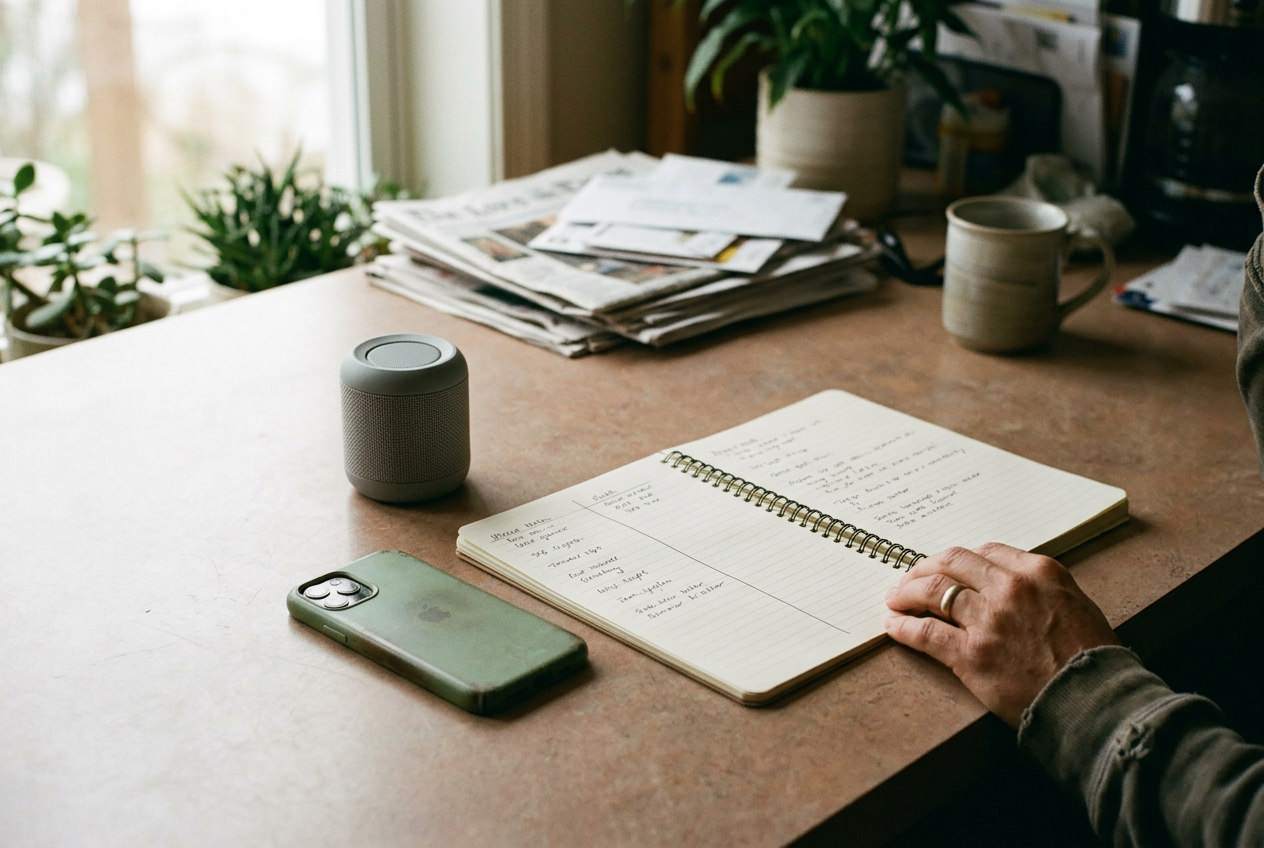
Mara kept a notebook beside the small speaker in her father’s kitchen. She had started it twenty-two months after his dementia diagnosis, when his speech had become less predictable and the family needed a way to remember what helped.
The entries were brief. A familiar song had settled him after lunch. A recorded message from his late wife had made him search the house. One afternoon he had followed a reminder to lock the side door, then checked it until Mara moved the speaker out of sight.
Her father, Paul, was seventy-eight. Some days he could tell a camping story with its old timing intact, pausing before the part his children knew was coming. On other days, a common noun would not arrive, and he would stop talking rather than accept the word someone offered.
For nine years, Paul had recorded stories for his grandchildren on his phone. He read picture books, described family trips and sometimes left practical messages about the house. Mara and her brother Daniel found 47 usable files, most under a few minutes, stored among photos and old voicemail exports.
The recordings made his earlier voice feel available at a point when conversation was asking more of him. Mara wondered whether that voice could deliver reminders without sounding like another instruction from a caregiver, and whether it could finish the stories Paul still tried to tell but could no longer hold together.
Daniel heard a different possibility. Their children might one day have new recordings of their grandfather reading stories he had never seen and describing memories he had not selected. The voice would be familiar. The authorship would not.
Mara tested a voice-generation platform before the family had settled the disagreement. She uploaded a six-minute sample and wrote 11 short scripts, including reminders about the side door and drinking water. Two were new versions of family stories, built from details Paul had repeated over the years.
She did not intend to deceive him. She thought a test would give them something concrete to consider, since arguments about a tool none of them had heard kept circling back to the same assumptions. Yet when the first file played, Paul’s pauses and softened consonants were there, while the sentence itself landed with a smoothness his speech had never possessed.
Mara recognized him and did not.
Daniel listened from the kitchen table. He had expected the voice to sound artificial enough that the family could dismiss it, but the resemblance was stronger than he wanted, which made the new words feel less acceptable rather than more. He asked Mara not to make any others until they had spoken with their sister and Paul’s regular caregiver.
That request hurt. Mara was handling most weekday appointments and the repeated calls that came when Paul could not find an object in front of him. She heard Daniel’s objection as judgment from someone who left after dinner, although she also knew he was naming a concern she had postponed because the prospect of a calmer morning had felt immediate.
The notebook sat between them. On a new page, Mara wrote down the 11 generated files and left space beside each one for what happened next.
They tried one reminder with Paul. It used his generated voice to say that the side door was locked and he was safe inside. He looked toward the hallway, then at the speaker. He identified the voice as his own, but he appeared troubled by not remembering the recording and asked more than once who had made it.
Mara stopped the file. She did not record the moment as success or failure. In the notebook, she wrote that he recognized himself, searched for the source and remained unsettled after the speaker was put away.
A week later, she played an original recording in which Paul told one of his camping stories. He joined in near the end. On another afternoon, the same recording irritated him because he wanted the speaker turned off before the story reached its familiar finish.
The family had hoped familiarity would be a stable quality they could build around. The notebook showed something narrower: a voice might comfort Paul in one setting and confuse him in another, while his response could depend on fatigue, the subject of the recording or a change none of them could identify.
Consent was harder to write down. Years earlier, Paul had sent recordings to his children without restrictions. He liked hearing the grandchildren replay them and had once discussed organizing the stories into a family archive. He had never discussed a tool that could produce new speech in his voice.
Mara tried to explain the idea to him during two conversations separated by several weeks. In one, he seemed pleased that the stories might continue. In the other, he focused on who had his phone and whether anything had been taken from it. Neither exchange gave the siblings an answer they felt able to carry into every later use.
Daniel did not believe the old recordings granted permission to generate new language. Mara did not believe Paul’s uncertainty erased the generous way he had shared his voice before. Their sister remained less certain, especially about stories for the grandchildren, which carried no immediate safety purpose but might outlast everyone’s memory of how they were made.
The platform introduced another problem. The uploaded sample included grandchildren’s names, and one file contained Paul’s late wife speaking in the background. Mara could remove the source files from the account dashboard, but she could not tell from the available information whether deleting them also removed every model or derived copy created during processing.
She contacted the support inbox and received a general explanation of account controls. It did not resolve the family’s concern about what remained after deletion. Daniel wanted all of the uploads removed. Mara agreed, partly because the uncertainty had changed the meaning of the experiment: the voice was no longer only a family artifact once it had been sent elsewhere for analysis.
They settled on a smaller arrangement. Current reminders came from Mara or Paul’s caregiver, using ordinary voices that could be changed when his routine changed. Seven original recordings stayed on the speaker for times when Paul wanted a story, and someone remained nearby to stop them if he became distressed.
No generated stories went to the grandchildren. The family kept the scripts in Mara’s notebook rather than as audio files, including one based on a fishing trip that Daniel remembered differently. The disagreement did not disappear. It moved into the margin, where Mara noted which details no one could confirm.
Fourteen months after she opened the notebook, its last completed page still separated original recordings from generated speech. Beside the 11 test files, Mara had written that all were deleted. Beside the seven recordings Paul had made himself, she continued adding brief notes about the days he asked to hear them.
Questions people ask
Can an
AI version of a familiar voice comfort a parent with dementia?
It sometimes may feel familiar, but this family did not find the response predictable. Paul joined in with an original story on one day and rejected it on another. The generated reminder unsettled him because he recognized the voice without remembering the words or the recording.
Can old recordings show that a parent consented to voice cloning?
Paul had willingly shared recordings with his family, but he had never discussed generating speech he did not record. His later responses varied, so his children could not treat one conversation as settled permission. They distinguished between replaying his chosen words and creating new ones in his voice.
What privacy concerns came up when the family uploaded the recordings?
The files held more than Paul’s voice. They included family names and another person speaking in the background, while the platform’s information did not give Mara confidence about deletion of derived material. The uncertainty contributed to the family’s decision to remove the uploads and generated files.
Did the voice reminders make daily care safer?
The generated reminder did not produce the calm response Mara hoped for, and stored instructions could become outdated as Paul’s care changed. The family used a living caregiver’s voice for current information and kept Paul’s seven original recordings for stories, each one tracked in the notebook.
One story a day
The story of the day, in your inbox
One real story about AI each morning — no hype, no alarm, just company for the road.