Their Package Camera Started Cataloging Every Visitor
The system helped residents track deliveries. Then its activity log began grouping guests, counting repeat visits, and tying those records to alerts tenants wanted to keep.
September 24, 2026 · 7 min read

Lena noticed the change in a 43-row activity log.
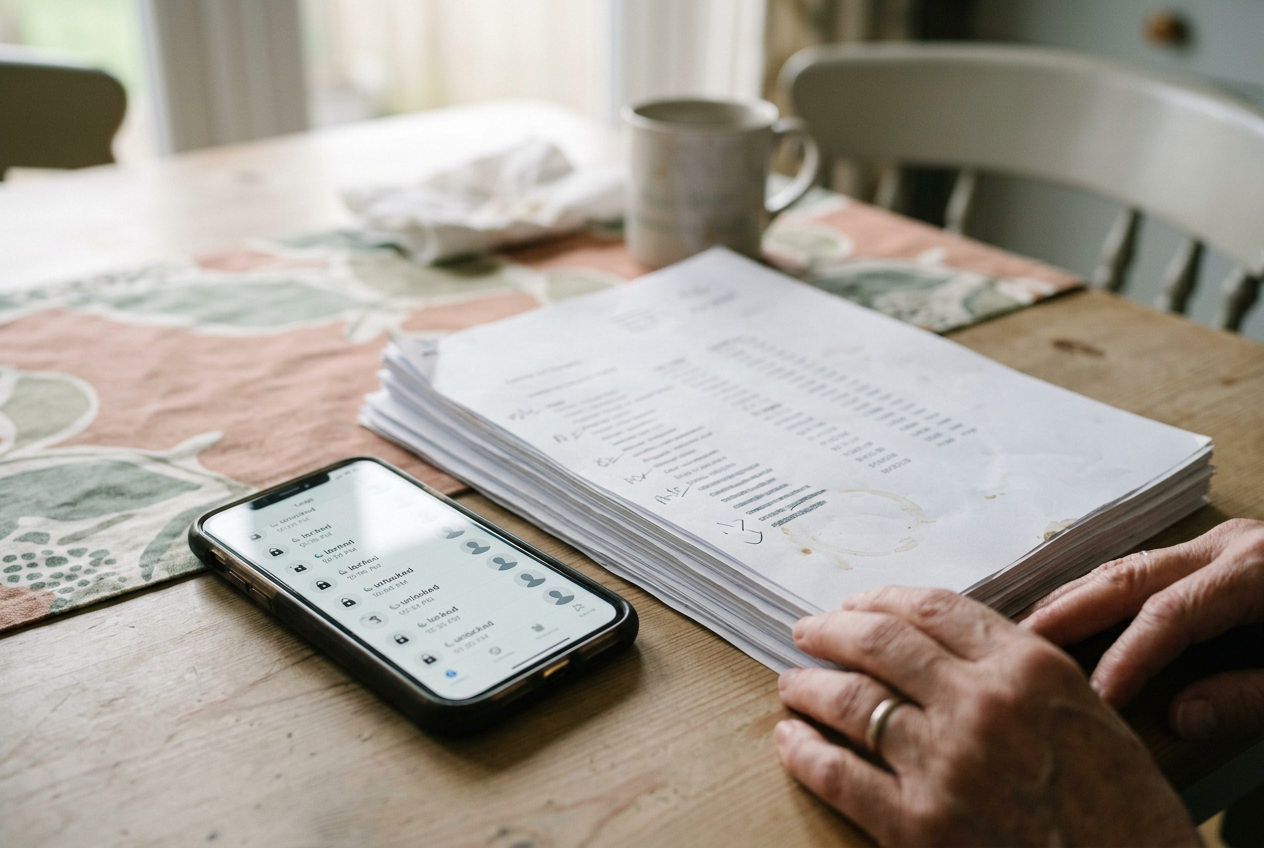
She had downloaded the log from the apartment building’s package app after a friend mentioned that the entrance camera seemed to recognize her. Each row contained a thumbnail, a broad description of the person in it, and a summary of what the system believed had happened. Some rows marked deliveries. Others grouped people as returning visitors and counted appearances across the previous 28 days.
The friend appeared six times.
The descriptions were ordinary: an adult carrying a tote bag, a person arriving with food, a returning visitor seen on weekday evenings. Taken separately, none disclosed much. Together, they described a relationship pattern that Lena had never chosen to record. Her friend usually stayed for dinner.
The log could not know that, but it could match an arrival with a later departure and calculate the interval between them.
The camera had been installed after residents reported $620 in missing packages over two months. Lena supported it. Delivery alerts meant she could collect a box soon after it arrived rather than finding it hours later near the building entrance. Once, a notification helped her locate groceries that had been left in the wrong part of the lobby.
For eleven months, that was how she understood the system: it watched packages.
The 43-row log showed that it watched people first.
How a package camera becomes a visitor tracker
A conventional motion camera can record video whenever pixels change. The system in Lena’s building did more. A detection model searched each frame for recognizable categories, including people and packages, then placed an internal boundary around each detected object.
Those detections became tracks. If a person moved through several frames, the software tried to determine that the shapes belonged to one individual rather than several different people. It could associate the person with an object, record the direction of travel, and note whether the object remained after the person left.
That sequence is useful for package alerts. A box-shaped object appearing near the entrance does not establish that a delivery occurred. The software gets a stronger signal when it sees a person approach while carrying the object, place it down, and leave without it.
The same machinery can produce a visitor history. Systems can convert visible features into a mathematical representation, often called an embedding, which places similar-looking images near one another in a numerical space. A later image can then be compared with earlier ones. The system does not need to know a person’s name to decide that the same person may have returned.
Some tools use faces for that comparison. Others combine the face with body shape, clothing, carried objects, and movement through the camera’s view. A fixed entrance makes matching easier because people tend to appear from the same angle and pass through the same narrow area.
Once repeated tracks are linked, pattern descriptions require little additional intelligence. The software already has timestamps and estimated matches. It can count appearances, sort them by part of the day, and pair likely arrivals with likely departures. A summary such as a frequent evening visitor is an inference built from those observations, not a fact the camera directly saw.
That distinction was absent from the 43-row log. Its compact descriptions looked settled, even where the underlying match was uncertain.
What the system got wrong
One row grouped Lena’s brother with another resident’s guest. Both had appeared in dark jackets and caps during the same week. The thumbnails were small, and one face was partly turned away, yet the dashboard treated the sightings as one returning person.
This failure has a technical reason. Similarity systems do not retrieve a hidden identity from an image. They calculate how close two representations are, then apply a threshold chosen by the operator or vendor. Lowering that threshold can catch more repeat visitors while also merging different people.
Raising it can reduce false matches while splitting one person into several records.
Camera conditions narrow what the model has to work with. Compression removes detail. Backlighting can flatten facial features, while a cap or hood hides information the model used in earlier images. When clothing contributes heavily to the match, two people dressed alike can appear more similar than one person photographed in different clothes.
The system made another mistake with Lena’s friend. On one visit, it classified her as a delivery person because she carried a handled paper bag and paused near the package area. The object and movement resembled examples associated with food delivery, though she was bringing dinner for herself.
That error reveals a limit of behavioral descriptions. The camera observes visible correlations, not intention or relationship. Carrying food toward an apartment entrance can belong to a worker, a resident, or a guest. If the training data or product rules favor one explanation, the interface may present that guess without showing the alternatives.
Lena marked the mistaken rows on the printout. The errors did not make the log feel harmless. A wrong record could still expose that someone had visited, while a correct record could reveal a routine neither person had agreed to share.
Why the opt-out also removed package alerts
Lena looked for a visitor-tracking control in the resident dashboard. The available setting was broader: disabling camera analysis also disabled delivery notifications. Muting summaries stopped some messages, but the system continued processing entrance activity and retaining events in the account history.
The support inbox confirmed the product had no resident-level setting that preserved package detection while excluding people associated with a delivery event. Building management could adjust retention and account access, but residents could not separate the functions themselves.
Part of that coupling came from the mechanism. The package feature depended on person detection to distinguish a delivery from an object that had already been sitting near the entrance. Removing every person-related calculation could weaken the package alerts residents had been promised.
The rest was a product decision. A system can use a person track briefly to detect an object drop without keeping a reusable visitor profile, generating appearance descriptions, or counting returns across weeks. Those later functions require additional processing and storage. They are not inevitable consequences of detecting a package.
The dashboard collapsed those choices into one permission. Lena could keep the alerts and accept the broader analysis, or disable the service attached to her resident account. She could not say yes to a delivery event and no to a guest history.
That mattered because the camera covered a shared entrance rather than a device inside her home. A guest could decline to enter, but there was no practical consent screen before the camera processed them. Other residents had different views. One neighbor liked the repeat-visitor summaries because an unfamiliar person had entered behind a resident and returned later that month.
Another turned off notifications but remained unsure whether doing so changed what the building could see.
Lena kept the package alerts.
She also began collecting deliveries sooner and meeting some friends outside, choices that reduced what appeared in the activity log without resolving who controlled it. Two months later, the dashboard still listed her friend as a recurring visitor, although one of the six sightings remained classified as a delivery.
The printout stayed in a kitchen drawer. Lena had circled the six rows and crossed out the one that belonged to her brother.
Questions people ask
Can a package camera identify a visitor without knowing their name?
Yes. A system can compare faces or other visible features and group images that appear to show the same person. It may assign an internal identifier rather than a name. That still allows the software to count visits, estimate arrival and departure patterns, and describe someone as returning frequently.
Why does turning off visitor tracking affect package alerts?
Some package alerts depend on detecting a person carrying and leaving an object, so the underlying features overlap. In Lena’s building, the product bundled that detection with longer-term visitor analysis. The same technical pipeline supported both, but retaining profiles and summarizing repeat visits were additional product choices.
Are visitor matches reliable?
They can be wrong even when the dashboard sounds confident. Similar clothing, partial faces, image compression, and fixed camera angles can push two people’s representations close enough to cross the system’s matching threshold. Lena’s 43-row log merged her brother with another guest and mistook a dinner visit for a delivery.
Does muting notifications stop the camera from analyzing visitors?
Not in the system Lena used. Muting changed which messages reached her, while event processing continued in the account history. After she silenced the visitor summaries, the dashboard still added a seventh thumbnail of her friend to the recurring-visitor record.
One story a day
The story of the day, in your inbox
One real story about AI each morning — no hype, no alarm, just company for the road.