Her AI Nursing Simulator Missed Symptoms on Dark Skin
She earned high scores treating virtual patients. In clinical training, a patient’s dark skin exposed what the adaptive simulator had taught her to overlook.
August 9, 2026 · 7 min read
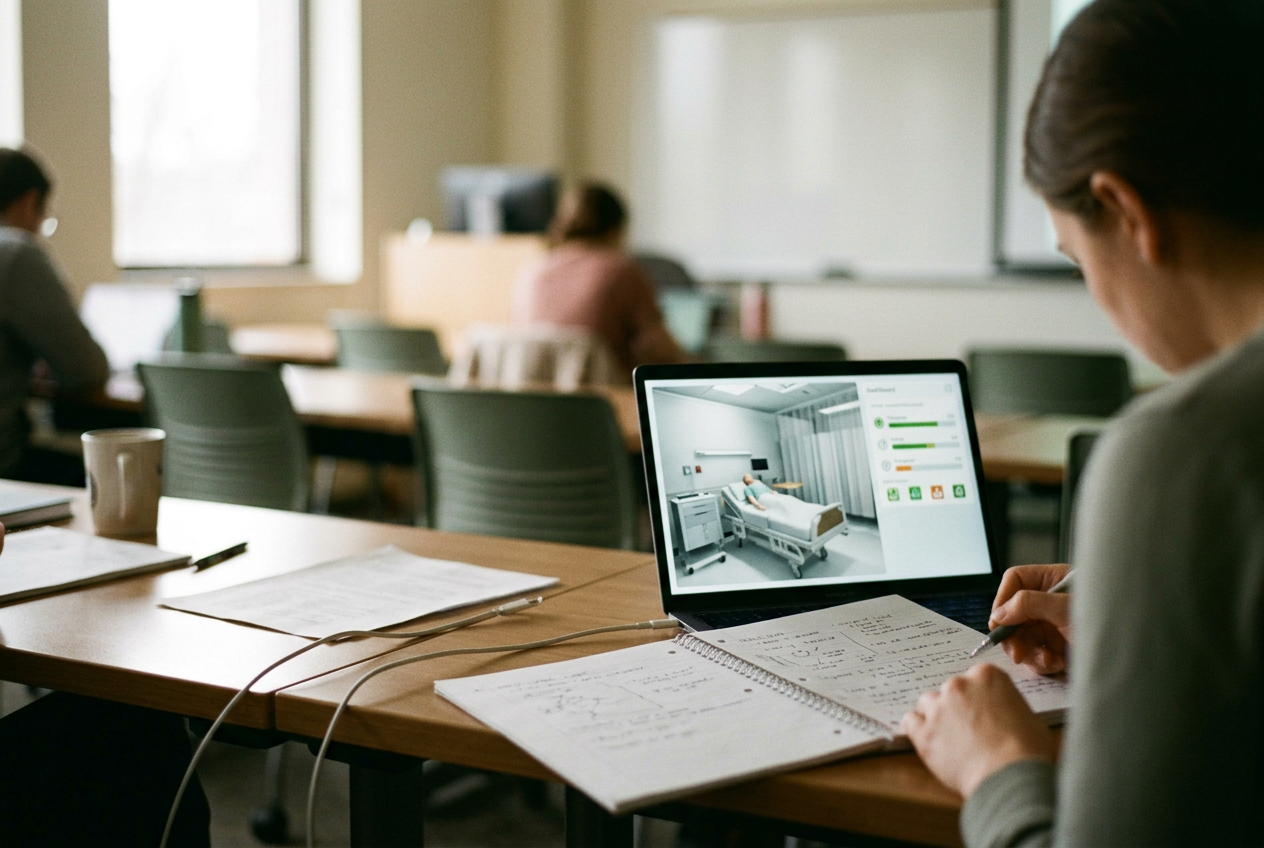
Nia kept a notebook beside her laptop during nursing school. Each virtual patient got a page divided into two columns: what the simulator showed, and what she did next.
The pages became a record of competence. A patient’s breathing changed; she checked oxygen levels. A pale face appeared on-screen; she reviewed circulation and chose an intervention. The software adjusted the patient’s condition after each decision, then placed a score on her dashboard.
By the end of the term, most of those scores sat above 90 percent.
The simulator was useful. Nia could repeat a scenario without asking a classmate to stay late, and she could make a poor choice without causing harm. At her desk, with dinner cooling nearby and the laptop fan running, she practiced until the order of decisions felt less like memorization and more like recognition.
Then she began clinical training.
During one shift, Nia helped care for a dark-skinned patient whose breathing had become more labored. The numbers on the monitor were changing, but the visual signs did not resemble the ones she knew from the screen. She looked at the patient’s face, paused, and waited for a color change that never arrived in the form she expected.
Her supervising nurse stepped in. The patient received attention, and Nia followed the rest of the encounter from close by, aware of the notebook in her bag and the scores she had trusted.
Later, she opened it to a page about low oxygen. Under what the simulator showed, she had written “blue lips.” The second column contained a clean sequence of actions. There was no note about how that sign might appear on dark skin, or where else a clinician might notice a change.
What the score had measured
The simulator did more than play a fixed video. Its adaptive system assembled a virtual patient from a scenario model, changed that patient’s condition in response to Nia’s choices, and estimated her mastery from ordinary signals: which assessment she selected, how long she paused, whether she changed course, and the order in which she acted.
Those estimates shaped what came next. Strong performance could move her toward a harder case, while a missed step might trigger another scenario built around the same skill. The dashboard reduced this history to a score and a few categories. That score mattered because instructors used it as one indication that students were prepared to move from rehearsal toward clinical practice.
The visual patient was part of the assessment. If the system displayed pallor, cyanosis, inflammation, or a rash in a way Nia recognized, she could identify the problem and earn credit for the next decision. Yet the software’s patient library contained far more examples in which those signs were rendered on light skin, and some darker-skinned avatars appeared to use nearly the same color effects placed over a different base tone.
That design choice did not merely make the pictures less inclusive. It changed what the system could validly infer. The software treated Nia’s correct response to one visual presentation as evidence that she had mastered the underlying clinical concept, then used that inference to select later cases and report readiness.
A spreadsheet could have recorded her answers. It could not have generated a patient whose appearance changed in response to her decisions, interpreted those decisions as mastery, and kept feeding that conclusion back into her training. The AI’s confidence became part of what Nia learned about herself.
She had performed well. She had also practiced inside a narrow visual world.
The classmates compare screens
The turn came during a study session with classmates. Their laptops were open around a classroom table, power cords crossing between notebooks and water bottles. Nia brought up the clinical encounter without identifying the patient. Another student said she had hesitated over a rash on a darker-skinned avatar because the discoloration looked faint.
Someone else remembered seeing dark skin mostly in routine cases, while urgent color changes appeared more often on lighter-skinned patients.
They began comparing their scenario histories.
Because the simulator adapted to each student, they had not all received the same sequence. One classmate had encountered repeated respiratory cases with light-skinned avatars. Another had seen a dark-skinned virtual patient, but the key sign had been delivered through a monitor value rather than the patient’s appearance. Nia’s own high-scoring cases often made the visual cue easy to separate from the background skin tone.
The pattern was incomplete. They could not inspect the model, count the full image library, or see how the platform weighted visual recognition against other actions. Their dashboards showed outcomes, not the reasoning behind them. Still, putting the screens side by side made something visible that no individual score revealed: the system’s version of variation was uneven, and its personalization kept students from knowing what other students had been shown.
Nia returned to her notebook. She added a mark beside every case in which skin appearance had influenced her decision, then wrote down the apparent skin tone of the virtual patient when she could remember it. Several pages remained blank because the detail had seemed irrelevant at the time.
That absence bothered her more than a low score would have. A low score names a gap, even if imperfectly. Her dashboard had converted repeated success under limited conditions into a statement about readiness, while the conditions themselves stayed out of view.
Relearning what counts as a sign
In later clinical sessions, Nia paid closer attention to how nurses described changes relative to a patient’s usual appearance. She watched them consider the lips and inside the mouth, the nail beds, palms, and conjunctiva depending on the symptom and the patient, rather than expecting one dramatic color shift to carry the whole judgment.
This did not make the simulator worthless. She still used it to practice prioritization and to see how a virtual patient responded after an intervention. The score became less persuasive. On late evenings, she would pause a scenario and ask what visual information had been made obvious, what had been moved into a numerical reading, and which body the program seemed to expect.
Her class raised the pattern with instructors. The response was practical but limited: faculty began pairing some virtual cases with clinical images and discussion of how signs can differ across skin tones. They also asked the platform’s support team for more information about the avatar library and scoring model. The answers described broad efforts to expand representation, without showing enough detail for the students to reconstruct how their own scores had been produced.
There was another concern in the dashboard. The simulator retained a detailed action log, including pauses, changed answers, and repeated attempts. Some exercises also allowed spoken interaction with a virtual patient. Nia had understood that her work would be graded; she had not known how long granular behavior might be kept, whether audio was stored, or whether those records could help train later versions of the system.
That uncertainty changed the study sessions. Students still compared scores, but they also compared what each person had consented to, or thought they had consented to, when the software opened at the start of the term. The same data that let the system personalize practice could expose hesitation during a sensitive professional assessment.
Nia’s notebook gained a third use. Beside the clinical signs and her decisions, she began noting what the software had observed about her.
Questions people ask
Why did the nursing simulator miss symptoms on dark skin?
The virtual patient library represented some visible signs more clearly and more often on lighter skin. Because the adaptive system treated correct responses to those images as evidence of mastery, it could report strong performance without testing whether a student recognized the same condition across a wider range of skin tones.
Was the student’s high score inaccurate?
The score reflected what she did inside the scenarios she received, so it was not fabricated. Its meaning was narrower than it appeared. The simulator measured her responses to selected cues, then generalized from them, while neither the dashboard nor the score showed which kinds of bodies had been underrepresented.
Can an adaptive simulator still help nursing students?
For Nia, it remained useful for repeating decisions and observing how a virtual condition changed after an intervention. She stopped treating the score as a complete statement of readiness, especially when visual recognition mattered, and her class used comparison and additional clinical material to expose gaps that personalized scenarios had kept separate.
What privacy data did the simulator collect?
It logged choices, pauses, changed answers, and repeat attempts so it could score performance and adapt later cases. Spoken exercises raised further questions about audio retention and reuse that the students could not settle from the dashboard. The last page of Nia’s notebook still has a blank column labeled “audio retained?”
One story a day
The story of the day, in your inbox
One real story about AI each morning — no hype, no alarm, just company for the road.