AI Wrote a Paramedic’s Reports. He Kept a Second Log.
The tool cut routine paperwork nearly in half. On harder calls, its polished mistakes pushed a rural paramedic to document each scene twice.
September 15, 2026 · 7 min read
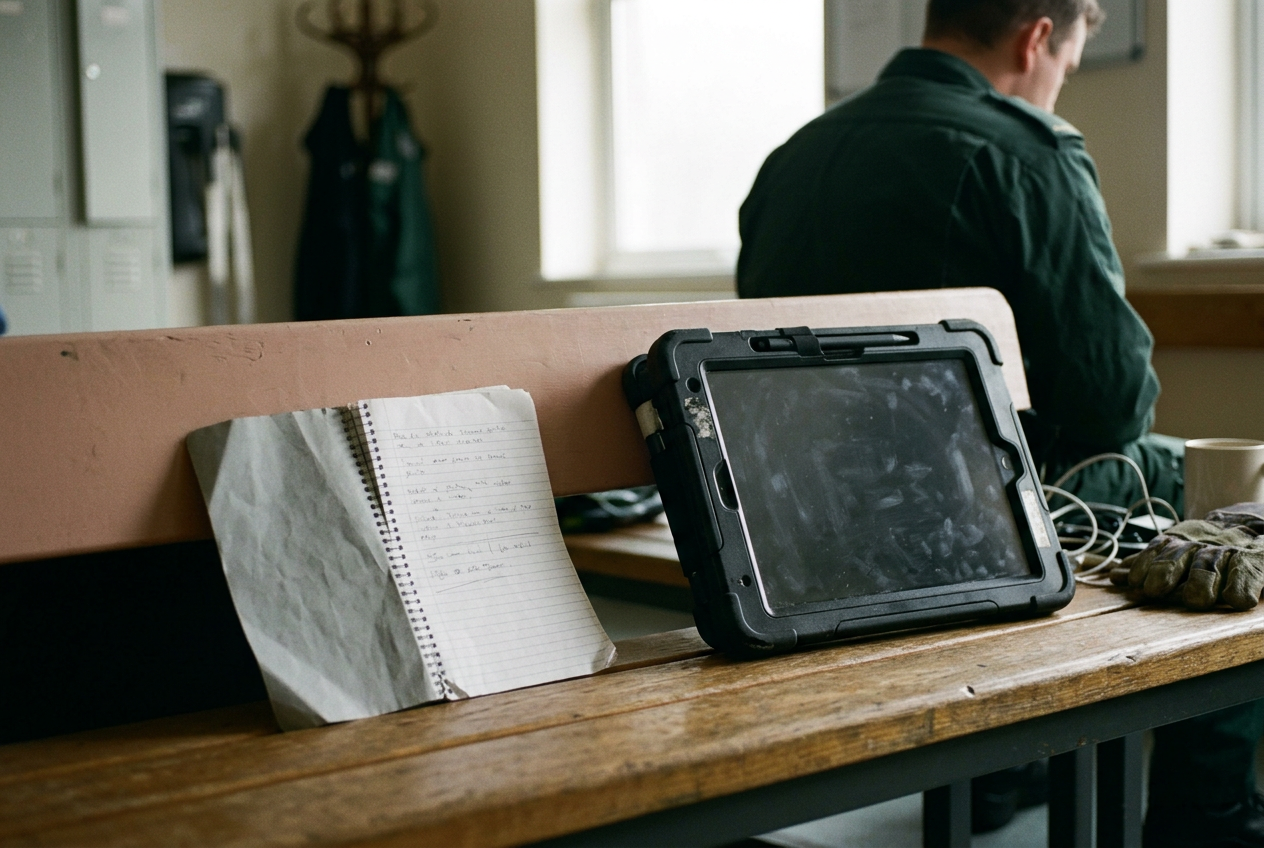
The notebook fits in a uniform pocket. It contains no patient names, but each entry has the month, the type of call and a few lines about what the automated report got wrong. There are 63 entries from seven months.
The paramedic has worked on an ambulance for 11 years in a rural county where a trip to the hospital can take 35 minutes. He writes a report after every patient encounter. The report becomes part of the medical record, and it may later be read by hospital staff, billing workers, supervisors or attorneys.
His ambulance service introduced an automated documentation tool in April 2024. A tablet microphone captured speech during the call. Speech-recognition software turned that audio into a transcript, then a language model arranged the transcript and data from the monitor into a clinical narrative.
The first results were good.
A routine fall at home used to leave him typing for about 24 minutes after the patient was transferred. During his first six weeks with the tool, he tracked 18 similar reports. His average fell to 13 minutes. The draft already had the patient’s main complaint and the broad sequence of care, so he could correct it instead of starting with an empty box.
That mattered near the end of a shift, when another call could arrive before the report was done. He finished more paperwork in the ambulance rather than carrying it into his next day off. For clear conversations in quiet rooms, the tool often produced a fair account.
“It writes clean,” he said. “That’s the trouble.”
What the clean draft concealed
The system did not preserve the encounter as a recording preserves sound. Its first layer selected likely words based on the audio and on patterns learned from other speech. Its next layer turned those selected words into the kind of ordered narrative commonly found in medical documentation.
A mistake in the transcript could therefore become more convincing in the report. If the speech-recognition layer picked a familiar word that sounded close to an unfamiliar medication, the writing layer supplied grammar around it. The finished paragraph rarely looked uncertain.
On one call, “metoprolol” became “metoclopramide.” Both are medications, but they are used for different reasons. On another, a patient said, “I ain’t took it since Sunday.” The transcript read, “I took it Sunday.
” The missing negative reversed the meaning.
The paramedic caught both errors while comparing the draft with his memory. He began paying more attention when patients spoke in a regional dialect or dropped the ends of words, because the tool had been less reliable with those voices than with his own practiced radio speech.
Medication names were hard for a different reason. Many are uncommon in everyday language and differ by a few sounds. A human listener can look at a pill bottle or ask the patient to repeat the name. The model receives audio, and when the sound is unclear, it still has to choose a likely string of words.
The harder failure appeared during a call in a farm outbuilding. The patient’s brother answered from nearby while the paramedic’s partner called out a blood pressure. Equipment was running outside. The patient was frightened and spoke in fragments.
The generated report attributed one of the brother’s answers to the patient. It also placed an intervention later than it occurred, apparently arranging the events into a typical clinical order rather than preserving their actual sequence. The draft sounded composed. The scene had not been.
Speaker separation and chronology are weak points in this kind of system because a microphone does not reliably identify who has authority to answer, and a generated summary may group statements by topic even when they were spoken minutes apart. A sentence about breathing can be moved beside another breathing-related sentence, although something important happened between them.
He rewrote most of that report. The job took longer than writing from scratch because he had to read every sentence against his memory, locate statements that belonged to the brother and rebuild the sequence without accidentally keeping the model’s version.
The notebook becomes a second report
He bought the notebook after that call.
At first, he used one line per mistake. He noted the phrase the patient had used and what appeared in the draft. After calls with several speakers, he wrote who said what and whether the generated narrative had changed the order.
The notebook was not an official medical record. That was part of its value to him and part of its risk. He kept it outside the agency’s documentation system, where an edited report could replace the draft on the screen, but the notes still described real encounters that patients might recognize from context.
He avoided names and addresses. Even so, a farm injury in a small county can identify a person without either one, and the paramedic understood that a private account of patient care could create a privacy problem of its own. He stored the notebook at home rather than leaving it in the ambulance.
Three months after he started the log, a supervisor reviewed a call in which the final report differed substantially from the automated draft. The system had placed oxygen after the patient was moved. The paramedic had changed the final report to show that oxygen came first.
His notebook contained the sequence he remembered, along with a note that the draft had combined his partner’s statement with his own. It did not settle every issue. It gave him a contemporaneous account when the polished machine version made his correction look like the unusual part.
That changed how he thought about the tool. On routine calls, it was a time saver. On noisy calls, it created a second task: he had to identify errors that were harder to notice because the sentences were fluent and used the expected clinical language.
The agency’s formal answer was that the paramedic remained responsible for the signed report. He agreed with that in principle. In practice, responsibility now meant checking whether the tool had changed a negative, assigned a statement to the wrong speaker or written an expected sequence instead of the sequence he saw.
A blank report announces that work remains. A finished paragraph does not.
The calls he records and the calls he does not
The microphone raised another problem. It picked up speech that would never have appeared in his report, including comments from relatives and conversations elsewhere in a house. The system needed enough audio to identify the clinical facts, but it could not know in advance which sounds would matter.
The ambulance service told workers that recordings were processed to create documentation. The paramedic could not see where each audio file went after upload or verify when it disappeared. He knew the official report would remain. He was less certain about the raw voices behind it.
He began muting the tool during encounters he considered too sensitive, then dictated a recap in the ambulance. That reduced the amount of private conversation captured, although it also removed the feature that saved him most time. A recap depends on memory, and the model still smooths whatever he says into a conventional report.
Nine months after the tool arrived, he continued using it. The routine gains were real. A clear call with one speaker could still leave him with a solid draft in less time than he needed to type one.
His notebook remained in use too. Some pages hold a single medication correction. Others contain half a page on who spoke and what happened first. He has considered stopping because the book creates its own exposure, but he has not trusted the official workflow enough to discard it.
The two records do different work. The generated report is built to be complete and readable. The notebook preserves the moments when readability changed the facts.
Questions people ask
How can AI write a paramedic’s patient report?
The tool in this story captured speech through a tablet, converted it into text and used a language model to arrange that text with monitor data. It could produce a structured narrative quickly, but it did not independently know which speaker was reliable or whether its chronology matched the scene.
Why did the system struggle with dialect and medication names?
Speech recognition chooses words from sound patterns and the language examples used to build it. Regional speech may be represented unevenly, while medication names can sound alike and appear less often in ordinary conversation. Once the writing model placed a mistaken word in a fluent sentence, the error became less visible.
Did keeping private notes create a patient privacy risk?
The paramedic believed it did. He left out names and addresses, but details about an uncommon rural call could still identify someone. The notebook gave him a separate account when an automated draft was wrong, while also placing patient-related information outside the official record system.
Does he still use the automated reporting tool?
Yes, on clear calls where one person is speaking and the draft is easy to check. He often mutes it during sensitive encounters or scenes with overlapping voices, then writes more of the report himself. On those calls, the notebook stays shut.
One story a day
The story of the day, in your inbox
One real story about AI each morning — no hype, no alarm, just company for the road.