
A Paramedic’s Report Tool Turned “Maybe” Into “Confirmed”
An experienced paramedic kept a notebook of generated reports that made uncertain observations sound final. Fixing them delayed the crew; leaving them could affect care and later reviews.
August 9, 2026 · 8 min read
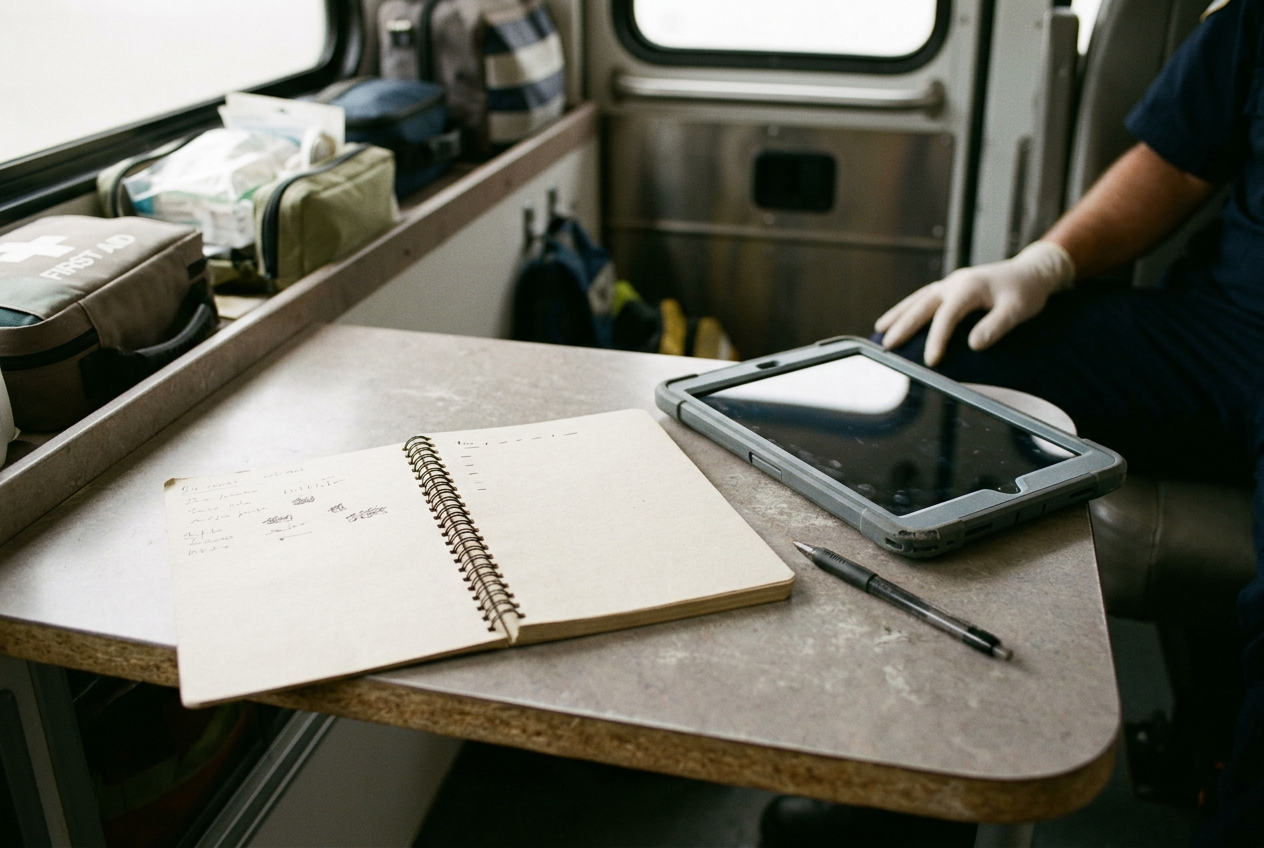
In April 2024, Renee began carrying a notebook in the side pocket of her work bag. She had been a paramedic for 18 years and did not usually keep private notes about software. This notebook contained no patient names, addresses or medical record details. Each page had two columns: what the crew knew and what the generated report said.
One early entry came from a call involving an adult who may have fallen in a kitchen. The patient could not remember hitting their head. A family member had heard a noise but had not seen the fall. Renee noted tenderness and no visible wound, then entered “possible head strike” in the reporting system.
The draft narrative said the patient had sustained a head strike.
She changed it back.
The difference was a few words, but it removed the uncertainty carried by the patient, the witness and the physical exam. The report would travel with the patient, remain in the agency’s record and potentially be read later by clinicians, billing staff, quality reviewers, insurers or attorneys. Renee’s name would appear as the person who completed it.
The notebook grew from there.
The tool completed the thought
The reporting tool had been introduced five months earlier. It assembled a narrative from checkboxes, vital signs, short typed observations and dictated notes. Its drafts were orderly and fast to read. They also had a habit Renee came to recognize: where the source material left room for doubt, the generated sentence often selected one conclusion.
An odor that could have been alcohol became alcohol intoxication. A patient who could not recall the name of a medication became a patient who was not taking it. A witness who reported shaking movements produced a narrative describing a seizure, though the crew had not seen the episode and several explanations remained possible.
None of those lines had to remain. The paramedic signing the report could edit them, and the agency reminded crews that they were responsible for the final record. That answer was clear on responsibility but less useful during a shift, because the crew still had to locate each strengthened claim inside paragraphs that otherwise looked complete.
Renee had always reviewed reports. The new task was different. She compared the narrative with the boxes, then compared both with what she remembered hearing in the home, on the sidewalk or beside the stretcher, searching for a change in certainty rather than a misspelled medication or an incorrect number.
During six weeks, she marked 24 reports in the notebook. Nine contained at least one sentence that sounded more certain than her source note. It was not a formal audit, and she did not treat the fraction as a rate. She was trying to establish that the pattern existed outside her memory.
On the notebook’s ninth page, “possible allergic reaction” appeared in the left column. “Allergic reaction” appeared in the right.
The correction had a work cost
Before the tool arrived, Renee often finished most of a narrative while her partner prepared the ambulance for the next call. With generated drafts, the first version appeared sooner, but review took longer whenever the language had outrun the evidence. A difficult report could add about ten minutes after the patient had been transferred.
Ten minutes did not stay attached to one document. It could delay the crew’s return to service, move charting toward the end of the shift or leave Renee reconstructing a patient’s phrasing after another emergency had filled her attention, and the pressure increased on busy days because the report looked finished even while she knew it was not ready to sign.
She tried shorter dictation. She tried typing full sentences instead of fragments. The tool still resolved some tentative phrases into declarations. Writing “patient reports possible fainting” did not guarantee that “possible” survived in the narrative.
Renee raised the pattern with her supervisor and shared examples without copying patient details into ordinary email. She was told to keep reviewing and correcting the output while the concern went through the agency’s software process. That preserved the formal expectation already placed on her. It did not return the minutes.
Three months later, an update changed parts of the report layout. The notebook continued.
The work problem was easy to see from the ambulance: more editing, later clearance and another point where fatigue could enter the record. The safety problem appeared farther downstream, where Renee had less control.
A sentence did not stay in one chart
During an internal review of a call, Renee saw one of the generated phrases repeated in later documentation. Her original field observation had described a patient as “appearing confused,” a limited statement made during a noisy scene. The generated narrative described altered mental status. Later notes used the stronger phrase without explaining where it began.
That did not prove the wording had changed treatment. It showed that the sentence had traveled.
Medical records depend on earlier records, especially when a patient cannot provide a full history. A definitive statement can become the starting point for the next person, while the uncertainty behind it disappears. The same language may carry weight in a complaint, a coverage dispute, a workplace injury review or a lawsuit long after the crew has forgotten the call.
Renee was less worried about an obviously absurd sentence, which a reviewer would catch, than a plausible sentence that crossed one small line. “Possible intoxication” and “intoxicated” fit in the same paragraph. They do not document the same observation, and the stronger version can affect how later readers understand a patient’s speech, consent or account of an injury.
The tool also sometimes produced a denial where the source material only showed that a symptom had not been documented. If the draft said a patient denied chest pain, Renee wanted to know that someone had asked and received an answer. An unchecked box was not enough.
That distinction became another line in the notebook: “not reported” on one side, “denied” on the other.
The privacy answer stayed broad
The records already contained sensitive information because emergency medical care requires it. The generated narrative added another set of practical concerns for Renee. She wanted to understand which parts of a chart were processed to create the text, how long any intermediate data remained available and who outside the agency could access it while maintaining the system.
The explanations she received described general safeguards and authorized use. They did not give her enough detail to map the route of a dictated sentence from the ambulance to the finished report, and she could not tell from the screen whether the tool used only the current chart or whether corrected language influenced later drafts.
She changed what she could control. The notebook held patterns, not cases. She omitted names, locations, ages and unusual details that could point back to a patient. Even so, the effort created an odd division in her work: the official system contained the full medical record, while the paper notebook contained the evidence she needed to describe what the official system was doing.
Privacy was not separate from accuracy. If a patient disclosed something sensitive and tentative, a stronger generated sentence could expose more than the patient had said. Removing the sentence later might correct the signed report, but Renee had no view into what happened to the draft before she edited it.
The agency did not stop using the tool during the period represented in the composite account. Renee did not stop using it either. It was part of the required reporting system, and refusing the draft did not remove her obligation to complete the chart.
She became faster at spotting its habits. Words such as “confirmed,” “denied” and “caused by” drew her attention. So did neat explanations for messy scenes. Experience helped, though it also made the conflict sharper: the tool saved keystrokes by finishing a thought, while her training required her to leave some thoughts unfinished.
Near the back of the notebook, one entry concerns a patient found after an unwitnessed episode. The source note says “possible seizure.” The generated line says “seizure.” Renee drew a vertical mark between them and returned to the report.
Questions people ask
Can a generated emergency medical report affect later care?
It can become part of the information later readers use. In Renee’s experience, one stronger phrase appeared again in subsequent documentation, without the uncertainty in her original observation. The story does not establish that treatment changed, but it shows how generated wording can move beyond the first report.
Who is responsible for errors in a generated paramedic report?
Renee’s agency treated the clinician who signed the report as responsible for the final text, even when the system drafted it. Responsibility and legal standards vary by workplace and jurisdiction. This composite account describes her experience and is not professional or legal advice.
What privacy issue did the paramedic identify?
Renee could not see how dictated material and draft text moved through the system, how long intermediate data remained available or which outside workers could access it. She kept her own tally without patient identifiers because the examples still involved sensitive medical encounters.
Did reporting the problem make the tool stop adding certainty?
Not during the period covered here. Renee shared examples, continued reviewing every draft and saw a later layout update, but the language pattern remained. Her notebook stayed in her work bag, with “possible seizure” on one side of the last marked line and “seizure” on the other.
One story a day
The story of the day, in your inbox
One real story about AI each morning — no hype, no alarm, just company for the road.