AI Mangled 186 Lines. A Deaf Troupe Rebuilt the Captions.
A small Deaf theater troupe wanted faster live captions. After the software spoiled jokes and rushed quiet scenes, performers gave a human operator the final call.
August 9, 2026 · 7 min read
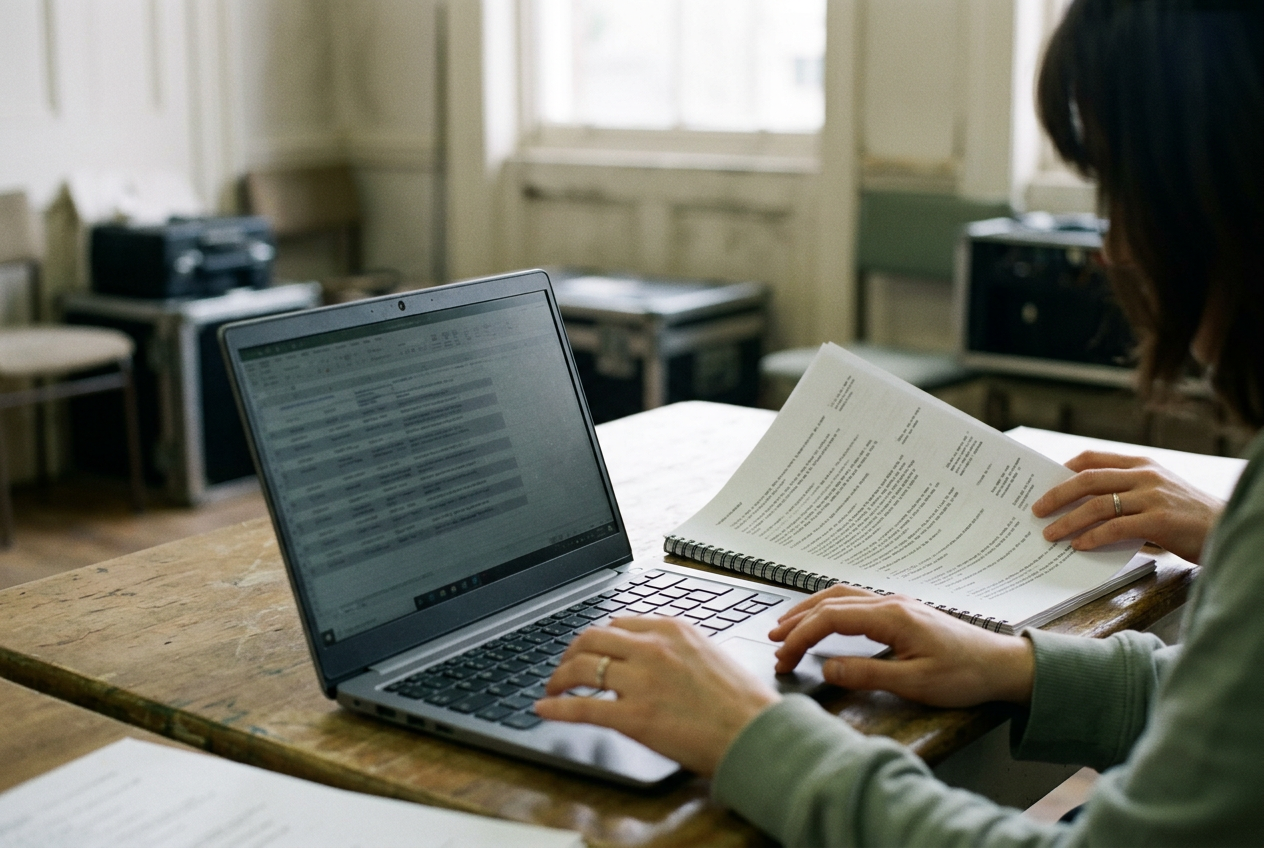
The first bad laugh arrived during a rehearsal in a community theater, with folding chairs pushed back from the stage and a laptop feeding captions to the projection screen.
An actor signed the name of her character’s aunt. A voice performer spoke the line for audience members who did not understand American Sign Language, and the captioning tool listened to that voice. On the screen, the aunt’s name became “antenna.”
Several people laughed. The actor stopped.
The laugh she had worked for was coming later, after a look toward the kitchen table and a small turn of the wrist. Now the room had spent it on a transcription error. The director walked to a rehearsal table, opened a spreadsheet called the caption log, and added another entry beside the text the audience had seen.
By then, the spreadsheet held 43 problems. After nine weeks of rehearsals, it would hold 186.
Each entry paired the projected wording with the intended line and a short note about what had changed onstage. Names were common. So were phrases delivered by voice performers who had to follow the timing and emphasis of actors signing several feet away, which meant the captioning tool was processing speech that was already an interpretation of a performance.
The troupe had expected mistakes. Its members had not expected those mistakes to become scene partners.
The first projection
The production was a comedy about relatives preparing for a city hearing. Most of the dialogue was signed, while spoken interpretation and open captions made the show available to people with different language and access needs. The captions would remain visible to everyone rather than appearing only on personal devices.
For a small troupe, automated captioning appeared to solve a practical problem. A trained human captioner cost money the production had little of, especially across rehearsals and performances, while the tool could listen continuously and put text on the screen with little delay.
During an early run, that speed felt useful. An actor missed a planned entrance and another performer improvised a line to cover the gap. The software caught most of it. The projected words were rough, but the audience could follow the exchange without waiting for someone to locate the new language in a prepared script.
Then the scripted scenes resumed.
A character named DeShawn became “the shore.” A line about a permit became a line about a pyramid. When two performers overlapped in an argument, the captions combined their words into a sentence neither character had said.
The caption log grew after every rehearsal. Performers gathered around the laptop, sometimes still holding props, and debated whether an entry counted as an error or merely an awkward rendering. That distinction mattered. A sentence could carry the basic information while removing the character’s impatience, or it could replace a specific name with a common noun and make a family relationship harder to understand.
The director first treated the spreadsheet as a repair list. Pronunciations could be adjusted. The voice performers could speak more clearly. Certain words could be added to the tool’s vocabulary.
Yet the actors began to resist the implication that their timing should become easier for software to process, particularly when a clipped delivery or an interruption had been chosen to reveal irritation between characters.
One performer started watching the projection instead of her scene partner. She wanted to know whether her line had survived. Her eyes moved above the audience after each spoken interpretation, and another actor noticed, then began waiting for her attention to return before continuing.
Their argument scene slowed down.
The technology had entered the relationship between them, not through a dramatic failure but through repeated glances at a screen.
Keeping the pause
The hardest entry in the caption log contained no mistaken word.
Near the end of the show, a daughter signs that she has completed the paperwork her mother kept avoiding. The mother looks down, folds the document, and waits before answering. During that pause, the voice performer is silent.
The captioning tool had already received the next scripted line during a test, because the voice performer came in early while trying to keep the captions moving. The response appeared before the mother lifted her hands. Audience members could read her decision while the actor was still deciding it.
At the rehearsal table, the actor objected to calling this a timing problem. The pause was part of the line. It held the mother’s embarrassment and the daughter’s uncertainty, neither of which appeared in the projected text.
The troupe tried inserting a written stage direction, but that also told the audience what to notice. They tried delaying the voice performance, though the automated system sometimes filled the silence with stray sound from the room. A chair moving could produce a word. Laughter occasionally became a fragment of speech.
The spreadsheet entry stayed open for more than a month.
Meanwhile, the caption operator, who had initially been asked to monitor the system and restart it after failures, was making judgment calls from the side of the stage. She muted nonsense. She corrected character names before they reached the projection. During improvised moments, she let the machine’s draft through when it was readable and held it when the words would distort the scene.
Her work was becoming part of the performance, although the production had not yet acknowledged it.
The director changed the setup. Prepared captions for the scripted dialogue were loaded into the laptop, and the operator advanced them while watching the actors rather than following a fixed pace. Automated transcription remained available in a preview window for missed lines, audience interaction, and departures from the script. Nothing reached the main screen without a person choosing it.
This arrangement was slower to build. It also changed rehearsals, because the operator needed to learn where an actor’s pause might expand and where a joke depended on the text arriving before a facial reaction. Performers began directing some questions toward her instead of discussing captions as a technical layer that would be added later.
The caption log changed too. Beside the error descriptions, the director added notes about performance choices. The “antenna” entry led to a prepared caption for the aunt’s name. The unfinished entry about the mother’s pause became an instruction to hold the next caption until the actor lowered her hand.
Rehearsing with another person
At first, some company members found the operator’s presence unsettling. She could alter what a hearing audience read, and for actors whose signed dialogue passed through a voice performer before becoming text, that authority felt substantial.
A disagreement surfaced over a joke that depended on a character using the wrong formal word at a public hearing. The automated tool kept correcting the mistake, which made the character sound more polished than the actor intended. The operator could preserve the wrong word, but only if she understood that it was deliberate.
They rehearsed the exchange repeatedly. The actor adjusted the setup so the written line could be read without forcing him to stretch the pause beyond what felt natural. The operator learned to release the mistake intact. The next laugh came where the company expected it.
That success did not settle every concern. The captions still represented signed performances through written English, and some choices that were clear in ASL became flatter on the screen. The troupe discussed whether a caption could be accurate while remaining incomplete. No setting on the laptop answered that.
During the final rehearsals, the director stopped counting every minor difference. The caption log remained at 186 entries, even though new variations appeared. The company used it less as evidence against the tool and more as a record of moments when language, timing, and character had pulled apart.
On the first public run, the operator sat beside the stage with the script and laptop. The automated preview moved quickly during an unplanned audience reaction, then stumbled over a character’s name. She replaced it before sending the caption to the projection.
Later, the aunt’s name appeared correctly. The actor waited, turned her wrist, and delivered the joke that had been lost during the first test. The laugh arrived after the line.
Questions people ask
Can automated captions handle a live theater performance?
They handled improvised speech quickly in this production, but scripted names and overlapping dialogue produced repeated errors. The troupe found that speed alone did not preserve comic timing or emotional intent, especially when the software heard spoken interpretations of signed performances rather than the actors’ voices directly.
Why did the troupe keep using AI after logging 186 problems?
The automated preview remained useful when performers departed from the script or responded to the audience. Instead of sending every result to the projection, the production placed the tool behind a human decision, where its quick draft could help without becoming the final text by default.
What did the human caption operator change?
She corrected names, blocked stray text, and decided when prepared captions should appear. Her larger contribution came from rehearsing with the performers, which let her recognize intentional mistakes and hold text through pauses rather than treating every silence as a delay to overcome.
How did captions affect the actors’ performances?
Early on, one actor watched the screen to check whether her dialogue had survived, weakening her attention to her scene partner. After the operator joined rehearsals, performers could return their focus to each other. During the mother’s final pause, the screen stayed empty until the actor lowered her hand.
One story a day
The story of the day, in your inbox
One real story about AI each morning — no hype, no alarm, just company for the road.