AI Erased Her Wheelchair. The Failed Images Funded Rehearsal
A dance instructor needed images for a funding pitch. When AI kept removing her wheelchair, she printed 24 failures and made the case for a paid live rehearsal.
November 9, 2026 · 7 min read
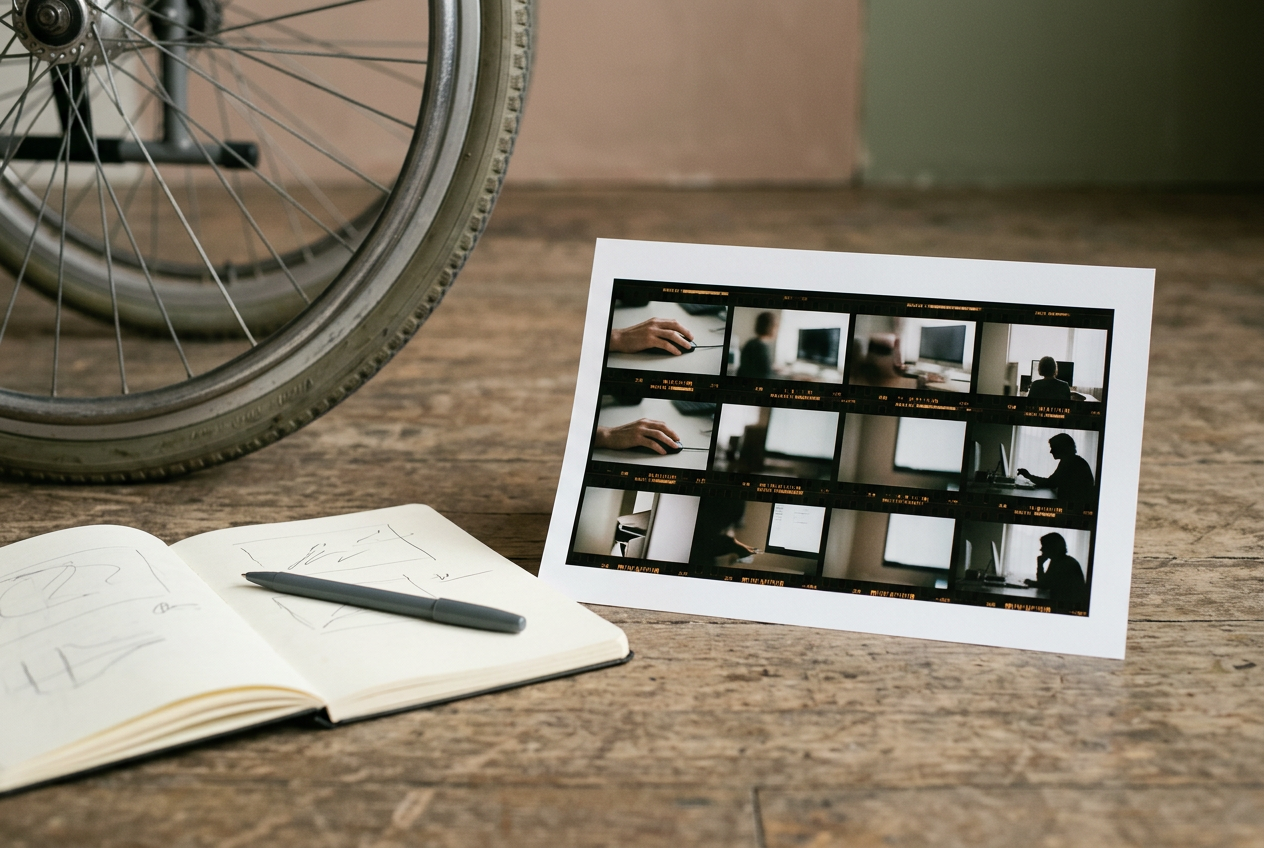
The contact sheet held 24 versions of a dance that did not exist.
The instructor had printed it at a copy shop after six weeks of trying to make pitch images for a new performance. In some frames, the dancer stood beside an empty wheelchair. In others, the chair had become a stool, a cart or a piece of stage scenery. Several images removed it altogether while keeping the dancer’s hands curved around air.
She circled each failure in pen.
The project was a duet built around weight transfer. One dancer used a manual wheelchair, while the other moved between the floor and the chair’s push handles with permission. Their choreography depended on the chair’s wheels, brakes and changing center of gravity. It was not a seated version of a standing dance.
Remove the chair and the duet lost its structure.
The instructor understood why funders wanted a visual. She was seeking $8,200 for studio rental, dancer pay and technical development, and the application portal encouraged applicants to show what an audience might see. Her rehearsal footage came from a phone balanced against a water bottle. The studio wall showed an exit sign and a stack of mats.
Nobody looked lit for a stage.
A colleague suggested generating concept images. The instructor had used image tools for mood boards before, mostly to test lighting angles and costume contrast. They were quick, and sometimes useful. At her desk after teaching, she uploaded a rehearsal still, added a text description of the duet and selected a feature that promised to preserve the photographed pose.
The first result gave both dancers standing legs.
She tried again.
The chair becomes scenery
The generator’s pose feature did not see the photograph the way a choreographer did. It converted visible joints into a simplified map of shoulders, elbows, wrists, hips, knees and ankles. That map could guide the approximate placement of a body, but the wheelchair was not a joint. Its frame, wheels and contact points belonged to the surrounding image, where the model had more freedom to invent.
Text instructions were supposed to supply the missing context. Yet an image generator does not assemble a wheelchair from an understanding of propulsion, balance or how a dancer’s palm meets a push rim. It predicts visual patterns from examples in its training data, then produces an image that fits those patterns. If wheelchair users appear less often in dance imagery, or appear more often in medical, sports or caregiving scenes, the model has fewer relevant patterns to draw from.
That showed up on the contact sheet. One result gave the dancer a narrow chair with no usable wheels. Another attached a wheel to the dancer’s hip. A third kept the large rear wheels but placed the seat behind the body, which would make the pose physically impossible.
The images were polished enough to pass during a quick scroll. They failed under a dancer’s hand.
The instructor adjusted the wording, adding details about seated balance and a manual chair used as part of the choreography. She uploaded a cleaner rehearsal image. She masked the chair so the generator would retain more of it, but the tool filled parts of the mask with fabric and stage equipment. When it preserved the wheels, it often straightened the dancer’s torso and changed the choreography into a passive seated pose.
After 24 attempts, she stopped.
The contact sheet cost $6.40 to print. That figure stayed in her notebook beside the larger production budget, partly because she tracked every project expense and partly because the smallness of it annoyed her. For less than lunch, she had acquired a neat record of how readily a machine could make her work easier to picture by making it someone else’s work.
A preview that lies
There was a relationship problem inside the technical one. The other dancer had agreed to let a rehearsal still guide the images, but neither performer had agreed to become a corrected body, and the instructor felt the difference each time the generator lengthened a leg or replaced a hand.
At the next rehearsal, she spread the contact sheet on the floor. The dancers looked at it from their actual positions: one in her chair, one sitting nearby with a knee raised. They laughed at an image in which the wheel had become a round table. The laugh did not settle the matter.
The wheelchair dancer pointed to the frames where the chair remained but her posture changed. Those bothered her more than the obvious disappearances. A missing chair could be named. A plausible seated figure might persuade a funder that the image represented the choreography, even though the model had removed the forward tilt that made the movement active and had placed both hands quietly in the dancer’s lap.
The instructor had started with a practical goal: make the unfinished piece legible to people who controlled money. Now the preview was doing something more consequential than decorating an application. It was proposing which version of the dancer looked believable.
She considered leaving generated images out and submitting the phone video. That would protect the choreography, though it might also confirm the familiar assumption that an early disability-led project was less visually developed. She considered commissioning an illustrator, but the budget did not include one. The application was due in two weeks.
Instead, she changed what the contact sheet meant.
She placed four generated images in the pitch deck beside stills from rehearsal. Short captions identified the physical error in each image: a missing wheel, a body placed outside the chair’s support, hands detached from propulsion. She did not present this as proof that image generation never works. She had used the same tool to test a low side light and kept that idea.
The failure was narrower and harder to shrug off. The system could render a convincing stage, but it could not reliably preserve the equipment and body relationship on which this dance depended.
Her request changed too. Rather than asking funders to trust a synthetic picture of the finished performance, she asked them to pay for two studio sessions where reviewers could see the movement in development.
What the funders saw
During the pitch conversation, the contact sheet sat near the front edge of the table. One reviewer picked it up before they watched the rehearsal clip. The instructor explained the pose map and its missing chair information, then showed how the generator repeatedly filled that gap with visual patterns it considered more likely.
The explanation took less space than the dance.
What mattered was the side-by-side evidence. In the real rehearsal still, the dancer’s left hand pressed the wheel while her torso moved forward and her partner counterbalanced through the chair’s frame. In the generated version, both dancers looked composed, but the working hand had moved to a lap and the partner held the back of an office chair. It was attractive.
It described a different event.
The funders did not approve the full $8,200 request. They offered $1,800 for the two paid studio sessions, with a later funding decision after an open rehearsal. That left the instructor with another budget gap and no guarantee. It also paid the dancers for showing the work in the medium where it could be judged without first translating their bodies into a model’s preferred arrangement.
At the first funded session, tape marked the performance area and a portable speaker sat against the wall. The wheelchair dancer repeated one passage while the instructor watched the angle of her partner’s grip. A reviewer sat nearby with the printed contact sheet on their knees.
The generator still had a place in the project. The instructor used it for rough lighting references, where a false hand or broken wheel did not determine the movement. She no longer used it to demonstrate bodies. That boundary was practical rather than pure, and it could shift if the tools changed.
She kept all 24 images.
Questions people ask
Why did the image generator keep removing the wheelchair?
The pose feature tracked body joints but did not encode the wheelchair as part of the dancer’s physical structure. The generator had to reconstruct it from text and learned image patterns, which made substitution likely when relevant wheelchair-dance examples were limited or outweighed by more common standing and seated poses.
Can an
AI image look convincing while getting a pose physically wrong?
Yes. Image generators optimize for visual plausibility, not for whether a person could balance, propel a chair or complete the pictured movement. In this story, smooth lighting and believable costumes hid missing wheels, unusable hand positions and a body placed outside the chair’s support.
Did the instructor stop using generated images?
No. She kept using the tool for rough lighting concepts, where errors in anatomy did not define the choreography. She stopped treating generated bodies as previews of the dance, because reviewers could mistake a polished invention for an accurate representation of the performers’ movement.
What did the funders accept instead of an AI preview?
They funded two live studio sessions for $1,800 and postponed the larger decision until after an open rehearsal. The instructor brought the generated contact sheet anyway, leaving it beside the sign-in page with every missing or altered chair circled in pen.
One story a day
The story of the day, in your inbox
One real story about AI each morning — no hype, no alarm, just company for the road.