
AI Notes Erased Her Anatomy Diagrams. She Scored 62%.
The summaries looked complete until an anatomy practical exposed what was missing. The tool had captured spoken facts while discarding the visual relationships that made them useful.
October 28, 2026 · 7 min read
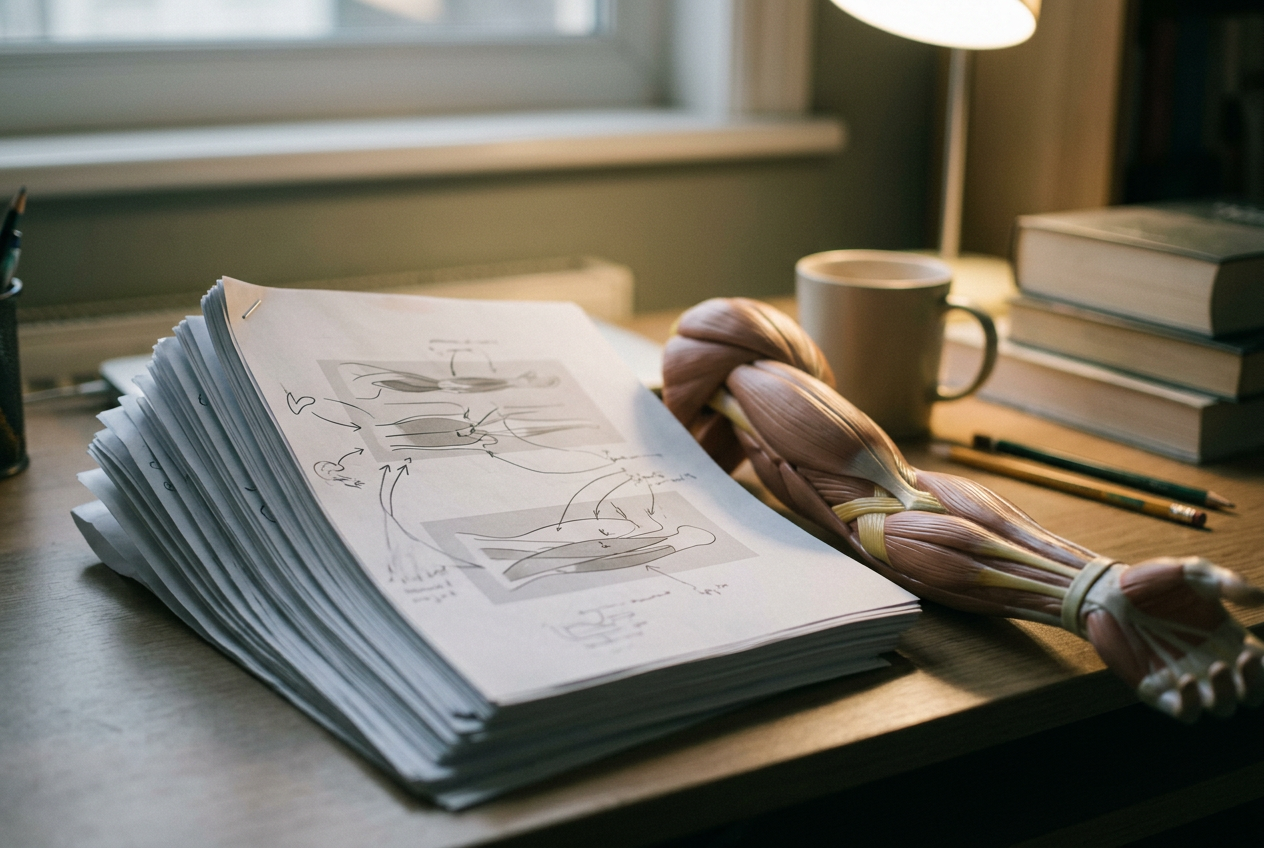
The packet was 27 pages, printed and clipped at one corner. Nia set it beside a plastic arm model at her apartment desk, where a mug held pens and a desk lamp lit the radius, ulna and rows of tidy bullet points.
She had relied on the college’s AI note-taking tool for six weeks. It listened through the classroom microphone, converted speech to text and produced a structured summary after each lecture. Headings arrived in bold. Definitions sat beneath them.
Repeated phrases were compressed, verbal detours disappeared, and the professor’s closing review became a short study list.
For Nia, a college junior with an auditory processing disorder, that cleanup mattered. Following a lecture while taking notes could leave her with half a sentence on the page and no memory of the sentence that came next. The tool gave her something stable to revisit. In a lecture built around terminology, it was often good.
Anatomy was different.
The professor spent much of class at a projection screen or beside a model, tracing the route of a nerve with one finger. She would describe a structure while pointing to where it passed under a muscle, then rotate the image and show what changed from another view. Her spoken language leaned on the room: this branch, that opening, the vessel beside it, the layer underneath.
The AI summary kept the nouns. It lost the pointing.
On the 27-page packet, the brachial plexus became a clean hierarchy of roots and branches. The page did not show which branch crossed behind another structure or where the network divided. A section on the shoulder named the muscles involved in rotation, but the curved arrows from the lecture slide were gone. The summary looked finished enough that Nia did not initially recognize it as incomplete.
She studied from it anyway.
At the first practical, she moved among models and specimen images while answering questions about relationships in space. She knew many of the names. She could not consistently place them. Her score was 62 percent.
Back at the apartment, she opened the packet beside the graded screen and began marking every question she had missed. Eleven depended on a visual relationship that had appeared in class but not in the generated notes. She drew arrows in the margins, first from memory and later from the textbook, until several pages became more ink than print.
The system heard one lecture and produced another
The tool was described around campus as an AI note taker, a label broad enough to hide several separate operations. Automatic speech recognition converted sound into text. A language model then reorganized that transcript, grouping related statements and reducing repetition. The output was not a verbatim record.
It was newly generated prose based on the record.
That distinction explained some of the packet’s polish. If the professor corrected herself, the summary often retained only the corrected version. If she returned to a definition after a long example, the system could place the definition and example together. Nia liked this.
She still does.
The problem sat at the edge of the system’s input. The version used in her classroom received audio and text extracted from uploaded slides. It did not interpret the diagrams as diagrams. Labels embedded as readable text might appear in the transcript or summary, but lines, orientation and relative position did not become part of the model’s account.
A slide could therefore contribute the words median nerve and brachial artery while withholding the fact that one traveled beside the other. To a text summarizer, both terms had been captured. To an anatomy student, the relationship was the point.
Deictic language made the gap wider. Words such as here, this and below depend on a shared field of view. A human note taker watching the professor can connect the word this to a highlighted tendon. An audio-first system receives the word without the gesture, then may omit it as unhelpful during summarization.
The resulting sentence can sound more complete than the evidence behind it.
Nia tested this against the lecture recording. During one section, the professor had spent several minutes drawing a pathway and revising it while explaining which structures passed through an opening. The generated notes reduced that passage to two factual bullets. Neither bullet was false.
Neither could reconstruct the drawing.
That was the unsettling part. The tool had not hallucinated an extra bone or swapped two muscles. Its summary was accurate at the sentence level and inadequate at the lesson level, a quieter failure that survived because the prose was orderly.
A packet becomes evidence
Nia brought the 27-page packet to the college accessibility office. By then, sticky tabs marked the pages where the lecture had depended on a diagram. She also brought two of her older notes from a psychology class, where the same tool had turned dense spoken explanations into summaries she could review without replaying an entire recording.
She was not asking the college to abandon it. That complicated the conversation in a useful way.
The initial response treated the issue as one of transcript accuracy. Staff asked whether terminology had been misspelled or speakers had been misidentified. Those were familiar defects, and the platform offered ways to correct words. Nia kept returning to the pages with hand-drawn arrows.
The missing information had never entered the text pipeline, so editing the transcript could not restore it.
Her argument was narrow: transcription gave her access to spoken language, but the course taught through spoken language joined to visual relationships. Providing one channel in a polished format did not make the other channel available.
A faculty member reviewed a lecture summary beside the original slides. On one page, the extracted slide text listed several anatomical structures in reading order, which placed labels from opposite sides of a diagram next to one another. The summary then grouped them into a plausible paragraph. Nothing in that paragraph preserved where the labels had been located.
The review changed the college’s use of the tool for Nia’s course. For the rest of the semester, she received the generated summary along with the slide deck and a set of instructor annotations for diagrams used heavily in class. She could also access the lecture recording when a gesture or model demonstration carried information the notes missed.
It was a workable bundle, though hardly frictionless. The AI summary still reduced the amount of audio she had to process, and on text-heavy days she used it almost by itself. On diagram-heavy days, she treated it as an index that told her which section of the slides or recording to reopen.
That changed her studying. Instead of assuming the packet contained the lecture, she checked it against the visual material, a new task created by the same system that had been assigned to reduce her note-taking load. The tool saved attention in one place and demanded inspection in another.
Her next practical score rose to 81 percent. She did not credit the increase to one fix. She had spent more time with models, met with a classmate and redrawn difficult pathways in a notebook. The packet remained on her desk, now useful in a more limited way.
Near the end of the semester, Nia opened a later summary and found a passage on the vessels of the lower leg. The names were there. So were the professor’s definitions. She turned to the matching slide, saw two routes separated by a line the system had never recorded, and added the line to the margin herself.
Questions people ask
Why can an AI lecture summary miss diagrams?
Many note-taking systems begin with audio transcription and then use a language model to generate an outline or summary. If the system does not receive visual information, or extracts only text from slides, it cannot preserve arrows, placement and spatial relationships even when its written summary sounds confident.
Is an AI summary the same as a transcript?
Usually not. A transcript attempts to represent what was said, while a generated summary selects, rearranges and compresses that text. In Nia’s packet, the compression removed repeated explanations and dangling words such as this or here, which made the notes cleaner while further separating them from the professor’s gestures.
Did the
AI note-taking tool still help the student?
Yes. It reduced the strain of processing speech and produced useful notes in classes where meaning was carried mainly through words. Nia kept using it in anatomy, but as one part of a larger set of materials rather than as a replacement for slides, recordings and annotated diagrams.
What showed that transcription did not provide full access?
Nia compared the generated notes with the original slides and lecture recording, then marked missed exam items that depended on visual relationships. The strongest evidence was ordinary: the 27-page packet named the relevant structures, while its margins held the arrows and routes she had to add by hand.
One story a day
The story of the day, in your inbox
One real story about AI each morning — no hype, no alarm, just company for the road.