
A Safety Badge Logged Her Bathroom Breaks as Idle Time
The warehouse badge arrived as protective equipment. Six weeks later, a report connected one worker’s restroom location to minutes marked idle.
August 9, 2026 · 8 min read
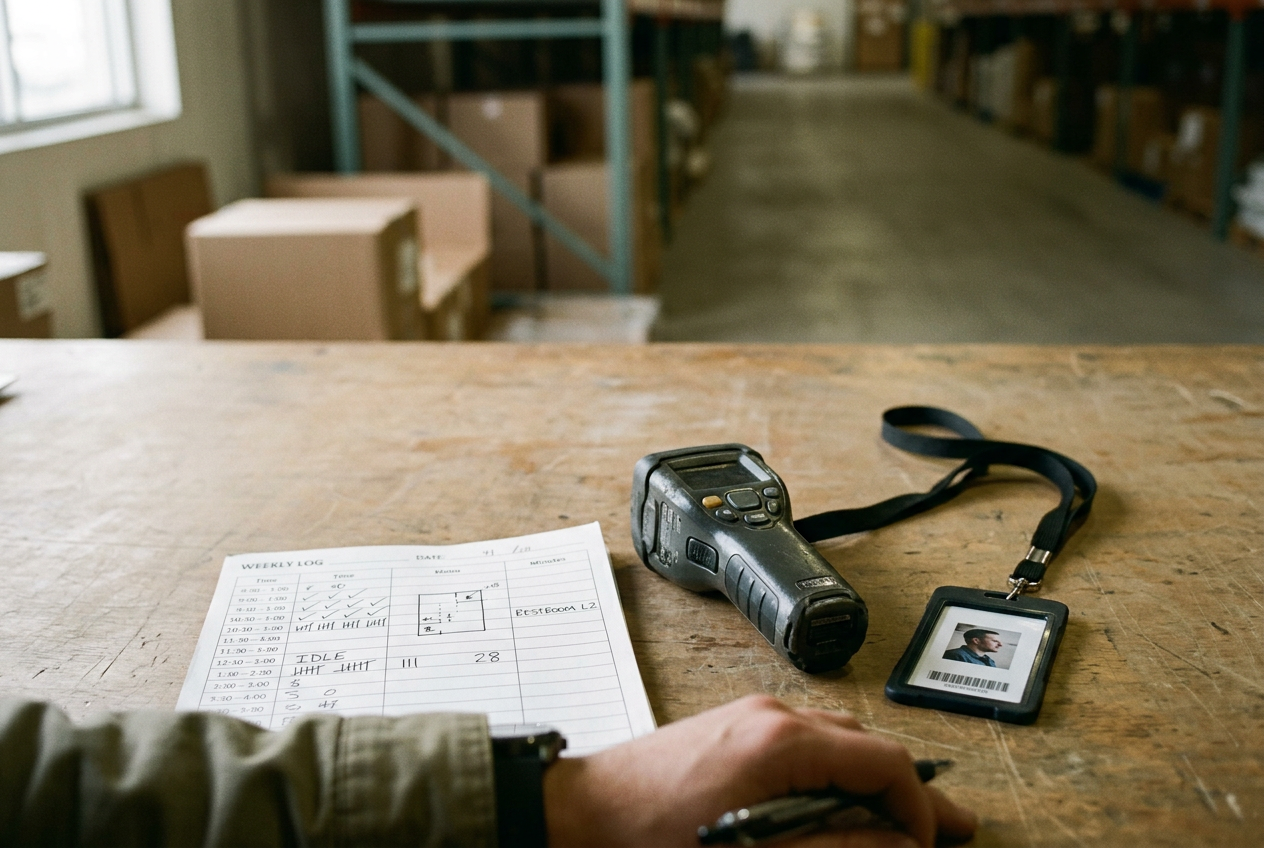
The badge arrived in October 2023, after warehouse managers announced a new safety program. Workers were told to attach it to their vests and keep it charged. It could alert them when moving equipment came close, and supervisors could use its location signal during an evacuation.
The worker at the center of this composite story made $21.40 an hour handling inventory. She had spent fourteen months in the building and understood the risks around loaded carts and forklifts. A warning she could feel against her vest sounded useful.
She signed an acknowledgment that the badge was required equipment. The explanation focused on collision alerts and emergency response. She does not remember receiving a plain account of how long location records would be kept, who could review them, or whether a period without a scan would be labeled as idle time.
At first, the badge changed little. It vibrated near moving equipment. A charging rack stood near the area where workers collected scanners. She treated the badge like the other required gear she picked up before a shift.
Six weeks later, her manager placed a weekly report in front of her.
The report is the hard artifact in this account. The worker kept a photograph of it. It covered five shifts and paired sections of the warehouse with blocks of time that the system considered inactive. One line connected eleven minutes near the restroom area with nine minutes marked idle.
The manager wanted to discuss gaps between recorded tasks. The worker looked at the restroom line. She had not left the building or stopped working without permission. She had used the bathroom, washed her hands, and returned to inventory.
Until that meeting, she had not known that the safety badge could produce a location history for a performance conversation.
What the report could show
A location badge does not need to record audio or identify what a person is doing to reveal a bathroom break. Fixed receivers can detect where the badge is within a building, then associate those location events with the worker assigned to it. A separate system can compare that record with activity from a handheld scanner.
The source material for this story does not establish the badge’s reporting interval or the full formula behind the idle calculation. It also does not show whether the scanner and badge systems were joined directly or combined later in a management dashboard. Those details remain unknown.
What is known is narrower. The weekly report placed a restroom location beside an idle-time figure, both tied to the same worker, and her manager used that document while discussing productivity.
That distinction matters because a missing scan is not the same as an absence of work. Warehouse tasks include walking between storage areas, waiting for equipment to clear a path, dealing with damaged packaging, and speaking with a supervisor. The worker’s hands could be occupied even when her scanner produced no new event.
The report did not explain any of that. It reduced the interval to a location and a number.
She asked whether bathroom time was supposed to count against her. Her manager said the report was one source of information and that workers were not evaluated from a single line. The worker was also told that the badge remained mandatory because it was part of the safety program.
Nothing on the weekly report separated the collision-warning function from the productivity function. Both depended on the same object clipped to her vest.
The break began to change
During the next month, she started planning bathroom visits around completed scanner tasks. If she felt she could wait until after another item was recorded, she waited. Once inside the restroom, she moved faster because she pictured the weekly report adding minutes while her scanner remained quiet.
She also drank less during the first part of a shift. The warehouse could become warm during physical work, but she began returning with water left in her bottle rather than risk another restroom visit. She did not report a medical injury. She did describe headaches and a growing concentration on the badge, which was supposed to help her pay attention to hazards around her.
The safety feature still worked. It vibrated near moving equipment as designed. That made her reluctant to describe the badge as useless, even though the report had changed how she treated basic needs.
Other workers began comparing what appeared in their coaching conversations. The accounts were uneven. Some had seen idle totals without location details. Others had not been shown a report at all.
The worker could not tell whether managers followed a common rule or opened different views depending on the employee.
Her own evidence remained the photograph of the weekly report. When she enlarged it on her phone, the restroom line was readable, but the page contained no explanation of how the nine idle minutes had been calculated. There was no visible indication that the system had excluded a permitted break.
She raised the issue again through the company’s ordinary employee channel. Her concern was not that the badge knew where she was during an emergency. It was that the same location data had entered a productivity discussion without a new explanation or a meaningful chance to object.
The response she received described the badge as a safety requirement and said operational information could be reviewed by management. It did not tell her how long location histories were retained. It did not identify every role with access to them.
Four months after the badge rollout, a broader notice appeared in the company’s internal system. It said data from workplace tools could support safety and operations. The notice did not arrive as a fresh request for agreement, and the worker saw no control that would allow the safety warning to remain active while withholding location data from productivity reports.
That is the shift at the center of her experience. The hardware did not need to change. A tool already attached to her body produced information for a second purpose, while the original safety explanation continued to justify why she had to wear it.
Consent without a new choice
Workplace consent is constrained when refusing a tool can mean refusing required equipment. The worker could remove the badge, but doing so would violate the warehouse rule and disable the collision alert. She could keep wearing it, which meant continuing to generate the location record used in the weekly report.
This story cannot establish whether the company’s internal policies legally permitted that use. It also cannot show whether every manager interpreted the data the same way. The reader submission documents the worker’s experience, not the company’s complete system or legal position.
The consent problem was practical. She had acknowledged a protective device after hearing about hazards and evacuations. She had not understood that a restroom visit could later appear beside idle minutes in a performance conversation, and no clear moment marked the expansion from safety monitoring to worker evaluation.
Over the following three months, she shortened most bathroom breaks. She stopped bringing the weekly report up with her manager because the badge was still required and the earlier response had not changed how its data was used. Her productivity discussions moved on to other weeks.
The report did not.
She kept its photograph on her phone. The image showed five shifts, a total for inactivity, and the line she returned to whenever she wondered whether she had misunderstood the meeting: restroom area, eleven minutes present, nine minutes idle.
Questions people ask
Can a warehouse safety badge track bathroom breaks?
It can reveal a bathroom visit if its location system identifies the restroom area and links that location to an assigned worker. In this story, the weekly report did both. The available evidence does not show whether the system identified activity inside the restroom or only the badge’s presence near that zone.
Is idle time proof that a worker was not working?
No. Here, idle time appeared to reflect a period without recorded task activity, but the company did not give the worker the calculation behind it. Walking, waiting for equipment, handling a problem without scanning, or taking a permitted break can all create gaps in digital activity without proving that someone abandoned work.
Did the worker agree to productivity monitoring?
She acknowledged a required badge after the company presented it as safety equipment. She did not recall a separate explanation that location records would be paired with idle time for performance discussions. A later internal notice referred broadly to operational uses, but it did not create a new choice about wearing the badge.
What changed after the bathroom break appeared on the report?
She shortened later breaks and began leaving water in her bottle to reduce the chance of another restroom interval drawing attention. The badge remained clipped to her vest for safety, while the photograph of the weekly report stayed on her phone with the nine idle minutes beside the restroom location.
One story a day
The story of the day, in your inbox
One real story about AI each morning — no hype, no alarm, just company for the road.