A Chemistry Student’s AI Camera Changed Green to Blue
A low-vision student used an image assistant to read color changes in chemistry lab. When one sample received different descriptions, his accommodation became part of the experiment.
November 4, 2026 · 7 min read
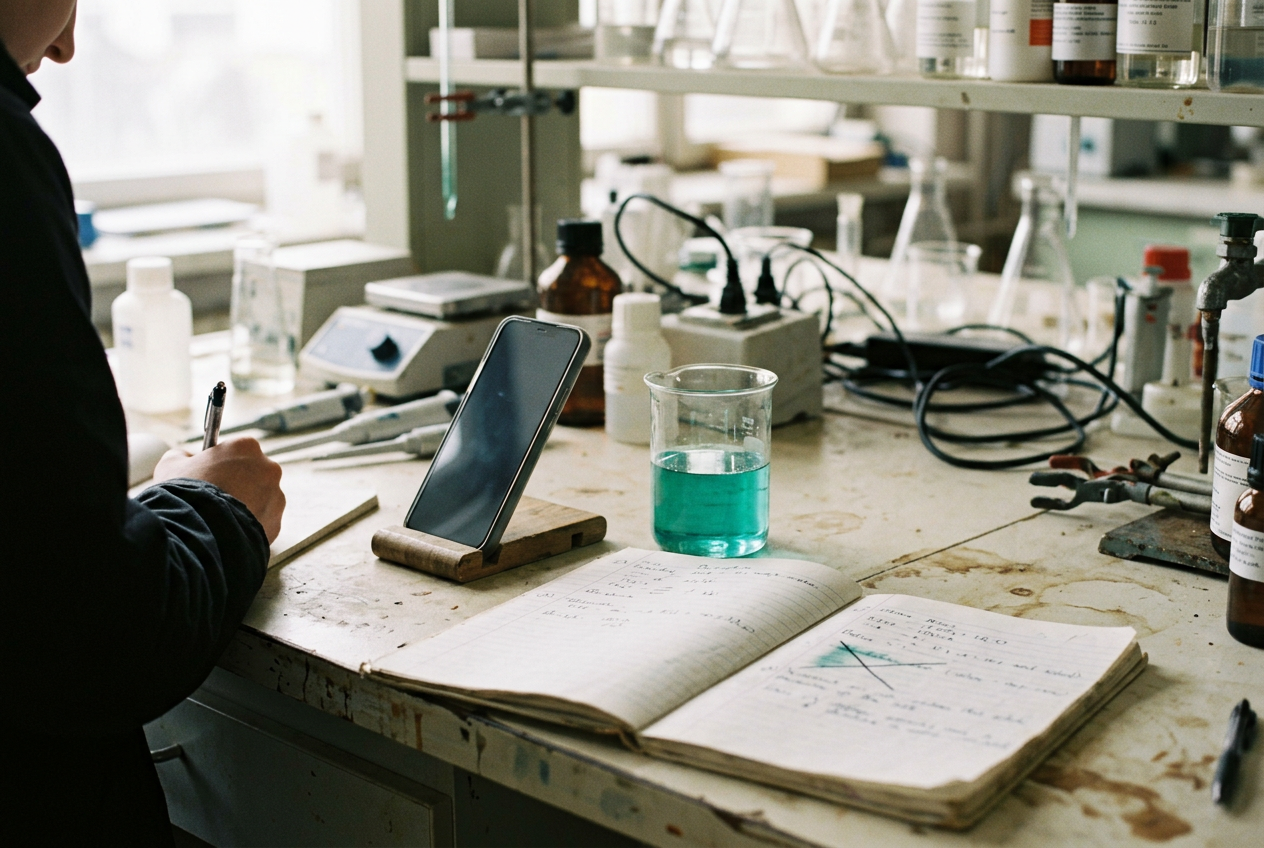
The uncertain result remains in a lab notebook. In one row, beside a sample that should have shifted from blue toward green, the student wrote blue-green, crossed it out, wrote green, then added a question mark.
He had made the marks during a college chemistry lab, with his phone propped beside the notebook and a line of glass containers on the bench. The assignment concerned chemical equilibrium: change the conditions around a dissolved copper compound, observe the solution’s color, and use that observation to explain which form of the compound had become more prevalent.
For most students, the color was evidence. For this student, whom I’ll call Andre, color was also an access problem.
Andre has low vision. He can read enlarged text and make out the position of equipment, but neighboring colors can collapse into each other, particularly under fluorescent lights or through curved glass. Blue and green are difficult. A weak green cast in a blue solution may not register at all.
During earlier labs, a partner or instructor had described those changes. That worked, though it meant waiting for someone to lean over and inspect his sample, then trusting a description he could not independently revisit. During the semester in this story, Andre began using a general-purpose image assistant on his phone. He could point the camera at printed labels, instrument displays, and glassware, then ask for a description.
The tool was useful enough to earn a place beside the notebook. It read small text without requiring him to move his face near the bench. It helped him locate a meniscus against the markings on a cylinder. When he photographed a rack, it could describe which container appeared darker than the others, giving him a quick way to orient himself before asking a person to confirm anything consequential.
That reduced the amount of lab work performed through someone else’s eyes. Andre liked that.
The crossed-out color
The trouble began with a sample near the middle of the exercise. Andre photographed it against a sheet of white paper and asked the assistant to identify the solution’s color. The response described a blue-green liquid, which matched the change predicted by his calculations, so he entered blue-green in the notebook.
A few minutes later, uncertain whether the shift had grown stronger, he took another image. The assistant now described the solution as green. The sample had been sitting untouched.
Green suggested a more complete change in equilibrium than blue-green did. That distinction mattered because the written analysis asked students to connect the observed color with the relative amounts of two chemical forms. Andre crossed out his first entry. Then he paused and photographed the container again from nearly the same position.
This time, the description leaned blue.
The notebook accumulated the disagreement in plain ink. The chemical sample had not obviously changed, but the apparent result had moved from blue-green to green and back toward blue, with each answer delivered in the same composed manner. There was no confidence meter beside the color words and no note saying that the lighting made the distinction unreliable.
Andre called over the instructor. To the instructor’s eyes, the sample sat somewhere between blue and green, with the balance depending on where it was held under the lights. That explained why a person might hesitate. It did not explain how the class should treat a tool that did not hesitate at all.
They tried the camera again with the container turned slightly and the white paper still behind it. The assistant varied its description. A darker patch near the curved edge seemed to pull the answer toward blue; glare across the center seemed to favor green. Moving the phone closer changed the automatic exposure, which changed the image before the assistant interpreted it.
The exercise had acquired a second experiment, though no one had planned it.
What the camera was doing
A general image assistant does not inspect color as a calibrated lab instrument would. It receives an image already shaped by the phone camera’s sensor, automatic white balance, exposure choices, reflections, and software processing, then uses learned patterns to produce a likely verbal description.
That distinction is easy to miss because the answer sounds observational. The system says a liquid appears green in much the same grammatical form a person would use, but it is generating a color label from visual features and context, not reporting a wavelength measurement traceable to lab equipment. Similar images can cross a boundary between nearby words, especially when the categories themselves are fuzzy.
The prompt can matter too. Asking whether a sample is blue or green narrows the likely response to those labels. Asking for a broad description may produce teal, blue-green, or a comment about lighting. None of those phrases has to correspond to a stable threshold inside the system, and a conversational assistant may favor a clear answer because clear answers are often useful in the material on which such systems are trained.
In Andre’s lab, the technology did something a spreadsheet could not have done. It converted a camera image into an apparently direct sensory report, and its shifting labels changed the evidence he recorded. Remove the assistant and the particular problem disappears; he would still need access support, but his notebook would not contain three machine-generated versions of one stationary sample.
The instructor could look at the liquid and judge that particular observation. What the instructor could not see was why the assistant had selected each word, how sensitive it was to glare, or whether another phone would produce the same descriptions. There was no accessible audit trail linking a label to particular pixels, and no lab calibration showing that the system could distinguish the colors used in the course.
That left an awkward question of academic support. A magnifier enlarges an image in a way an instructor can inspect. A color sensor can return a numerical reading that may be tested against known references. The image assistant offered something broader and more flexible, but its operation was harder to verify at the moment its description entered the student’s graded work.
Andre did not want it banned. The tool had already made parts of the lab easier, and requiring a person to confirm every description would erase much of the independence he had gained. Still, the instructor was reluctant to accept its color words as sole evidence when the lab’s purpose was to interpret color.
Safety complicated the discussion. During this exercise, the disputed description affected analysis rather than an emergency decision. In another lab, a subtle color change might indicate that a titration had reached its endpoint, prompting a student to stop adding reagent. A confident misdescription could lead to an inaccurate result or an unnecessary addition, even if ordinary lab protections limited the physical risk.
The phone introduced a quieter concern. To frame a container, Andre sometimes captured neighboring work areas, handwritten labels, or classmates at the edge of the image. Neither he nor the instructor could establish from the lab bench how long those images or prompts might be retained by the service. The camera was an accommodation, but it was also a networked camera in a shared classroom.
A provisional way through
For the remaining color-dependent work, the instructor treated the assistant as an initial description rather than a measuring device. Andre could use it to orient himself and record what it reported, while a person or lab instrument supplied confirmation when a color distinction carried the result.
That arrangement was workable. It was not full independence, and Andre noticed the difference. He could ask the camera first, form his own interpretation, and approach the instructor with a specific discrepancy instead of waiting passively for someone else to narrate the bench. Yet the decisive observation still belonged to a sighted person whenever the machine’s language wandered.
His final write-up included the uncertain observation and relied more heavily on the direction predicted by the chemical conditions. The instructor accepted the analysis without pretending the camera had settled the color. The crossed-out row stayed in the notebook because it showed what had happened more honestly than a cleaned-up entry would have.
Andre continued using the assistant after that lab. He trusted it with labels and broad spatial descriptions, where an occasional correction was manageable. He became more cautious when the task depended on neighboring shades, reflective surfaces, or an endpoint that could pass while the camera reconsidered its wording.
Weeks later, he returned to the notebook while preparing for an exam. The page held the equations he needed, along with the row where the observational evidence had broken apart. Blue-green remained legible beneath the line through it. Green sat beside it.
The question mark was darker than both.
Questions people ask
Why can an
AI image assistant give different colors for the same sample?
The phone changes exposure and white balance as framing and glare shift, even when the sample stays still. The assistant then predicts a likely color word from that processed image and the prompt. Near the boundary between blue and green, small visual changes can produce different language without any chemical change.
Can an instructor verify what an AI camera sees?
An instructor can compare the output with the physical sample or a calibrated instrument, but that does not reveal why the model selected one label rather than another. In Andre’s lab, repeated images exposed the inconsistency; the system provided no usable record showing which visual features had pushed each answer toward blue or green.
Was the image assistant still useful to the student?
Yes. It read labels, described equipment positions, and gave Andre a first look without requiring another person to narrate every task. Its limits became consequential when a subtle color distinction was itself the evidence, so the class treated those descriptions differently from lower-stakes help with orientation.
What happened to the disputed lab result?
The instructor accepted an analysis based on the chemical conditions and a human check of the sample, while preserving the uncertainty around the assistant’s descriptions. Andre did not replace the original entry with a tidy answer. His notebook still shows blue-green crossed out, green beside it, and a question mark.
One story a day
The story of the day, in your inbox
One real story about AI each morning — no hype, no alarm, just company for the road.