
A Camera Logged 14 Hard Brakes. He Drove for the Score
His weekly scorecard ranked every hard brake caught by a camera above the mirror. Within six weeks, the delivery driver was making choices for the dashboard as well as the road.
August 9, 2026 · 7 min read
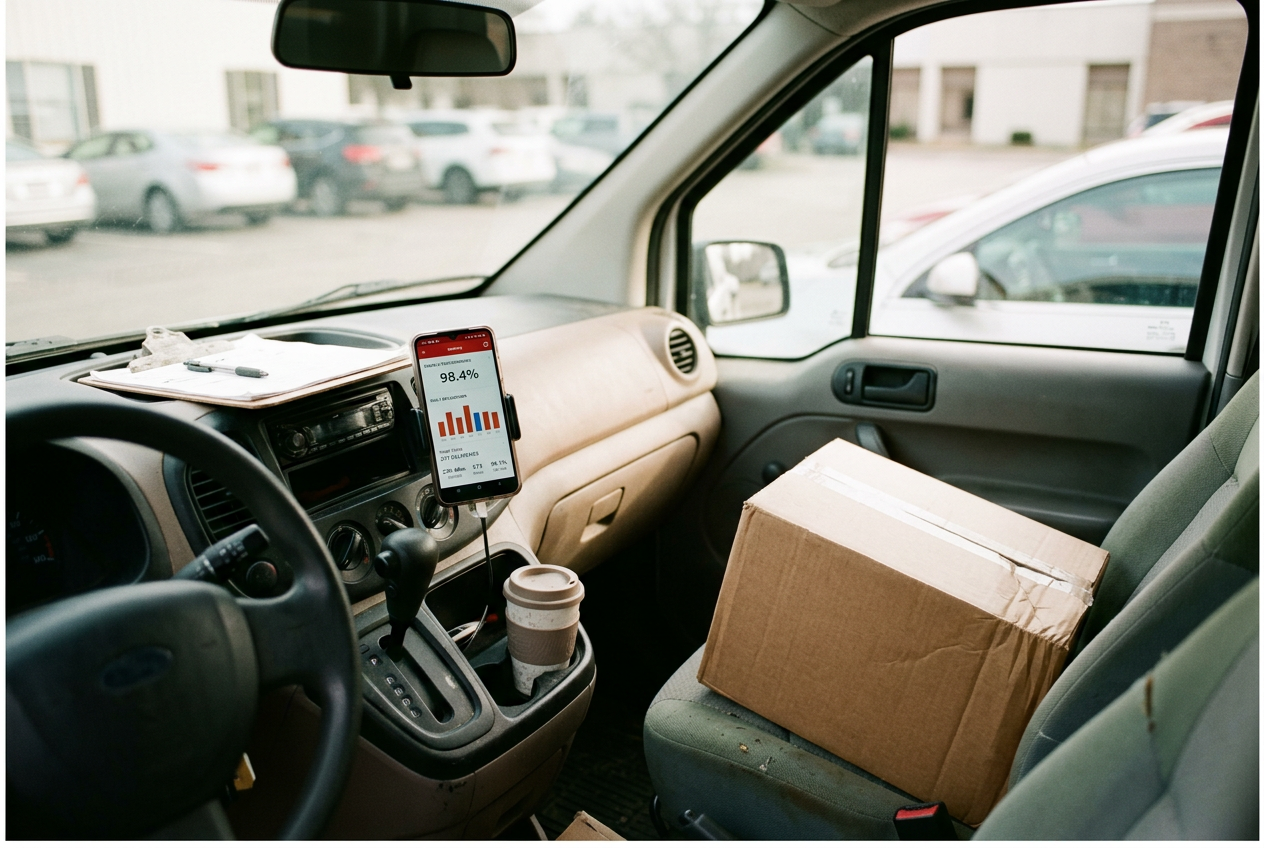
The weekly scorecard appeared on his phone after eleven months as a delivery driver. His overall score was 82 out of 100. A line beneath it showed 14 hard-braking events, and another placed him 63rd among 78 drivers working from the same delivery site.
That line became the record he watched.
The driver in this story is a composite, built from accounts of workers who described camera-based monitoring in delivery vehicles. Their routes, scores and experiences have been combined so that no individual or company is identifiable. The central pattern was consistent: a camera system marked driving events, the platform converted them into scores, and supervisors used those scores to compare workers.
He had known the vehicle was monitored. A camera unit sat above the mirror, facing the road and the cab, while location and vehicle data fed into the same system. What he had not understood was how a moment at the wheel would later become a count on a dashboard, separated from the traffic that produced it.
A delivery van backed into his lane. He braked. A car moved across two lanes near an intersection. He braked again.
On a residential street, a child rolled a bicycle out from between parked vehicles, stopped, and pulled back. That stop also appeared among the clips attached to the scorecard.
The system did not say that any collision had nearly happened. It marked the motion as hard braking.
What the score could see
The company’s training materials told drivers that the tool identified events such as hard braking, rapid acceleration and close following. Managers could review short video clips connected to some events. The workers did not know the threshold that turned ordinary braking into a scored event, whether that threshold changed with speed or road conditions, or how often a person reviewed the result before it affected their standing.
The mechanism was clear in broad terms. Sensors in the vehicle detected a change in movement, the camera supplied video around that change, and the platform assigned the event to the driver’s record. What remained hidden was the judgment between those steps. A driver could see the result without seeing the rule that produced it.
During a routine meeting, his manager went through the scorecard and focused on the 14 hard brakes. Several clips showed real hazards, the driver said. The manager did not accuse him of reckless driving, but the count still mattered because low scores could lead to more coaching and could shape who was considered dependable for preferred routes.
He earned $19.75 an hour. A better route did not raise that rate, yet it could mean fewer apartment buildings, less time searching for entrances and a better chance of finishing without falling behind. The score therefore reached beyond a safety discussion.
It sat beside the daily pressure to complete the route.
He started checking the dashboard at the end of each week. The number 14 stayed with him longer than any of the clips.
Some changes were useful. He left more space behind other vehicles and eased off the accelerator earlier near intersections, which reduced the need for sudden stops. The scorecard reinforced habits he already considered sensible, and after three weeks his overall score rose to 87.
Then the system began to occupy decisions that did not have one clean answer.
A traffic light changed when he was close enough to stop only with firm pressure on the brake. He continued through while the light was still yellow. Nothing happened. Yet his first thought afterward was not about the intersection.
It was that the system had probably recorded no event.
That distinction mattered. The score measured the movement the tool had been built to detect, while the road required him to respond to people, visibility and distance, which could change before a dashboard rule had any way to account for them.
Driving for two audiences
Six weeks after the first scorecard, the hard-braking line showed six events and his overall score had reached 91. His rank improved. He had learned what the dashboard rewarded.
He approached green lights with less speed because they might change. On crowded streets, he allowed extra distance even when other drivers repeatedly entered the gap. Those choices could support safer driving. At other moments, he noticed himself delaying a brake for a fraction of a decision, hoping the car ahead would move or the light would remain favorable, because a hard stop felt like a mark that would follow him beyond the cab.
The camera did not need to issue an instruction at that moment. The weekly scorecard had already done the work.
Delivery pressure complicated the calculation. A typical route assigned him more than 160 stops, although the total shifted with staffing and package volume, and extra caution could consume the small margins between parking, finding an address and carrying items to a door. The platform tracked progress through the route while the camera system scored how he drove it. A slow driver could fall behind.
A driver who recovered time could trigger more events.
There was no single screen showing that conflict. The route appeared in one part of the work system, while the driving score appeared in another, and he was expected to satisfy both.
One week, the dashboard attributed a hard-braking event to a stretch of road where he remembered hitting a pothole rather than braking. The clip did not settle the issue because the camera showed the road ahead but not what his foot had done. He sent a challenge through the support inbox. The event remained while the review was pending.
Two weeks later, the count changed from 14 to 13. No detailed explanation appeared. The correction proved that a marked event could be wrong, but it gave him no way to judge how often that happened across the rest of his score.
He stopped challenging isolated events. Each dispute took attention, and even a successful correction barely moved the weekly result once other events had accumulated. It was easier to change his driving than to establish what the system had misunderstood.
That was where surveillance became management. The camera collected the event, but the ranking gave it force, turning a series of sensor readings into a judgment about performance and placing each driver against coworkers whose routes might contain different traffic, road surfaces and delivery conditions.
The brake he did not regret
Eight months after he first saw the line marked 14, rain reduced visibility during an afternoon route. A pickup moved into his lane with little space between the vehicles. He pressed the brake hard enough to send a package off the passenger seat and onto the floor.
The van stopped without contact.
He knew before opening the dashboard that the event would probably be there. It was. The clip showed the pickup entering the lane, but the weekly scorecard still added one hard brake and lowered his total.
This time, he did not wish he had driven differently. The immediate danger had been plain, and the score looked less authoritative once he could compare its judgment with the package on the floor and the stopped vehicle in front of him.
The effect did not disappear. On later routes, he continued to ease off early near lights and watch following distance partly through the imagined view of the camera. He still checked his rank. A strong week brought relief, although he could not say whether it reflected safer roads, safer choices or fewer movements that crossed an undisclosed threshold.
His manager could see the same scorecard. Coworkers compared rankings when assignments changed. No one in the workers’ accounts could establish how long every clip was retained, who outside local management could access it, or how much a low score weighed against delivery speed when broader employment decisions were made.
The weekly scorecard remained precise where the work was not. Near the end of the composite account, it showed 88 out of 100 and eight hard-braking events. It did not show which brakes he would make again.
Questions people ask
Does a delivery camera record the driver all the time?
The drivers knew the camera unit monitored the road and cab, but they did not always know whether every moment was stored or only footage surrounding detected events. In this story, workers could view clips linked to marks on the scorecard, while retention periods and broader access remained unclear.
Can a driver challenge a hard-braking score?
The driver used the support inbox to dispute an event he believed came from a pothole. The count changed from 14 to 13 after two weeks, but he received no detailed account of the review, and the effort required made him less likely to challenge later events.
Can camera scores affect delivery work even without a formal penalty?
Yes. The score shaped coaching, rankings and perceptions of who could be trusted with preferred routes. Even when no direct pay deduction followed a low result, the driver understood that managers and coworkers could see the comparison, so the score influenced his behavior before any formal consequence appeared.
Why might a hard-braking metric conflict with road safety?
Hard braking can follow speeding or close driving, but it can also be the appropriate response to a vehicle, cyclist or pedestrian entering the road. The dashboard counted the vehicle’s motion without fully expressing that context. After the pickup crossed his lane, his weekly scorecard still recorded one more hard brake.
One story a day
The story of the day, in your inbox
One real story about AI each morning — no hype, no alarm, just company for the road.