
The Routing AI Put 11 Lawns in the Hottest Hours
A crew leader’s route kept getting denser during a heat advisory. Slowing down protected the workers, but the same system recorded them as inefficient.
October 7, 2026 · 7 min read
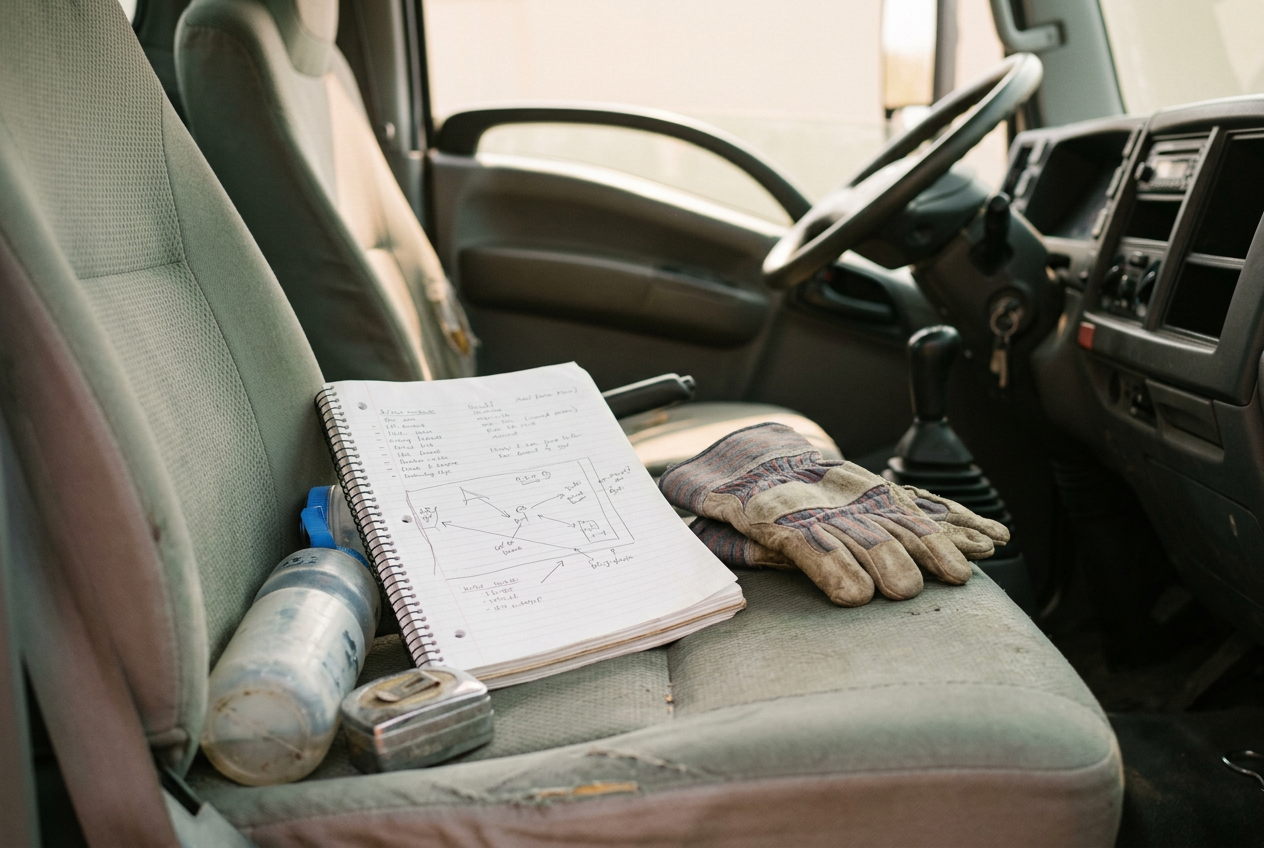
The crew leader kept a notebook in the truck. On one page from July 2024, he copied the route the scheduling app had built: 14 lawns, 11 of them grouped into the hottest part of the day, with predicted service minutes beside each address.
The company had introduced the app to reduce driving. Before that, a manager assembled routes from recurring customer schedules and what crew leaders knew about the neighborhoods. The result could be uneven. One truck might cross town twice while another finished early.
The new system was better at preventing that. It used property size, the service ordered, traffic estimates and past completion times to predict how long each stop would take. It then searched for a sequence that could fit more lawns into paid hours while limiting miles between them.
Those predictions changed as the crews worked. Each arrival, completion tap and location ping became another record of how long a property seemed to require. If a customer canceled or a crew fell behind, the app could rebuild the remaining route without waiting for a manager to sort it out.
That feature mattered during the heat advisory.
Two morning cancellations opened space in the route. The system filled it by pulling forward lawns from later in the week and grouping properties in a part of town where the crew’s historical completion times were short. Most were open lots with little shade. The app knew they were close together and knew this crew had serviced them quickly before.
It did not appear to treat the forecast temperature, direct sun or the cumulative strain of outdoor work as scheduling inputs.
By the time the route settled, the notebook showed 11 lawns packed into the hottest hours. The predicted service times ranged from 19 to 34 minutes.
What the system had learned
The crew leader understood why those lawns looked efficient to the software. They were modest properties with simple mowing patterns, and the truck could move between them without a long drive. On cooler days, the crew sometimes beat the estimates.
The prediction model treated those past completions as evidence about future work. That is where this story depends on the AI rather than an ordinary calendar or a careless dispatcher: the system learned task times from the crew’s own history, updated the route after cancellations and used those estimates to place additional work where it calculated there was room.
The old records did not describe the conditions under which the fast work happened. A 24-minute completion in May remained a 24-minute example when the system calculated a July route. The data showed that a lawn had been completed. It did not show how much water a worker drank afterward or whether the crew had finished under cloud cover.
The app also converted the route into a measure of performance. The company dashboard compared predicted minutes with actual minutes, along with completed jobs and driving time. Managers could see which crews stayed close to plan. The crew leader could not see every part of the score, but he could see the effect when breaks widened the difference between the prediction and the day’s result.
No one had to tell him that the route was tight. The notebook did.
He began writing a second number beside some properties: the actual minutes from arrival to completion. A predicted 22-minute lawn took 31. Another went from 27 to 39. The differences included water, a few minutes in the truck’s air conditioning and slower movement while workers handled mowers and trimmers in direct sun.
The app read the same interval differently. Unless someone entered an explanation, the extra minutes looked like service time, delay or idle time. A safety pause and an avoidable slowdown could produce similar traces in the location data.
Protecting the crew without refusing the route
The crew leader had some room to act. He could pause, change the order of stops and ask a manager to move a property. None of those choices was invisible.
Moving one lawn out of the cluster added driving and left unused space in the route. Pausing kept the truck at the same location longer than predicted. Sending a job back to the scheduling pool reduced the crew’s completed count. The system did not issue discipline by itself, according to the submission, but its dashboard supplied the numbers managers used when discussing efficiency.
He chose the pauses.
The crew carried water, and the leader directed workers toward shade when it was available. At properties without trees, they returned to the truck. He lengthened the breaks as the afternoon went on, then marked the actual minutes in the notebook even though he knew the app already held its own record.
That paper record served a different purpose. The scheduling system preserved what the truck and phones had done: where they stopped, when a job was marked complete and how long the interval lasted. The notebook preserved why.
At the end of the route, 12 of the 14 lawns were complete. Two went back into the pool for another day. The dashboard showed the crew below its planned completion rate, and the predicted-versus-actual gap had grown across the afternoon.
A manager later asked about the missed work. The crew leader described the advisory and the breaks, then shared the notebook page. The company did not erase the day’s performance data. The explanation was added to the review, and the two lawns were rescheduled.
The response left him with a narrow kind of discretion. He had been allowed to slow down, but the system still treated the original route as the standard against which the day was measured. Its prediction remained intact while his explanation sat beside it.
The missing weather signal
Routing systems can account for many constraints if those constraints are supplied and given weight. A company can block time, cap workloads or require longer service estimates under certain conditions. A model cannot protect a heat break that the scheduling objective does not recognize.
In this case, the software’s useful ability created the pressure. It found capacity that a person looking at the weather and the physical work might not have considered usable. It also kept finding capacity after the route changed, because each cancellation triggered another calculation rather than leaving an open patch in the day.
That made the tool effective on the company’s chosen terms. The crew drove fewer miles than it often had under manual scheduling. The tightly grouped lawns also meant less fuel and less unpaid waiting between jobs. The crew leader did not want to return to routes that sent the truck back and forth across town.
He wanted the forecast to count as much as the distance between addresses.
Heat-safety requirements vary by state, locality, employer and the kind of work involved. Some jurisdictions have specific rules for outdoor heat, while federal workplace protections may apply through broader safety obligations. Company policies also differ on water, shade, acclimatization and paid recovery periods. The reader submission did not establish that the route itself violated a particular requirement.
The clearer issue was how the company defined an efficient day. Its system could infer a crew’s likely pace from ordinary work signals, then use that prediction to add more work. It could not infer that a previous pace had become unsafe to repeat under different conditions.
After the advisory, the crew leader continued using the notebook. He recorded only unusual days: heavy rain, equipment trouble, smoke and heat. The app already had the route history. He kept the conditions that its history left out.
Questions people ask
Can routing
AI schedule outdoor work without considering heat?
Yes. A routing system may optimize for travel, predicted job length and completed work without using weather as an input. In this story, the software learned from past completion times and treated those records as reusable estimates, even though the earlier jobs had been performed under different conditions.
Does an employer have to provide heat breaks to landscaping crews?
Requirements vary by location, employer and working conditions. Some states and localities have specific outdoor heat standards, while other workplaces operate under broader safety rules and company policies. The submission showed that breaks were allowed, but they were not built into the route’s predicted service times.
What can location data reveal about a crew’s performance?
Location pings and completion taps can show when a truck arrived, how long it remained and when workers marked a job finished. They do not necessarily explain why a stop ran long. On the advisory day, that missing context was written beside each lawn in the crew leader’s notebook.
One story a day
The story of the day, in your inbox
One real story about AI each morning — no hype, no alarm, just company for the road.