An AI Mural Plan Erased the Shops That Built the Block
A youth mural crew received a polished AI concept built from city archives. When immigrant businesses were missing, the students stopped painting and started collecting memories.
September 9, 2026 · 7 min read
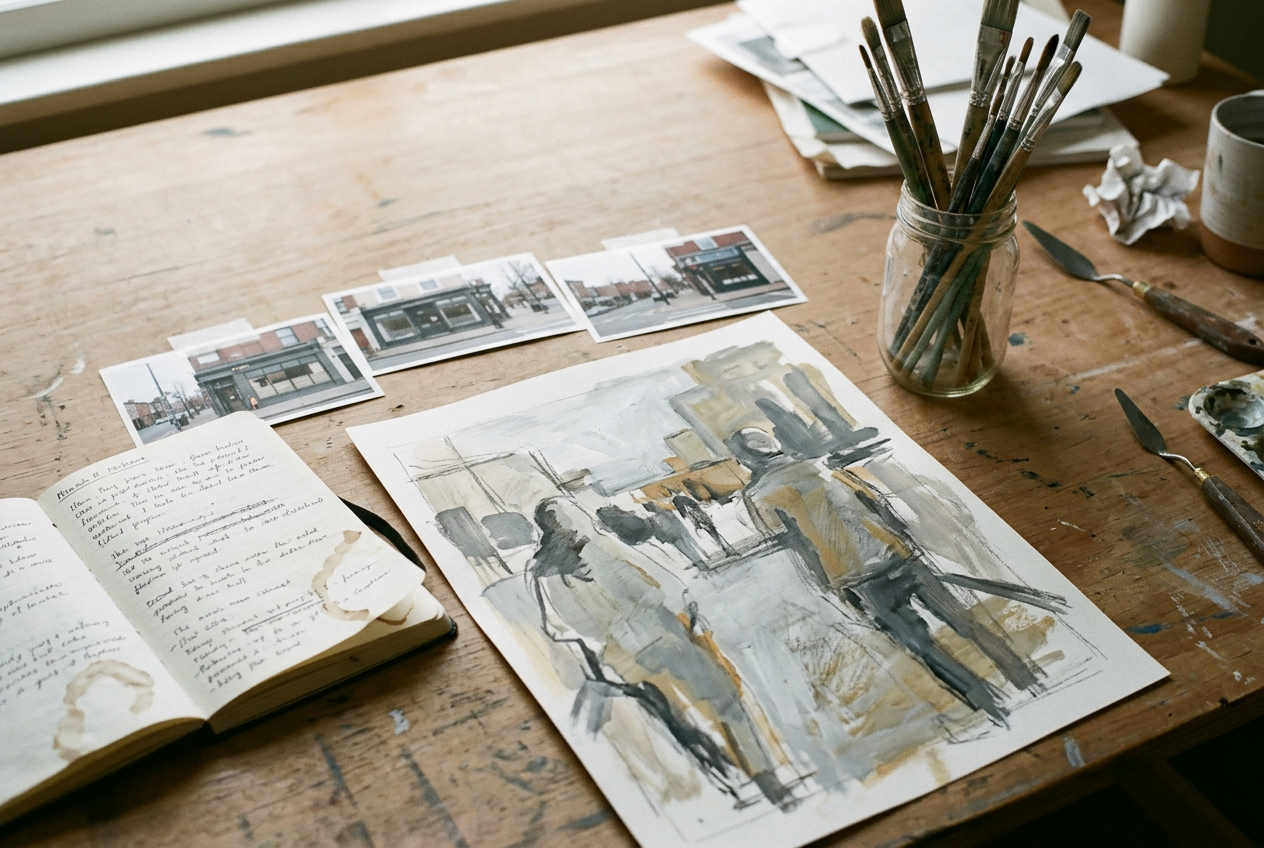
The concept arrived on an 11-by-17-inch printout, large enough for the youth mural crew to pass around the studio without crowding a laptop. It showed a century of neighborhood history arranged in a smooth sweep: streetcars, brick row houses, factory workers, children under a tree. The transitions were graceful. The perspective held.
Even the empty places looked intentional.
The crew had six weeks to move from design approval to paint. Their budget was $3,800, much of it already committed to supplies and lift rental, and the AI concept appeared to solve the part that usually consumed their first stretch of meetings: turning a box of historical material into one image that could cover a long wall.
Then one student put a finger on the row of storefronts.
She had grown up nearby. Her grandmother still bought spices on the block. The printout showed tidy windows beneath striped awnings, but none of the businesses she knew from family stories were there. No bakery run by two sisters who arrived in the 1970s.
No market where recent immigrants could ask for credit between paychecks. The signs above the generated shops contained letter-like marks that did not form words.
Another student recognized the old theater at one end of the design. Nobody recognized the stores.
The crew laid the printout on a worktable marked with paint. Its polish had made a claim before anyone examined the details: this was the neighborhood, assembled from the record and ready to enlarge. Now the students saw something else. The concept had reproduced the history that institutions kept, while inventing a plausible streetscape where the record ran thin.
They did not begin tracing it onto the wall.
What the generator had found
The program’s teaching artist had used a generative image system with access to a folder of digitized local archives. The folder held planning photographs, newspaper scans, property surveys, and images from a historical collection. A retrieval step converted the prompt and archive descriptions into numerical representations, then selected material judged semantically similar to phrases such as neighborhood history, work, migration, and commerce.
Those retrieved images and captions became reference material for the image generator. The system did not verify that every visible business had existed. It produced a composition by predicting visual features that fit the prompt and references, including features learned from many other images outside the neighborhood archive.
That distinction was sitting on the printout in plain view. The theater appeared because it had been photographed repeatedly and labeled in searchable records. The streetcar had several dated images. The immigrant-run stores appeared rarely, if at all, and their surviving photographs often lacked useful captions.
Some scans had handwritten notes that the archive’s text-recognition software had not read. A shop could exist in a photograph and still remain unavailable to a search system that relied heavily on typed metadata.
Where the retrieved record offered little, the generator supplied what looked likely. It knew the visual category of an older commercial block: awnings, display windows, signs. It did not know which grocer let families settle balances on Fridays, or which restaurant’s back table became an informal hiring desk for new arrivals.
A bad hand sketch would have shown its uncertainty. The generated concept hid uncertainty inside competent perspective and balanced color, which changed how the crew received it and why the omission lasted through an early review. The machine had not merely delivered incomplete research. It had turned that research into a finished-looking proposal that invited approval.
The teaching artist wrote two notes in the printout’s margin: “documented” beside the theater and “generated” beside the storefronts. There were more marks by the end of the session.
The work moved off the wall
Production stopped for nine days. The students carried copies of the concept to nearby businesses and showed residents the blankly convincing storefronts. They did not ask people to reconstruct the whole block. They asked what had occupied a particular corner, what people bought there, and what detail belonged in a picture.
Memories came with ordinary objects attached. A retired cook brought a paper menu saved in a kitchen drawer. A former shop owner unfolded a photograph showing produce boxes outside his father’s market. One resident remembered the bakery’s ticket dispenser but not the spelling on its sign; another supplied the spelling from a holiday card.
The accounts did not line up neatly. Two residents placed the same restaurant on different corners. A laundromat had changed names more than once. People disagreed about the color of a storefront, then agreed on the metal gate pulled down after closing.
The crew began separating what several people could support from what belonged to one person’s recollection, without deciding that the solitary memories were worthless.
This was slower than prompting the system again. It also altered relationships inside the program. Students who had treated research as preparation for the real work found themselves sitting with adults who rarely entered the studio, while residents who had expected to comment on a youth project became sources whose choices affected the wall.
One teenager kept a notebook of business names and drew a box around each detail backed by a photograph. Another added small circles beside memories repeated by multiple residents. The marks were not a formal verification method. They helped the crew remember what kind of claim each image would make.
After the pause, the 11-by-17 printout returned to the table. This time it was covered with arrows. A generated storefront was crossed out. The old theater remained, but it no longer dominated the composition.
The streetcar shifted toward the edge to make room for two businesses supported by photographs and for a third scene based on several residents’ accounts.
The crew kept one feature that began with the AI concept: its long diagonal view down the block. The angle let the mural hold buildings from different decades without pretending they stood together at one moment. The students redrew the people and storefronts by hand, using the gathered material, then tested the revised composition on paper.
Nobody decided that using the generator had been a mistake. It had produced a workable spatial structure faster than the crew expected, and its failure exposed a gap they might not have noticed if they had begun with the best-known archive photographs. Still, the tool had changed the first question from what belongs on this wall to what needs correcting in this image. That starting point mattered.
By the time painting began, the lost nine days had narrowed the schedule. Students stayed late at the studio table, transferring revised shapes onto larger sheets while brushes dried in jars nearby. The teaching artist reduced a background section rather than rush the storefronts.
On the wall, the immigrant businesses occupy less space than some residents wanted and more than the archive would have given them. One sign uses lettering copied from a photograph. Another storefront has no business name because the crew could not settle the conflicting accounts. They painted its gate down, with produce boxes stacked beside it, and left the disagreement intact.
The original printout stayed in the studio. Paint fingerprints gathered along its lower edge. Near the invented shops, a student had written a final note: “looks specific, isn’t sourced.”
Questions people ask
Why did the
AI omit businesses that residents remembered?
The system relied on digitized images and searchable descriptions, which favored buildings and events photographed often by institutions. Businesses with uncataloged photos, unreadable handwritten notes, or no preserved records were less likely to be retrieved, so the generator filled those spaces with visually plausible shops rather than historically supported ones.
Could the crew have fixed the concept with a better prompt?
A more specific prompt might have requested immigrant-owned businesses, but it could not supply records absent from the digital collection. Without added photographs or descriptions, the generator might still have invented convincing details. The crew improved the mural by changing the source material, not just the wording given to the tool.
Did the mural crew stop using AI after the omission?
No. They kept the generated perspective because it solved a composition problem, while replacing unsupported historical content with drawings based on photographs and resident accounts. The final division of labor remained unsettled: the machine shaped the view down the block, and the students decided what deserved to appear inside it.
How did they show uncertainty in the finished mural?
They omitted a disputed business name rather than choose one account, but retained physical details that several residents remembered. In the studio notebook, the entry for that storefront holds two possible names, a circle beside the metal gate, and a small drawing of produce boxes.
One story a day
The story of the day, in your inbox
One real story about AI each morning — no hype, no alarm, just company for the road.