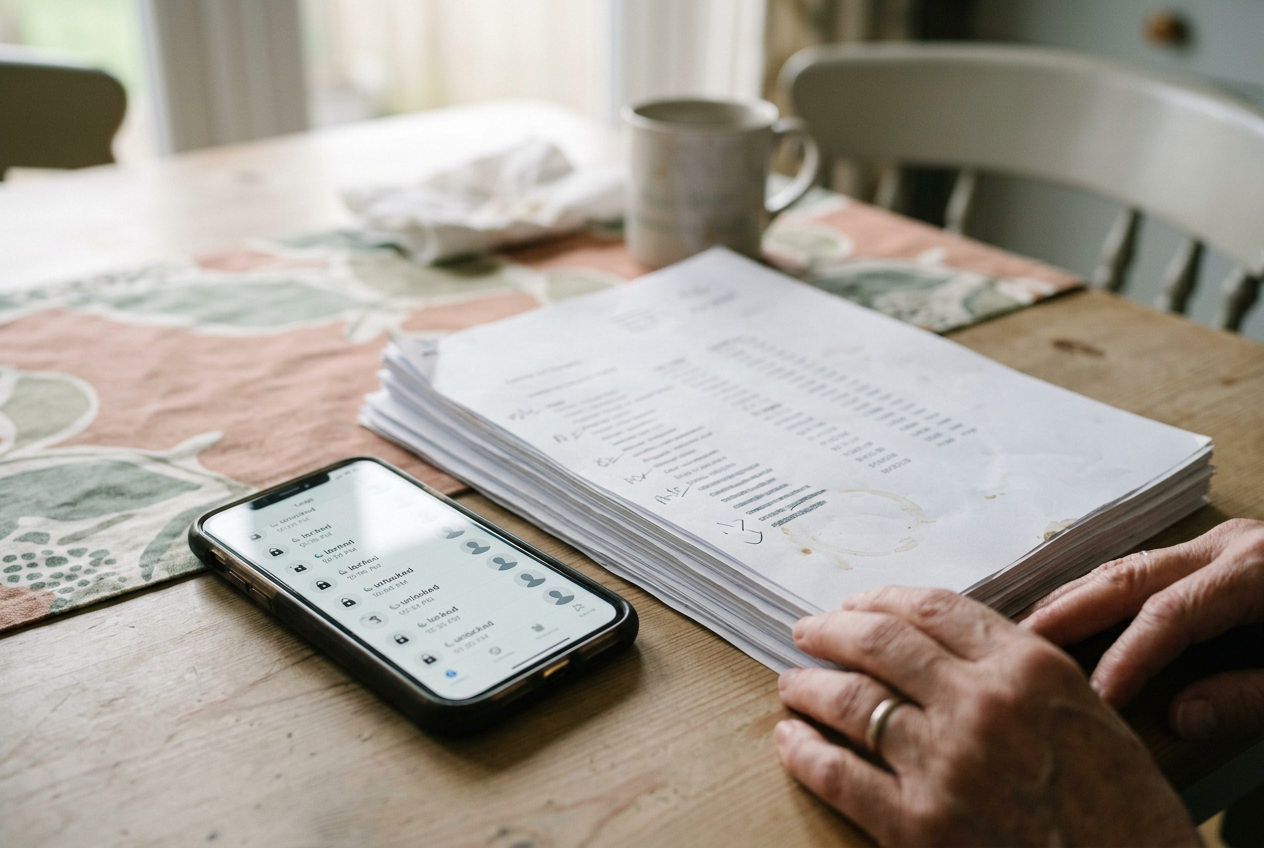
A Teen's Period-Chat Alert Appeared on the Family Tablet
A private question about a missed period surfaced through a synced notification. One family had to handle the health concern and learn why connected accounts had treated shared devices as private ones.
August 9, 2026 · 7 min read
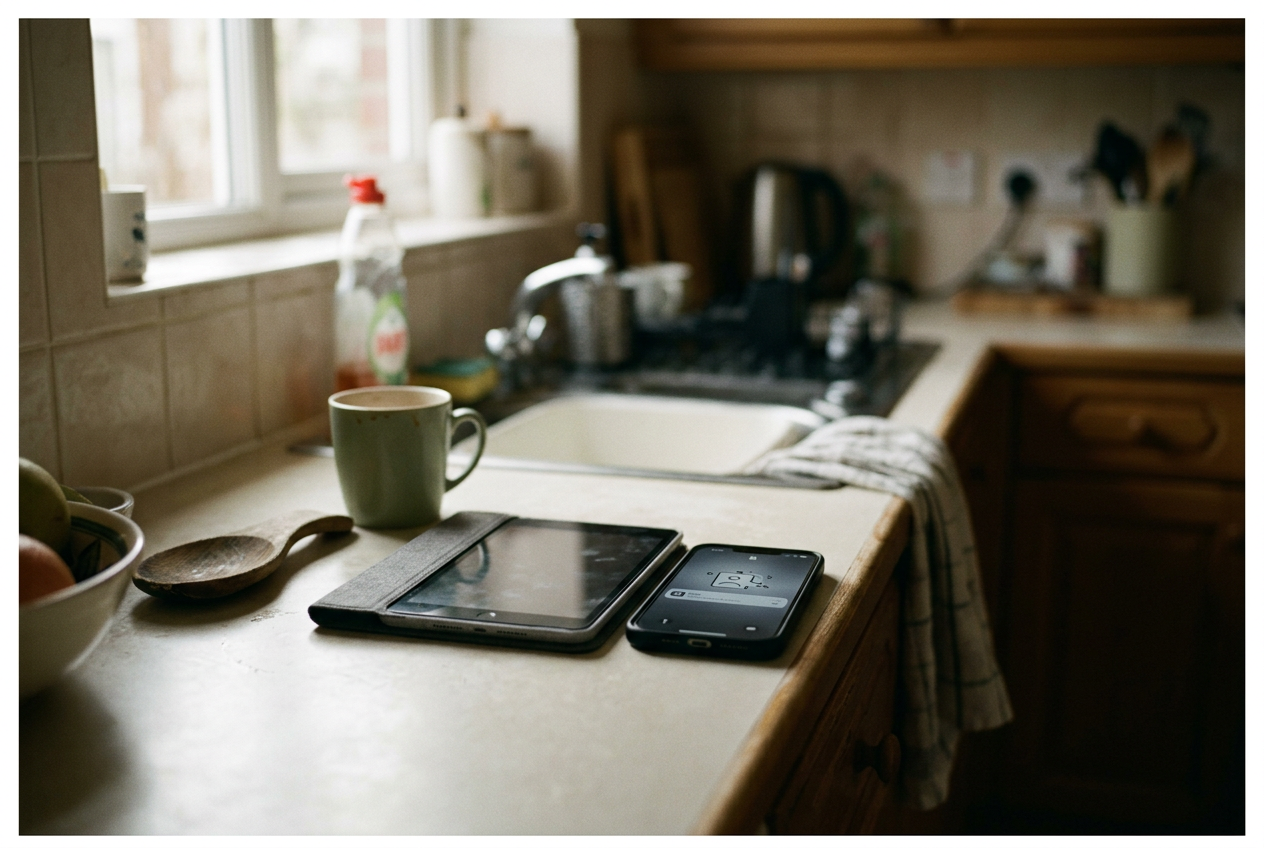
The screenshot showed a notification preview from a health app. It identified the subject as a missed period and referred to possible pregnancy, enough information for anyone holding the family tablet to understand what the teenager had asked.
Leah, a composite teenager in this story, kept that screenshot on her phone for nine months. She had taken it from the tablet after her younger brother noticed the alert and carried the device into the kitchen, where their mother was making dinner. The notification had disappeared by then, but its preview remained in the tablet's notification history.
Her mother read it. Leah watched.
The family had owned the tablet for nearly three years. It sat in the living room and was used for recipes, streaming and schoolwork. Everyone called it the family tablet, yet the account beneath it belonged to Leah's mother, who had first configured the device and later connected Leah's phone so that paid apps and media could be shared.
That arrangement had felt administrative. It did not feel like access.
Two weeks before the notification appeared, Leah's period had not arrived when she expected it. She had also had sex with another teenager, a fact her parents did not know. She opened a general health app on her phone and used its chat feature to ask about a late period and pregnancy risk. The app generated a response later, then sent the alert that appeared on both devices.
Leah had assumed the conversation belonged to her phone because she had typed it there, and because the app required a passcode before showing the full exchange. The assumption was understandable. It was also incomplete: the message remained protected inside the app, while the notification carried part of its meaning outside that locked space.
The screenshot became the family's record of that distinction. The full answer was private. The preview was not.
The health concern came first
Leah's mother did not know whether the notification described a current risk, an old question or something Leah had asked for a friend. She initially demanded to see the chat. Leah refused and went to her bedroom, taking her phone but leaving the tablet in the kitchen.
For the next day, the privacy failure and the health issue pulled against each other. Her mother was worried that Leah might need care. Leah thought handing over the conversation would reward an intrusion, even though no one in the family had intentionally opened her account.
Her father learned about the alert that evening. He focused first on the sexual activity implied by the preview, which made Leah less willing to explain what had happened, while her mother kept returning to whether the delayed period required attention. The same line of text had created two different emergencies inside the house.
They eventually agreed that Leah could discuss the health concern without showing the chat. Her mother bought a pregnancy test, which was negative, and arranged a clinic visit after the period remained absent. The clinician repeated the test, asked Leah questions in private and did not diagnose a cause at that appointment. Leah was given information about follow-up and contraception.
This account describes what happened to the family; it is not medical advice.
The appointment lowered one immediate fear. It did not repair the argument.
Leah still had the screenshot, and when she looked at it later, what bothered her was not only that her mother had seen the subject. Her brother had seen it first. He had not understood every implication, but he understood enough to ask why the tablet was talking about Leah's period.
One account had become several people's space
After the clinic visit, the family examined the tablet and Leah's phone together. They did not find evidence that anyone had entered her health app or read the complete chat. They found that the app existed on both devices under a connected account, and notification previews were allowed on the tablet even while it was locked.
That is the clearest mechanism supported by the family's review. The devices shared account services, the health app was present on both, and the tablet displayed a preview generated after Leah's chat response became available. They could not determine whether the alert had traveled through the device account's notification features or whether the app itself had registered both devices. Either route can produce a similar result, depending on the platform and settings.
The uncertainty mattered. Leah wanted one switch or one mistake to blame, but connected accounts do not always present privacy boundaries in a single place, and a person may change a setting on one device without understanding how an app, operating system and account service divide responsibility for the result.
Her mother had thought family sharing meant shared purchases. Leah had thought a phone passcode made the activity on that phone private. Her father had assumed the tablet could reveal only material someone deliberately placed there. Each belief described part of the setup.
None described the whole system.
The account treated the family as a group for convenience while the people inside that group still expected separate spaces. A shared media library was welcome. A shared health preview was not. The technology had no reliable way to infer that difference from the fact that the same account connected both devices.
They changed how notifications appeared and removed Leah's health app from the tablet. Leah later used a separate account on her phone, although doing so meant losing access to some purchases the family had shared. The tradeoff was small in dollars and larger in meaning: privacy became something she had to establish by separating herself from an account organized around household convenience.
The screenshot stayed on her phone.
The alert changed the family's rules
For about two months, Leah avoided using health chats. She searched the web in a private browser instead, which did not necessarily give her better information. It felt less likely to announce itself in the living room.
Her mother regretted asking to see the entire conversation. She also did not regret responding to the possibility of pregnancy. Those positions remained in tension, particularly because the alert had exposed enough to raise a health concern but not enough to show whether the app's answer was accurate, current or understood by Leah.
The family stopped treating device access as evidence of consent. Before borrowing Leah's phone, her parents began asking. Her brother was told not to carry notifications from one person to another, though the burden could not reasonably fall on a younger child who had encountered a message on a shared screen.
Leah's parents also reviewed what else appeared on the tablet. The result was less dramatic than the health alert but broader than they expected: message snippets, shopping updates and calendar entries had all crossed between devices at different points. Most had seemed harmless because no conflict followed. The period notification exposed an arrangement that had been visible for years.
Nine months after the clinic visit, Leah still had no complete account of which service delivered the preview. The family did not pursue the support inbox after receiving general information about notification settings, and they could not reconstruct every setting as it had existed that evening. What they knew was narrower and firmer. Leah had asked the question on her phone.
The tablet showed a preview. No family member had opened the health chat before it appeared.
She kept the screenshot because those facts were easy to blur during arguments. On the image, the app icon sat beside the short preview, with the tablet's battery indicator visible above it. That was all the proof she had, and all the proof the family needed to stop calling the tablet neutral.
Questions people ask
Why did a private health notification appear on a shared tablet?
In this family's review, the health app was present on devices connected through a household account, and the tablet allowed notification previews. They could not establish which service carried the alert, but the app's internal lock did not prevent the operating system from displaying part of the notification outside it.
Does a phone passcode keep app notifications private?
A passcode protected Leah's phone and the full health chat, but it did not control what appeared on another connected device. The family learned that message content, notification previews and access to the underlying app were separate layers, with settings that did not always match their expectations.
How did the family address the missed period without reading the chat?
Leah shared enough information for her mother to respond to the health concern while keeping the conversation itself private. A home pregnancy test was negative, and a clinic later assessed her in private. The clinician did not diagnose a cause at that visit, and the family did not rely on the app as medical advice.
Could the family prove which account setting caused the exposure?
No. Their device review showed that the app existed on both connected devices and that previews were enabled, but it did not preserve a full technical log. Nine months later, Leah's clearest record remained the screenshot on her phone, showing the health-app icon and the preview that had appeared on the tablet.
One story a day
The story of the day, in your inbox
One real story about AI each morning — no hype, no alarm, just company for the road.